
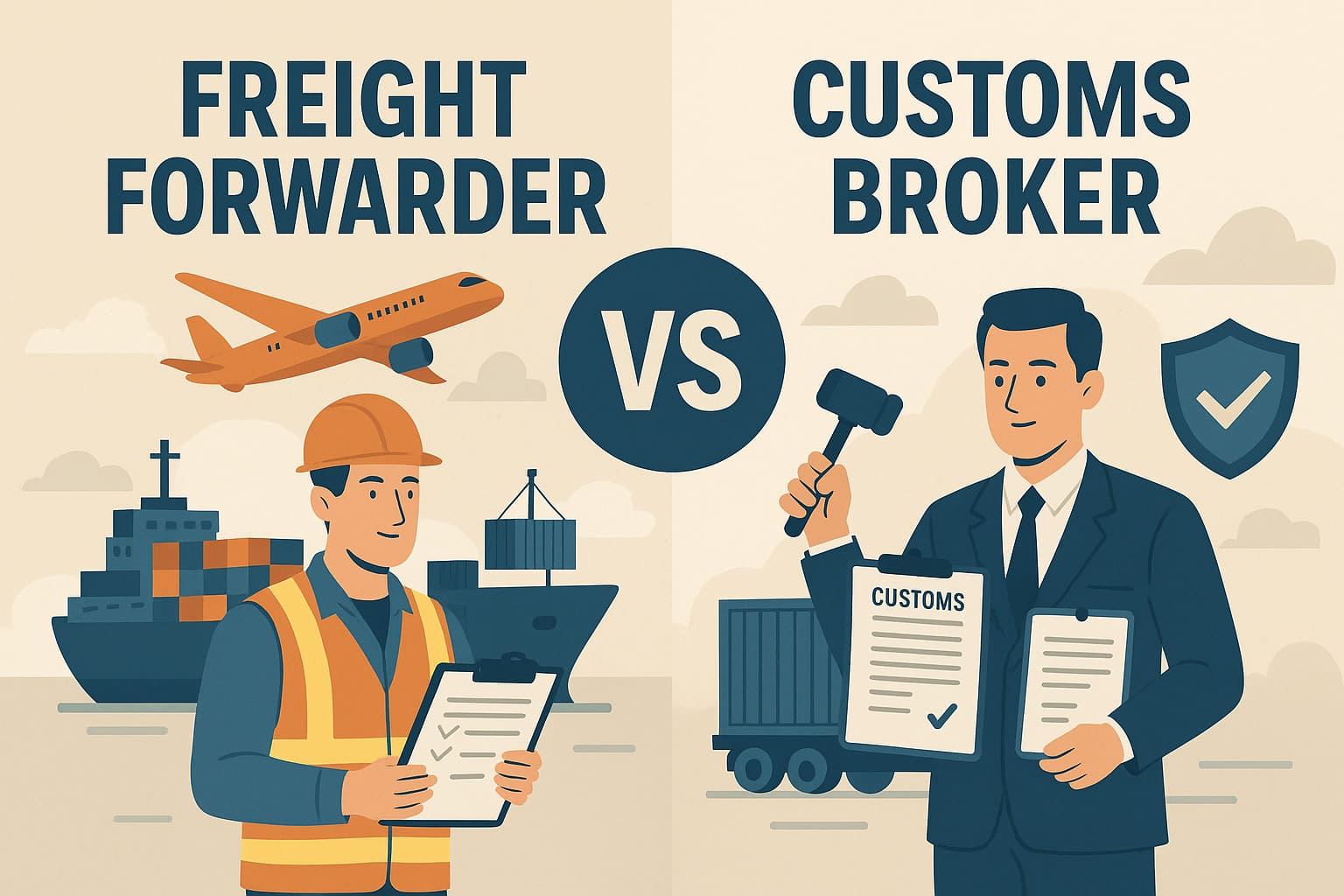
Discover the difference between freight forwarder vs customs broker Canada — who handles logistics, who manages customs, and why both are essential.
Why It’s Important to Know the Difference
In Canadian logistics, one of the most common points of confusion is the difference between a freight forwarder and a customs broker.
Both play critical roles in international shipping — yet their responsibilities, licensing, and involvement in your supply chain are very different.
If you ship goods across borders, understanding who does what can save you from delays, unexpected fees, and customs penalties.
At Metropolitan Logistics, we partner with licensed brokers and global carriers to help Canadian businesses navigate both sides of the process — freight coordination and customs compliance.
What Does a Freight Forwarder Do?
A freight forwarder is a logistics intermediary — the architect of the entire transportation process.
They don’t own vessels or airplanes; instead, they organize and coordinate multiple carriers to ensure your shipment moves efficiently from Point A to Point B.
Typical Freight Forwarding Responsibilities
| Task | Description |
|---|---|
| Route Planning | Designing the most efficient multimodal route (truck–rail–ocean–air) |
| Carrier Booking | Negotiating and reserving space with shipping lines, airlines, and trucking companies |
| Documentation | Preparing Bills of Lading, export declarations, and cargo manifests |
| Freight Insurance | Protecting cargo against damage, loss, or delay |
| Tracking & Coordination | Providing shipment updates and proactive communication |
Forwarders act as your logistics control tower, ensuring seamless transitions between transport modes and countries.
What Does a Customs Broker Do?
A customs broker focuses on regulatory compliance — ensuring goods legally enter or exit Canada without unnecessary holdups.
They act as intermediaries between importers/exporters and the Canada Border Services Agency (CBSA), making sure duties and taxes are correctly calculated and paid.
Core Customs Broker Responsibilities
| Responsibility | Explanation |
|---|---|
| Classification | Assigning correct HS codes and tariff numbers |
| Documentation | Filing customs declarations, permits, and certificates |
| Duty Calculation | Determining import taxes, GST/HST, and fees |
| Liaison with CBSA | Communicating directly with border officers |
| Recordkeeping | Maintaining compliance records for audits |
While a freight forwarder manages the physical movement, a customs broker manages the legal paperwork that allows that movement to happen.
Freight Forwarder vs Customs Broker: Key Differences
| Category | Freight Forwarder | Customs Broker |
|---|---|---|
| Core Function | Logistics & cargo coordination | Customs compliance & border clearance |
| Primary Client Need | Transportation efficiency | Regulatory accuracy |
| Regulatory Authority | Licensed by transportation agencies | Licensed by CBSA (Canada Border Services Agency) |
| Software Systems | TMS, cargo tracking, booking tools | Customs declaration systems, HS databases |
| Timing of Involvement | From pickup to delivery | At import/export clearance stage |
| Outcome | Shipment delivered safely | Shipment cleared legally |
These two roles complement each other. One ensures your cargo moves, the other ensures it moves legally.
How They Work Together in the Canadian Supply Chain
In a typical international shipment:
- Freight Forwarder arranges transport from your warehouse to the destination port.
- Customs Broker ensures documentation is approved for export or import.
- Once cleared, the forwarder continues coordination until final delivery.
Example: Shipping from Toronto to Europe
| Step | Handled By | Description |
|---|---|---|
| Pickup & drayage to CN Rail terminal | Freight Forwarder | Trucking from warehouse to terminal |
| Export paperwork & declaration | Customs Broker | Files export docs via CBSA |
| Ocean booking | Freight Forwarder | Reserves container slot to Rotterdam |
| Import customs in EU | Broker (EU partner) | Clears goods through customs |
| Delivery to final destination | Forwarder | Coordinates trucking to client’s address |
At Metropolitan Logistics, we integrate both processes — coordinating with licensed brokers to create one continuous logistics chain.
When Do You Need a Freight Forwarder, a Customs Broker, or Both?
| Scenario | Service Needed |
|---|---|
| Domestic shipments within Canada | Freight Forwarder only |
| Exporting goods overseas | Freight Forwarder + Customs Broker |
| Importing materials from the U.S. | Customs Broker (entry paperwork) |
| Cross-border eCommerce | Both — shipping + clearance |
| Complex industrial equipment | Both — due to tariff classifications |
Most Canadian businesses require both for international trade — one moves your cargo, the other ensures it complies with law.
Compliance and Licensing in Canada
Only licensed entities can act as customs brokers in Canada.
They must be authorized by the Canada Border Services Agency (CBSA) and follow strict regulations under the Customs Act.
Freight forwarders, while not CBSA-licensed, must comply with:
- Transport Canada safety regulations
- International Air Transport Association (IATA) standards (for air freight)
- FIATA (Freight Forwarders Association) best practices
Using unlicensed operators can lead to shipment seizure or fines — always verify credentials.
How Metropolitan Logistics Bridges Both Roles
As a Canadian freight forwarder, Metropolitan Logistics maintains strong partnerships with licensed customs brokers to offer an end-to-end shipping experience.
Our integrated approach includes:
- Coordinating container drayage from CN/CP terminals
- Managing export documentation
- Partnering with customs brokers for pre-clearance
- Monitoring real-time status via our logistics network
This collaboration minimizes delays and ensures full compliance — whether you’re importing goods through the Port of Vancouver or exporting via Montreal.
Common Misconceptions
| Myth | Reality |
|---|---|
| “Freight forwarders handle customs.” | They can assist, but clearance requires a licensed broker. |
| “Customs brokers book shipping.” | Brokers don’t manage carriers or schedules. |
| “You only need one.” | Both are necessary for smooth international logistics. |
| “Customs clearance ends at the port.” | Brokers also handle post-entry audits and tariff corrections. |
The Value of an Integrated Partner
Choosing a logistics provider that collaborates with both sides — freight forwarding and customs brokerage — ensures smoother workflows, fewer errors, and faster turnaround times.
Benefits of Integration
- Single point of contact for all logistics communication
- Reduced document errors and duplicate entries
- Real-time cargo visibility and customs tracking
- Shorter port dwell times
- Predictable landed costs
That’s why businesses across Toronto, Vancouver, Montreal, Calgary, and Halifax rely on Metropolitan Logistics for global freight coordination.
Conclusion
Understanding the distinction between freight forwarders and customs brokers is essential for any company engaged in cross-border trade.
Forwarders move goods across modes and countries; brokers move them through customs barriers.
At Metropolitan Logistics, we unify both — ensuring Canadian businesses experience seamless, compliant, and efficient shipping from start to finish. 👉 Get a Free Freight Quote
📞 +1 (365) 829 5000
📧 service@metropolitanlogistics.ca
1. FAQs
1. What is the main difference between freight forwarder vs customs broker Canada?
The key difference lies in their roles. A freight forwarder manages the logistics and transportation of your goods, while a customs broker handles compliance, documentation, and communication with the Canada Border Services Agency (CBSA). Both are essential for smooth cross-border trade in Canada.
2. Do freight forwarders in Canada provide customs brokerage?
Some do through partnerships with licensed brokers. Metropolitan Logistics, for example, coordinates freight forwarding and brokerage to simplify the shipping process.
3. Who deals with duties and tariffs?
Customs brokers calculate, declare, and pay duties to the CBSA on behalf of the importer, ensuring full compliance with Canadian law.
4. Can I ship internationally without a freight forwarder?
Technically yes, but coordinating carriers, routes, and export documents alone increases the risk of errors and delays.
5. How do freight forwarders and brokers communicate?
They collaborate via integrated systems and shared documentation to ensure every shipment clears customs without delays.
6. Is Metropolitan Logistics a licensed customs broker?
We’re a licensed freight forwarder that partners with certified Canadian customs brokers to deliver an end-to-end logistics solution.