
Warehouse relocation is one of the most complex operational projects a business can undertake. A single missed dependency can trigger inventory loss, order delays, damaged equipment, or extended downtime. That is why a structured warehouse relocation checklist is not a nice-to-have document — it is a core risk management tool.
In Canada, warehouse moves involve additional challenges: large distances between facilities, intermodal dependencies, seasonal constraints, and strict safety regulations. Companies that approach relocation without a checklist often underestimate timelines, misallocate labor, or fail to coordinate inbound and outbound freight.
This guide provides a practical warehouse relocation checklist designed for real operations. It breaks the process into clear phases, explains why each step matters, and includes a reusable warehouse relocation checklist template that can be adapted to different facility sizes and industries.
Throughout the guide, we reference professional Warehouse Relocation Services to show where expert support reduces risk and cost.
What Is a Warehouse Relocation Checklist?
A warehouse relocation checklist is a structured planning document that outlines every operational, technical, and logistical step required to move a warehouse without disrupting business continuity.
Unlike a general moving checklist, a warehouse relocation checklist accounts for:
- inventory flow and cutover timing
- racking and material handling equipment
- inbound and outbound freight coordination
- IT systems, WMS, and scanning infrastructure
- safety, compliance, and insurance requirements
In practice, the checklist acts as a master control document that aligns operations, logistics providers, contractors, and internal teams around a single relocation plan.
Phase 1: Pre-Relocation Planning (8–12 Weeks Before Move)
This phase determines whether the relocation succeeds or fails. Rushing planning is the most common and most expensive mistake.
Define Relocation Scope and Objectives
Start by clearly defining what the relocation must achieve.
Checklist items:
- confirm reason for relocation (expansion, lease expiration, consolidation)
- define success criteria (zero downtime, partial overlap, phased move)
- identify critical operational dates
- assign an internal relocation lead
Clear objectives allow logistics partners and contractors to design the move around business priorities rather than assumptions.
Facility and Layout Assessment
A new warehouse should not replicate old inefficiencies.
Checklist items:
- validate total square footage and ceiling height
- confirm dock count, door types, and trailer access
- review racking compatibility and load ratings
- assess power supply, lighting, and fire suppression
At this stage, many companies engage professional Warehouse Relocation to validate layout feasibility before committing equipment and labor.
Inventory Analysis and Classification
Not all inventory should move the same way.
Checklist items:
- classify inventory by velocity, value, and fragility
- identify obsolete or excess stock
- flag hazardous or regulated materials
- plan temporary storage if required
Inventory classification directly affects sequencing and handling requirements during the move.
Phase 2: Logistics and Resource Coordination (6–8 Weeks Before Move)
This phase converts planning into executable logistics.
Transportation and Handling Strategy
Warehouse relocation is rarely a single move. It is a sequence of controlled transfers.
Checklist items:
- determine number of truckloads required
- confirm container or trailer types
- plan staging and cross-docking if needed
- align move windows with carrier availability
Companies often rely on integrated Warehouse Relocation solutions to coordinate transport, handling, and timing under one operational plan.
Equipment and Racking Management
Racking and equipment relocation carries safety and compliance risk.
Checklist items:
- document racking specifications and configurations
- schedule professional disassembly and reinstallation
- inspect forklifts, conveyors, and dock equipment
- verify equipment certifications post-install
Improper racking moves are a leading cause of post-relocation incidents.
IT and Systems Planning
Warehouse operations depend on systems working immediately.
Checklist items:
- schedule WMS migration or reconfiguration
- confirm network cabling and Wi-Fi coverage
- test scanners, printers, and label systems
- plan system downtime windows
A systems failure on move-in day can halt operations even if physical relocation is complete.
Phase 3: Execution Readiness (2–4 Weeks Before Move)
This phase focuses on validation and dry runs.
Operational Dry Run
Before physical relocation begins, simulate the process.
Checklist items:
- validate pick, pack, and ship workflows
- test inbound receiving at new location
- confirm dock scheduling and yard flow
- review emergency procedures
Dry runs reveal gaps that are invisible on paper.
Staff Communication and Training
Relocations fail when staff are unprepared.
Checklist items:
- communicate move timeline to all teams
- assign clear roles and responsibilities
- train staff on new layout and safety rules
- confirm access credentials and parking
Well-informed teams reduce errors during high-pressure move windows.
Phase 4: Moving Day Checklist
Moving day execution must follow a controlled sequence.
Inventory and Load Control
Checklist items:
- lock inventory adjustments before cutoff
- label loads by zone and priority
- verify load manifests before dispatch
- track departures and arrivals in real time
Maintaining visibility prevents misplaced inventory and reconciliation issues.
Safety and Compliance
Checklist items:
- conduct pre-shift safety briefing
- enforce PPE requirements
- monitor racking and equipment handling
- document incidents immediately
Safety oversight is critical during compressed move timelines.
Phase 5: Post-Relocation Stabilization (1–4 Weeks After Move)
Relocation does not end when the last truck departs.
Inventory Reconciliation
Checklist items:
- perform cycle counts by zone
- reconcile variances against manifests
- validate lot and serial tracking
- close relocation discrepancies
Early reconciliation prevents long-term data integrity issues.
Operational Optimization
Checklist items:
- adjust slotting and pick paths
- fine-tune dock schedules
- review labor productivity
- capture lessons learned
Post-move optimization turns relocation into an operational upgrade.
Warehouse Relocation Checklist Template (Summary)
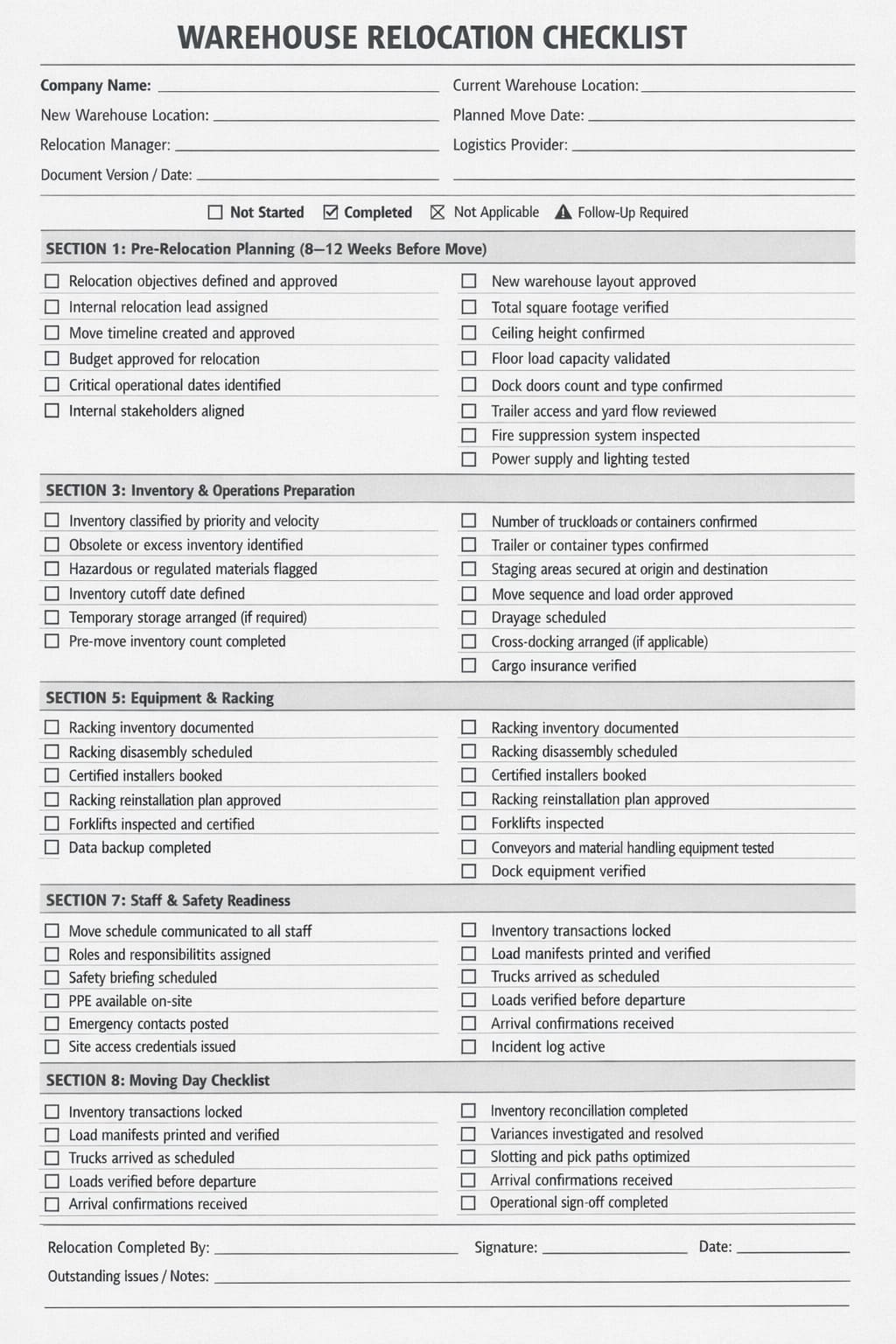
🟡 Printable Warehouse Relocation Checklist
Prefer a paper version? You can download the checklist for printing here and check off each step as your warehouse move progresses.
Below is a condensed warehouse relocation checklist template suitable for internal planning:
- define relocation objectives and timeline
- assess new facility layout and compliance
- classify inventory and handling requirements
- plan transportation and staging strategy
- schedule racking and equipment relocation
- prepare IT systems and WMS
- conduct operational dry run
- execute controlled move
- reconcile inventory post-move
- optimize operations at new location
This template should be expanded based on facility size, industry, and regulatory requirements.
Common Warehouse Relocation Mistakes to Avoid
Even experienced operations teams repeat the same errors.
- underestimating planning time
- failing to classify inventory properly
- ignoring drayage and staging constraints
- treating relocation as a one-day event
- delaying post-move reconciliation
A structured checklist prevents these issues before they occur.
Final Thoughts
A warehouse relocation checklist is not just a planning tool — it is a safeguard for your operations, customers, and revenue. Companies that approach relocation methodically reduce downtime, control costs, and emerge with more efficient facilities.
For complex moves, professional Warehouse Relocation Services provide the coordination, labor, and logistics expertise required to execute without disruption.
Need Professional Warehouse Relocation Support?
Metropolitan Logistics provides end-to-end Warehouse Relocation Services across Canada, supporting planning, transport, equipment handling, and operational cutover.
📞 Phone: +1 (365) 829 5000
✉️ Email: service@metropolitanlogistics.ca
Our team helps businesses relocate warehouses with control, visibility, and minimal disruption.