
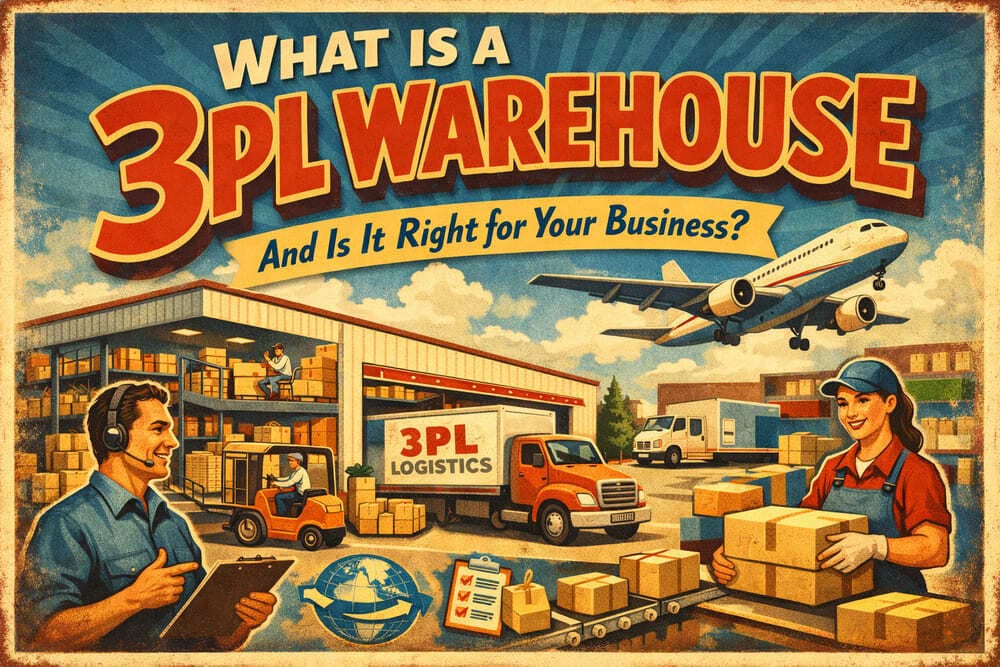
A 3PL warehouse is a third-party facility that stores your inventory, processes your inbound freight, and handles outbound distribution — so you don’t have to run those operations yourself. For Canadian importers and distributors, the decision to work with a 3PL provider is often one of the most consequential supply chain choices they make. This guide explains how 3PL warehousing works, what distinguishes different provider types, and how to evaluate whether the model fits your business.
What Does 3PL Mean?
3PL stands for third-party logistics. It refers to a company that provides outsourced logistics services — warehousing, inventory management, freight handling, and distribution — on behalf of another business. Instead of owning your own warehouse infrastructure, you pay a 3PL to use theirs.
The “third party” reflects the relationship structure: the first party is your business, the second party is your customer, and the third party is the logistics provider between them. In practice, a quality 3PL functions as an extension of your own operations — not a separate vendor you hand off to and lose visibility into.
2PL, 3PL, and 4PL: what’s the difference?
These terms appear frequently in logistics discussions. A 2PL owns the transport assets — trucks, ships, aircraft — and moves freight directly. Canada Post, CN Rail, and air carriers are 2PLs.
A 3PL coordinates those assets and adds value through warehousing, inventory management, and integrated services. Metropolitan Logistics operates as a 3PL — owning chassis, warehouse facilities, and drayage trucks while coordinating with ocean and rail carriers for the full freight journey.
A 4PL manages multiple 3PLs on behalf of large enterprises. For most mid-sized Canadian importers, however, a single well-chosen 3PL is sufficient.
How a 3PL Warehouse Works in Practice
Understanding the operational flow helps you evaluate whether a 3PL’s process matches what your supply chain needs.
Inbound: receiving your freight
When a shipment arrives at the 3PL facility — from a port drayage move, a domestic truck, or a rail connection — the receiving team unloads, counts, inspects, and scans each item into the warehouse management system (WMS). This creates the inventory record that tracks every unit from arrival to outbound shipment.
For businesses importing by ocean container, this step connects directly to drayage and transloading. A 3PL with its own drayage operation can move your container from the CN or CP terminal directly to its warehouse in a single coordinated operation — no handoff between carriers.
Storage: holding inventory until it’s needed
Your freight sits in racked, floor-stacked, or specialized storage depending on product type and volume. The WMS tracks real-time inventory levels, lot numbers, expiry dates, and location — giving you visibility without requiring physical presence at the facility.
Storage location matters considerably for Canadian importers. A facility in Brampton minutes from CN MacMillan Yard serves GTA-focused distribution efficiently. Similarly, facilities in Mississauga, Montreal, Vancouver, and Calgary each serve their regional supply chains. Metropolitan Logistics operates across all five markets, strategically located to minimize drayage distance and maximize throughput speed.
Value-added services: preparing freight for outbound
Between storage and shipping, most 3PL operations handle intermediate processing. These vary by provider and client, but typically include container stuffing and destuffing, cross-docking, blocking and bracing for export cargo, kitting and assembly, and retail-compliant labelling and repacking.
For importers whose products require preparation before distribution — repackaging for Canadian retailers or bilingual labelling compliance — value-added services are a significant part of what a 3PL provides beyond simple storage.
Outbound: shipping to your customers or DCs
When an order arrives, the 3PL picks inventory, packs it to your specifications, generates shipping documentation, and hands it off to the outbound carrier. For B2B distribution, this means pallet-level shipments to DCs or retail locations. For e-commerce, it means individual parcel fulfilment.
The speed and accuracy of outbound is where 3PL providers differentiate most clearly. Purpose-built warehouse operations with proper WMS technology consistently outperform in-house setups that treat fulfilment as a secondary function.
Types of 3PL Providers: Not All 3PLs Are the Same
The term “3PL” covers a wide range of businesses with very different capabilities. Understanding the distinctions helps you avoid selecting a provider that doesn’t match your actual needs.
Asset-based 3PLs
Asset-based providers own their facilities, trucks, and equipment. As a result, they have direct control over service quality — they don’t depend on subcontractors for core operations. Metropolitan Logistics operates as an asset-based 3PL, owning its warehouse facilities, chassis fleet, and drayage trucks across all five Canadian markets.
For businesses importing by ocean container, asset-based providers offer more reliable service than brokers who coordinate assets they don’t control.
Non-asset-based 3PLs
Non-asset-based providers coordinate logistics without owning the underlying assets. They negotiate rates, book capacity, and manage relationships — but the physical handling happens at facilities they don’t own. For straightforward freight forwarding, this model works well. For integrated warehousing and distribution, however, it introduces handoffs and accountability gaps that asset-based providers eliminate.
E-commerce fulfilment 3PLs
A specific subset of 3PLs focuses entirely on direct-to-consumer order fulfilment — pick-and-pack, parcel shipping, returns management. These providers integrate well with platforms like Shopify and Amazon. However, they are not set up for the container-level operations that B2B importers need — drayage coordination, transloading, cross-docking, and industrial-scale receiving.
Integrated logistics 3PLs
The most capable model combines warehousing with inbound freight management — ocean freight forwarding, drayage, transloading, and outbound distribution under one roof. For Canadian importers whose freight moves through multiple steps before reaching customers, this model eliminates handoffs and gives you a single point of accountability from port to delivery.
What a 3PL Warehouse Costs in Canada
3PL pricing follows a component model — you pay for what you use rather than a fixed overhead. Here’s what each component typically runs in 2026.
Storage and handling fees
Pallet storage runs CAD $7–$12 per pallet per month depending on market, product type, and volume. Bulk floor storage is typically lower per square foot but less accessible for active inventory. Inbound receiving runs $3–$8 per pallet received, while outbound pick and pack costs $1.17–$5.00 per order plus $0.50–$0.75 per additional item. Value-added services like kitting or relabelling run CAD $40–$60 per labour hour.
Technology and minimum commitments
WMS integration — EDI, API, or Shopify — carries a one-time setup fee of CAD $100–$1,000. Ongoing system access is typically included at higher volumes. Most established Canadian 3PLs also require minimum monthly commitments of 200–500 pallet positions, or a billing floor of CAD $2,000–$5,000. Below that threshold, flexible shared-space facilities are a more realistic option.
How to Evaluate Whether a 3PL Is Right for Your Business
The right answer depends on your volume, supply chain complexity, and what you’re trying to solve.
The volume threshold question
If your business handles fewer than 200 inbound pallets per month, most established 3PLs won’t prioritize your account. Below that point, smaller boutique providers are a better fit. Above 500 pallets per month, however, the economics of 3PL warehousing almost always beat in-house operations — especially when you account for the full cost of lease, labour, equipment, and management overhead rather than just the rent.
The supply chain complexity question
Businesses with simple supply chains — one origin, one destination, consistent volumes — gain less from 3PL integration than those with complex flows. That said, Canadian importers receiving ocean containers almost always benefit from a 3PL with drayage and transload capability near port and rail terminals. The efficiency gains at the terminal stage are immediate and measurable regardless of total volume.
The control vs. flexibility trade-off
The most common hesitation around 3PL adoption is losing control of inventory. In practice, modern WMS platforms give clients more real-time visibility than most in-house systems provide. The key due diligence question is system compatibility — confirm that the 3PL’s WMS integrates with your ERP or order management platform before committing.
For businesses where daily proximity to inventory matters — product customization, quality inspection, or rapid customer-specific responses — visiting the facility and understanding its access protocols is worth the time before signing.
3PL Warehousing for Specific Canadian Import Scenarios
Importers receiving ocean containers at Canadian ports
For businesses moving freight through Vancouver, Montreal, or Halifax, the most important 3PL attribute is proximity to port and rail terminals combined with transload capability. A warehousing and transload facility within 15–30 minutes of the relevant terminal eliminates the longest drayage leg and allows same-day cargo processing.
Retail and wholesale distributors
For B2B distribution to retail chains, the priority is accuracy, compliance with retailer routing guides, and mixed-SKU pallet handling. Ask any prospective 3PL for their order accuracy rate and their process for handling retailer chargebacks — these two questions reveal more about operational quality than almost anything else.
Businesses expanding to new Canadian regions
For a Toronto-based importer adding Western Canada distribution, partnering with a 3PL that already operates in Vancouver and Calgary provides immediate regional reach. There’s no new lease, no new staff, no new management overhead. Metropolitan Logistics covers all five major Canadian logistics markets from a single provider relationship.
Pharma, biotech, and medical device importers
Regulated product categories require specific certifications, temperature-controlled storage, and documented chain-of-custody processes. Not every provider meets these requirements. Metropolitan Logistics handles medical and pharmaceutical logistics as a specific practice area with the documentation and handling protocols these clients require.
Frequently Asked Questions
What is a 3PL warehouse? A 3PL warehouse is a third-party facility that stores your inventory and handles inbound receiving, order processing, and outbound distribution on your behalf. You pay for the space and services you use rather than owning and operating the warehouse infrastructure yourself.
What does 3PL stand for? 3PL stands for third-party logistics. It refers to a company that provides outsourced logistics services — warehousing, freight management, and distribution — for other businesses. The “third party” refers to the logistics provider operating between your business (first party) and your customers (second party).
How much does a 3PL warehouse cost in Canada? Pallet storage runs CAD $7–$12 per pallet per month in most Canadian markets. Add inbound receiving ($3–$8 per pallet) and pick and pack ($1.17–$5 per order). Total cost depends on your volume, SKU complexity, and service requirements. Always request a detailed mock invoice using your actual numbers before committing.
What is the difference between a 3PL and a warehouse? A warehouse is a storage facility. A 3PL is an operational partner that manages your inventory within that facility — receiving freight, tracking stock, processing orders, and coordinating outbound shipments. In short, the warehouse is the building; the 3PL is the service running inside it.
Is a 3PL right for small businesses? 3PLs make economic sense when your volume exceeds roughly 200 inbound pallets per month. Below that level, most established providers won’t prioritize your account. Smaller businesses are better served by shared-space or boutique fulfilment providers until volume grows to attract quality 3PL interest.
What should I look for in a Canadian 3PL? Facility location relative to your freight flows, proximity to port and rail terminals if you import by container, WMS integration capability, asset ownership versus brokered services, and specific experience in your product category. Always visit the facility and ask for an itemized mock invoice before signing.
The Bottom Line
A 3PL warehouse gives you access to professional logistics infrastructure — storage, handling, and distribution — without building or leasing it yourself. For Canadian importers, the most valuable 3PLs combine warehousing with integrated drayage and transload operations near the terminals where your containers arrive. That combination eliminates the most common friction points in the container-to-customer journey and gives you a single accountable partner across the full move.
Metropolitan Logistics operates warehousing and transload facilities in Brampton, Mississauga, Montreal, Vancouver, and Calgary, combined with container drayage from all major Canadian ports and rail terminals and freight forwarding for ocean, air, and ground shipments.
Request a quote or call +1 (365) 829 5000 — describe your inbound freight volume and distribution requirements, and we’ll outline what an integrated 3PL operation would look like for your supply chain.
Related reading:
- When to Outsource Your Warehousing and Distribution
- How Drayage Works in Canada: From Port to Warehouse, Step by Step
- How to Import Goods into Canada – Step-by-Step Logistics Guide
- Warehousing & Transload Services
- Cross-Dock Services