Container Drayage, Container Trucking & Delivery in Toronto
We are a Toronto drayage company that moves containers between the GTA's rail terminals and ports and your dock, imports in and exports out, on our own tractors and chassis. Call it drayage, container trucking, intermodal trucking, container haulage or container transport: it is the same truck trip, and we run it every day, with our North York warehouse as the backup when your dock is not ready.
Local drayage across Toronto and the GTA, container delivery to Mississauga, Brampton, Hamilton and every Southern Ontario city, long-haul drayage as far as Ottawa and Montreal. Live unload, drop & pick, grounded on the floor, held in our yard or transloaded: you choose how the box is delivered, we handle everything in between.
Instant online rates — pick the route below and the price comes back on the spot
Import drayage and export drayage — what each one includes
Container trucking runs both ways: inbound container delivery from the terminal, outbound container transport to the terminal. Same trucks, same dispatch desk — this is exactly what we take care of on each.
Import drayage
Your loaded container lands at a GTA rail terminal or port. We pull it, bring it to you and return the empty.
1Step 1
We pick up your loaded container at the rail terminal or the port the day it is released.
2Step 2
We bring it to your door and you unload — live while the driver waits, dropped, or grounded.
3Step 3
We return the empty to the shipping line's depot inside free time and send you the receipts.
What it includes
Release, customs-status and free-time check before a truck is committed
Terminal appointment and pickup at CN Brampton, CPKC Vaughan, CN Malport or the Port of Toronto
The right chassis for the weight — tandem, tri-axle or quad-axle
Container delivery your way: live unload, drop & pick, grounded on the floor, held in our yard or transloaded at our dock
Empty returned to the line's depot inside free time; gate receipts and signed POD the same day
Export drayage
You have a booking with a shipping line. We bring you the empty, take the loaded box to the rail or port and make the cut-off.
1Step 1
We pick up an empty container at the line's depot and bring it to your door.
2Step 2
You load it — live while the driver waits, or over a few days on a chassis or on the ground.
3Step 3
We seal it, weigh it and deliver it to the rail terminal or the port before the cut-off.
What it includes
Booking, empty-release and cut-off check with the line before the empty is pulled
Empty inspected at the depot and positioned at your dock — or at our warehouse for loading by our crews
Live load while the driver waits, or the empty dropped on a chassis or grounded so you load over days
Seal number, scale weight and SOLAS VGM recorded and photographed before the gate-in
Loaded container gated in at CN, CPKC or the port ahead of the rail or vessel cut-off, with in-gate receipt
How it works
Container transport, step by step
Four steps for every container move — a local drayage run in the GTA or a long-haul trip to Montreal: what you send us, what we check, and what you get back.
Step 1 of 4
You send us the container details
One email or phone call to dispatch. We check everything that can stop a container from moving before we commit a truck, then send you an itemized price and a pull date as soon as possible.
Overweight, dangerous goods and free-time problems are flagged now — not at the gate
Booking — import containerExample
Container
HLBU 813223-0 · 20′ dry
Terminal
CPKC Vaughan · grounded, customs released
Deliver to
Mississauga · dock appointment 09:00
Cargo weight
24,800 kg → tri-axle chassis
Free time
Ends Thursday · pull booked Wednesday
Delivery
Live unload
Step 2 of 4
We pull the container
We hold the terminal appointment, mount the chassis the weight calls for and pull the box the day it becomes available — or the day you choose. Before it leaves the terminal, the driver checks the container number, the seal and the doors.
Tandem, tri-axle or quad-axle chassis matched to the cargo weight, so the combination is legal on Ontario roads
Dangerous goods placarded and documented under TDG before dispatch
Export: the empty is inspected at the depot, so you never load a damaged box
Brampton Intermodal Terminal (BIT) · ≈30 min
Vaughan Intermodal Terminal · ≈15 min
Both Class I railways, daily: our tractors pull from CN's Brampton Intermodal Terminal and CPKC's Vaughan Intermodal Terminal every working day. Railway logos belong to their owners.
Container number, seal and doors are checked and photographed before every move.
Step 3 of 4
Container delivery, the way your site works
Most containers go straight to your dock for a live unload. If the dock is busy, there is no dock, or you need days rather than hours, we drop it on a chassis, set it on the ground, hold it in our yard or unload it at our warehouse.
Live unload: the driver waits (two-hour window) and takes the empty away in the same trip
Drop & pick or grounded: you unload at your own pace and we come back for the empty
Held or transloaded at North York when your dock is not ready — the terminal clock stops being your problem
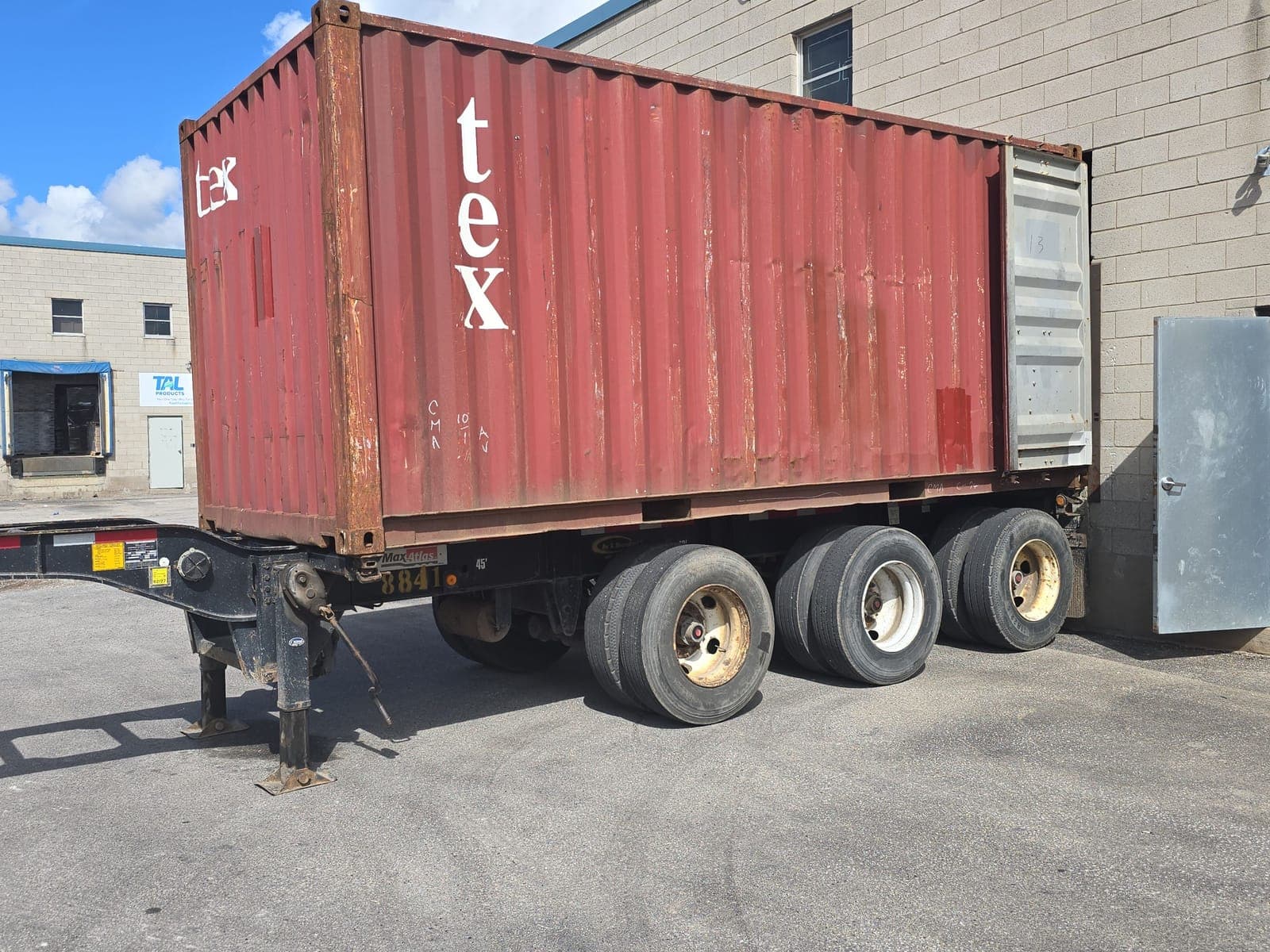
A 20-footer on a tri-axle chassis, backed to the customer's dock for a live unload.
Step 4 of 4
Empty back, paperwork done
The empty is gated back at the line's depot inside free time — or, on an export, the loaded box is gated in at the terminal before cut-off. You receive the receipts the same day, and the invoice matches the quote.
Out-gate and in-gate receipts, signed proof of delivery and photos of the container
Chassis days, waiting time and terminal fees itemized exactly as quoted
Recurring volume: a standing rate sheet and a weekly pull plan built around your receiving slots
Proof of deliveryExample
Delivered
Wed 09:12 · live unload, signed at the dock
Unload time
1 h 40 min · inside the free window
Empty returned
Wed 13:05 · Brampton depot, in-gate receipt
Chassis days
1 · included
Attached
POD · gate receipts · 6 photos
Know your route? The calculator prices it in seconds.
Shipping container delivery is not one thing. Not every site has a dock, and not every dock is free the day the box lands — tell us which option fits and we dispatch accordingly, and switch mid-move if your day changes.
Grounded: the container sits on the floor, so a forklift or a crew can load and unload at ground level for as long as you need.
Live unload at your dock
The truck backs onto your dock, you unload while the driver waits (two-hour window) and the empty leaves in the same trip. The cheapest option when your dock is ready.
Drop & pick
We leave the loaded container on a chassis at your site. You unload on your own schedule and we come back for the empty. You pay chassis days, not waiting time.
Grounded — on the floor
No dock, or a load that takes days? We set the container on the ground at your site, off the chassis, and lift it back on when you are done. Work at floor level, no chassis days.
Held in our yard
Dock not ready? We pull the box before terminal free time ends and hold it in our secure North York yard by the day — cheaper than terminal storage plus per-diem.
Transloaded at our warehouse
Our crews unload it at our dock, the empty goes back the same day, and your freight is delivered on pallets by straight truck when you want it — to one address or several.
The same options apply to exports: we bring the empty live, drop it or ground it for you to load — or you deliver your freight to our warehouse and we load the container there.
Container holding
Held in our yard until your dock is ready
When the terminal's free time is running out and your dock is not, most drayage companies have nowhere to put the container. We do: it waits in our yard — sealed, photographed, off the terminal clock — and goes to you on the day you say.
In the yard: containers stacked and lifted by reach stacker until their delivery day.
Pulled before free time ends
We watch the terminal clock and pull the box before storage starts, so demurrage never shows up on your invoice.
Stacked or grounded, no chassis tied up
A reach stacker lifts the container off the chassis and sets it on the ground or on a stack, so you are not paying chassis days while it waits.
Sealed and photographed in and out
The seal stays on. The box is photographed when it arrives in the yard and again when it leaves for your dock.
Billed by the day, released on your schedule
A daily rate, no minimum stay. Name the delivery day and the container is back on a chassis and at your dock that morning.
Steamship lines
Drayage for every steamship line calling Toronto
Whichever line your box ships on, we pull it, deliver it and return the empty to that line's depot — every carrier's releases and free time handled weekly.
Logos belong to their owners. Not seeing your line? We pull for any carrier — just ask.
Equipment
Chassis, tractors and a container handler for every kind of box
Container hauling is an equipment job: a chassis that keeps the load legal, a tractor that can carry dangerous goods, and a machine that can lift the container off the road.
Reach stacker in the chassis yard: containers lifted on and off chassis, stacked or set on the ground.
Tandem, tri-axle and quad-axle chassis
Matched to the cargo weight so the combination is legal on Ontario roads. Heavy 20-footers ride on three or four axles.
B-train for two 20-footers
Two 20′ boxes for the same consignee move on one combination: one trip, one driver, one rate.
Reach stacker for lifting and grounding
Containers lifted on and off chassis, stacked in the yard, or set on the ground at sites that have no dock.
Tractors placarded for dangerous goods
TDG-trained drivers and placarded tractors for hazmat containers, including Class 7 loads.
At the doors
We open the container, check the cargo and photograph it
Before anything comes out, the seal number is matched to the paperwork and the load is photographed as it arrived — so damage or a shortage is on record before the first pallet moves.
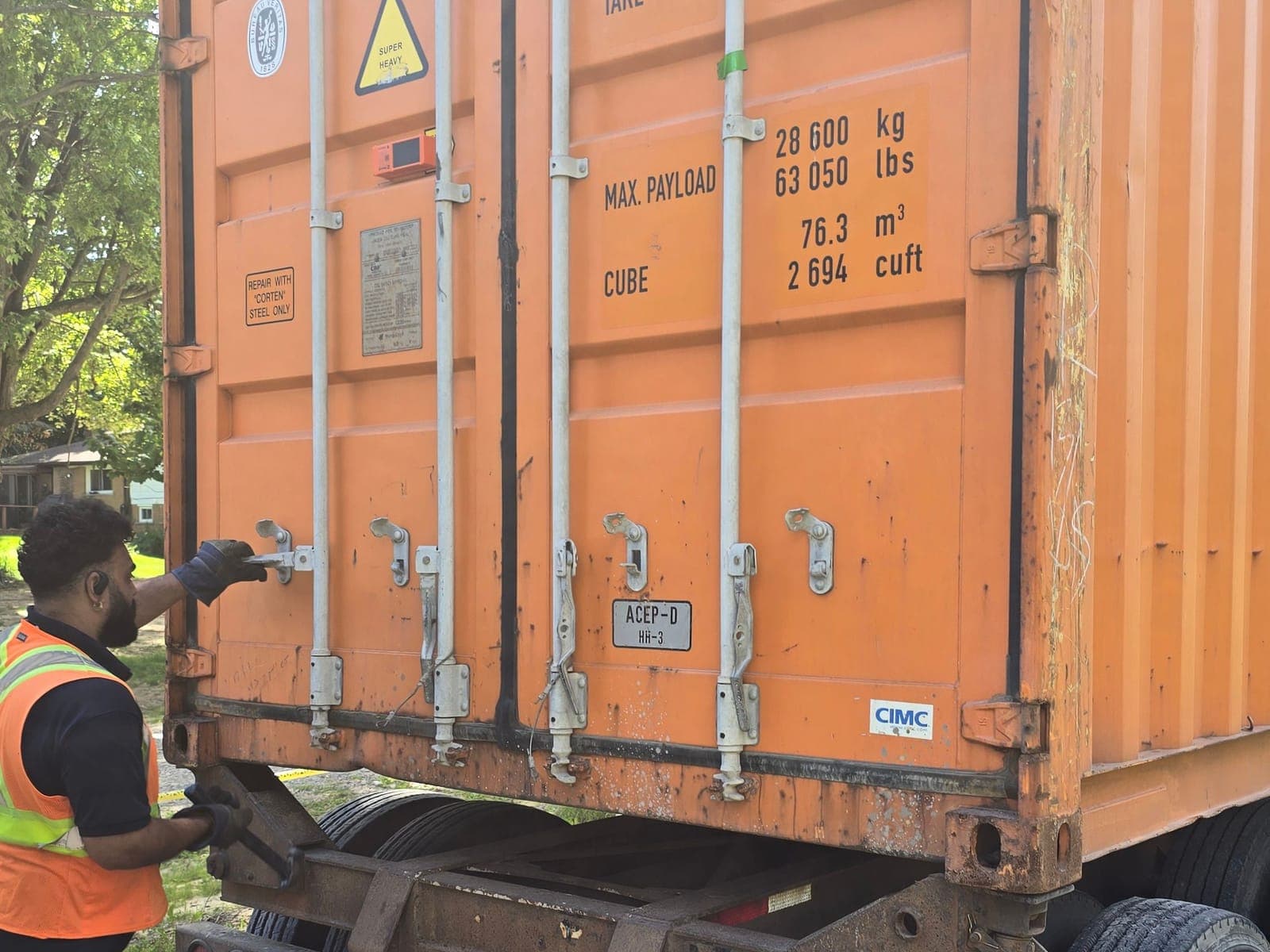
Doors open: the load photographed as it arrived, before the unload starts.
Seal checked against the documents
The seal number on the doors is matched to the bill of lading before the doors open. If it does not match, we stop and call you.
Cargo photographed as found
Doors open, load as it arrived, and again when the box is empty. The photos go with your proof of delivery.
Palletized or floor-loaded
Forklift for palletized freight; our own crews for floor-loaded boxes — at your dock or at our warehouse.
Strapping and bracing for exports
Loading a container for export? We supply strapping, dunnage and blocking so the cargo does not shift on the rail or at sea.
Exports
Export containers leave sealed, secured and documented
Once the container is loaded — at your dock or at ours — we close it up the way the shipping line and the terminal expect.
Numbered bolt seal on the door bar; the number goes on the paperwork and in the photos.
Numbered bolt seal applied
A high-security bolt seal goes on the doors as soon as loading is done. The number is recorded on the paperwork and photographed.
Cargo secured for the voyage
Strapping, blocking and bracing supplied on request, so the load stays where you put it through rail and sea.
Weight and VGM recorded
Scale weight and SOLAS VGM taken before the gate-in — the terminal will not accept the box without them.
Gated in before the cut-off
The loaded, sealed container is delivered to CN, CPKC or the port ahead of the rail or vessel cut-off, with the in-gate receipt sent to you.
Capabilities
Everything else we do with a container
If it involves a container, we do it — local drayage, long-haul container transport, dangerous goods, repairs — on the same trucks, from the same dispatch desk. The moves we run every week between the GTA terminals, our yard and your dock:
Live load for exports
Empty positioned at your plant, loaded while the driver waits, gated in at the terminal before the cut-off.
Weekly pull plans
Recurring imports planned a week ahead around your receiving slots, so boxes move the day they ground.
Overweight on tri-axle & quad-axle
Heavy 20-footers — tile, steel, paper, bagged product — run legal on tri-axle or quad-axle chassis.
Dangerous goods (TDG)
Placarded hazmat containers, including Class 7, with trained drivers and documents checked before dispatch.
Container repairs
Doors, seals, floors and minor damage fixed before the box goes back — no repair bill from the line.
Empty returns & depot runs
Empties to the line's designated depot in Brampton, Mississauga or Vaughan, with in-gate receipts on every unit.
Local drayage: terminal, depot & cross-town
CN–CPKC interchanges, terminal-to-depot runs and cross-town repositioning of loaded or empty units, same day.
B-trains — two 20′ in one trip
Two 20-footers for the same consignee move together on one combination: one trip, one driver, one rate.
Flat racks & open tops
Out-of-gauge cargo on flat racks and open tops, quoted per move with permits arranged where needed.
Customs holds & exams
Containers on a CBSA hold or exam: we coordinate with your broker and move the box the day it clears.
Weights, VGM & paperwork
Scale weights and SOLAS VGM for exports, gate receipts, PODs and photos on every move.
Long-haul drayage
Container transport beyond the GTA — London, Windsor, Ottawa, Montreal, Sarnia, Sudbury — on the same trucks, booked and quoted the same way.
In the field
From the yard and the dock
A few more from the everyday: the loads, the chassis and the boxes behind the words above.
Loaded containers staged on chassis in the yard, waiting for their delivery day.
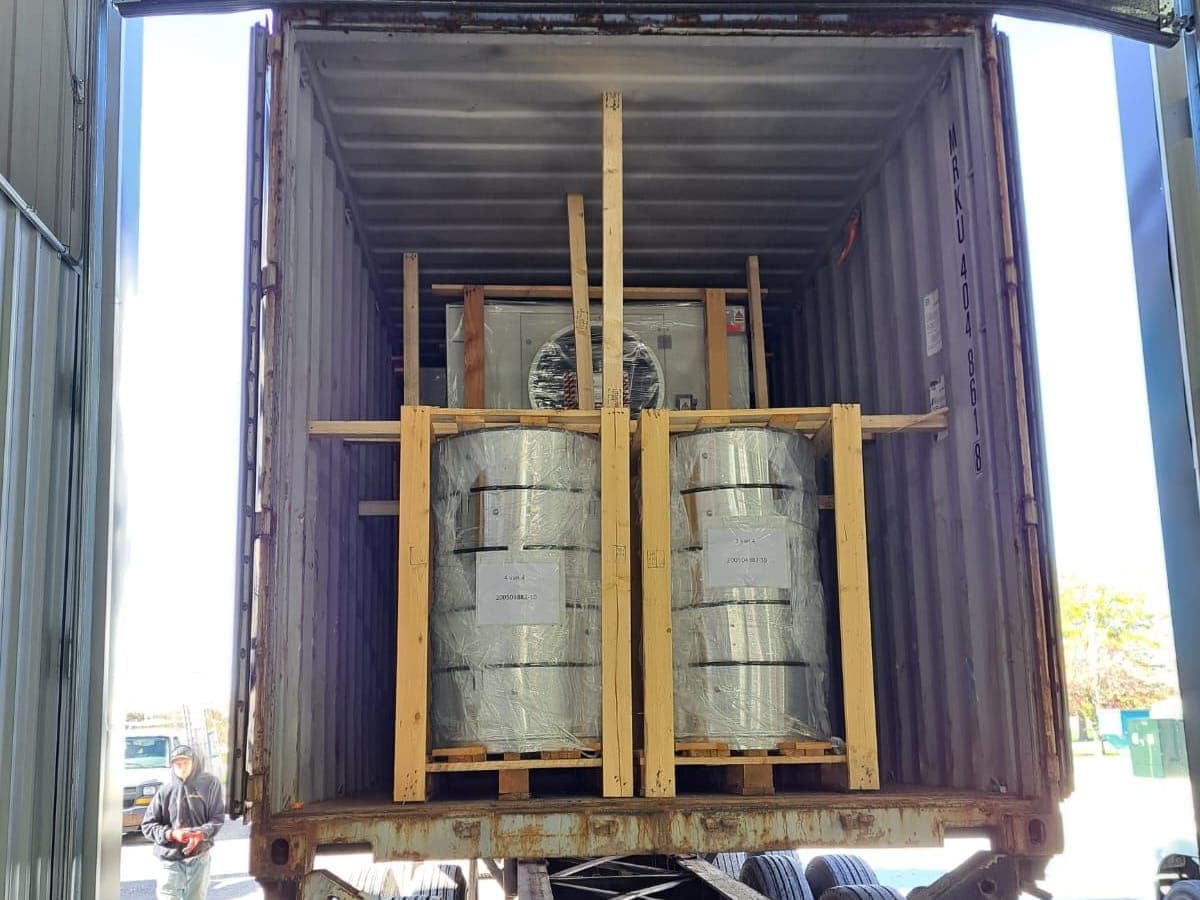
Machinery blocked and braced with lumber, checked at the dock door before it moves.
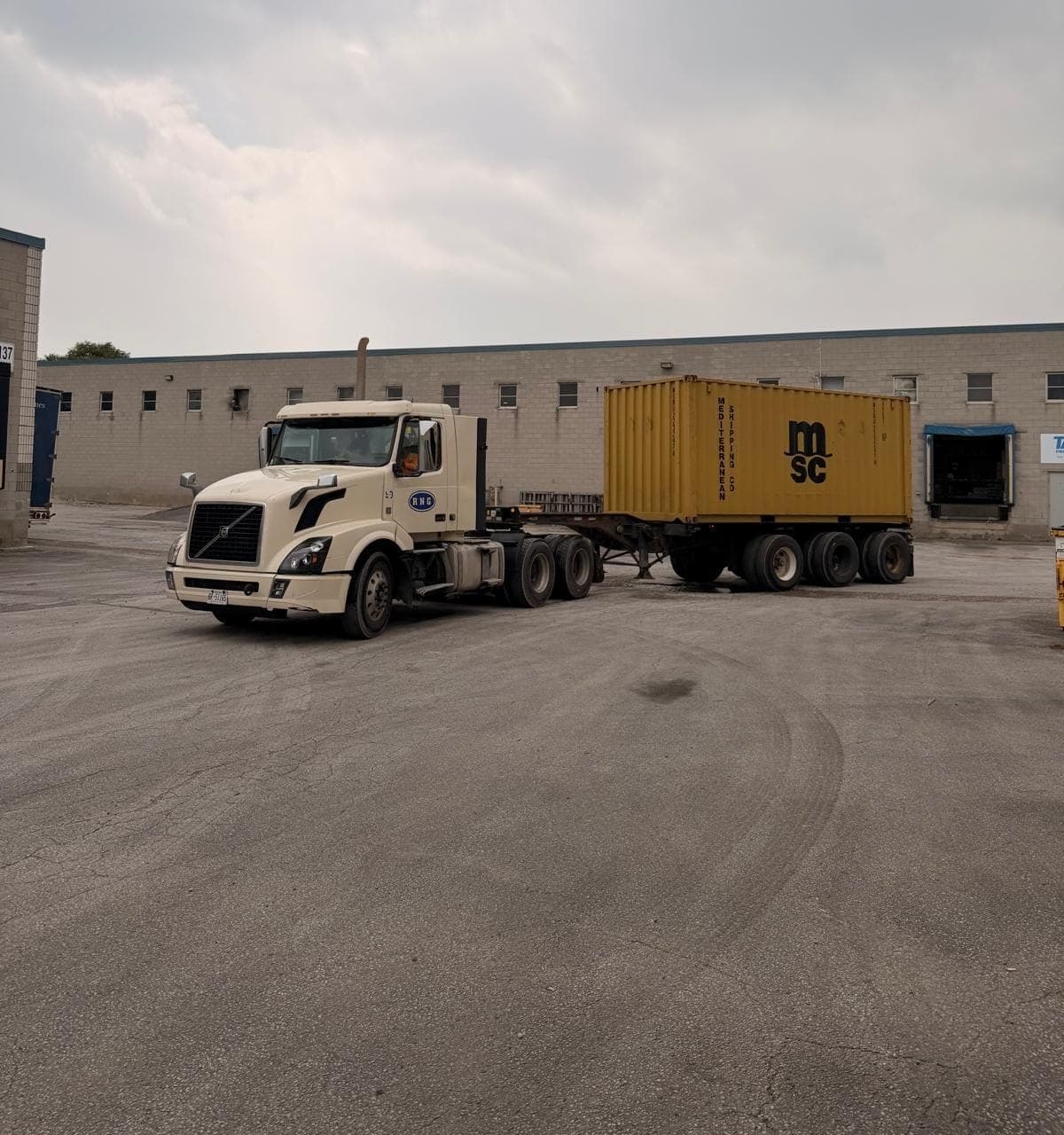
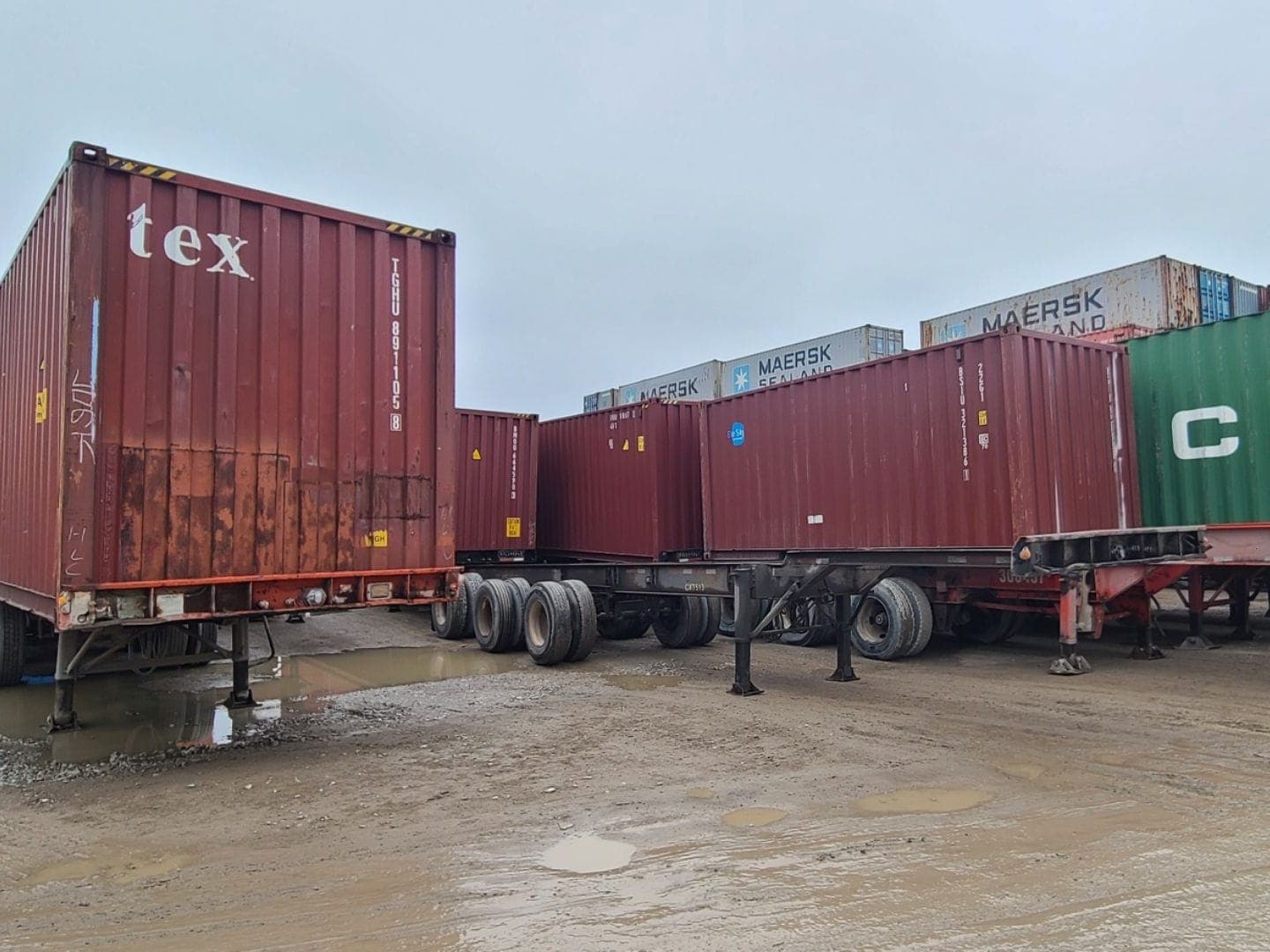
Container trucking, GTA style: a 20′ box on a tri-axle chassis, hooked up and ready to roll.
What's included
Everything on the invoice, nothing hidden
Terminal appointments and container availability tracking
Chassis supply — tandem, tri-axle, quad-axle — and chassis-day management
Container delivery your way: live unload, drop & pick, grounding, holding or transload on every move
Container holding in our yard and pre-pull before free time expires
Empty return to the line's depot with gate receipts
Export empty positioning, seal and VGM recording, terminal in-gate before cut-off
TDG-compliant handling for placarded dangerous goods
Container repairs before return; photos and signed POD on every move
Built for
Who uses this service
Importers who need reliable container delivery to GTA and Southern Ontario warehouses and plants
Exporters loading containers in Southern Ontario for rail to the coast
Freight forwarders and NVOCCs comparing container trucking companies for a Toronto drayage agent
Sites without a dock that need containers grounded for loading or unloading
Distributors with tight dock schedules who need holding, pre-pull or transload flexibility
Drayage routes from Toronto: container transport across Southern Ontario
Every drayage route starts at a GTA terminal: CN Brampton, CPKC Vaughan, CN Malport or the Port of Toronto. From there our trucks run container delivery to more than thirty cities — same-day local drayage in Toronto and the GTA, container trucking down the 401 and QEW corridors, and long-haul container transport as far as Ottawa and Montreal. No cross-country and no U.S. drayage: the fleet stays in the region, so appointments are kept.
Lake OntarioLake ErieLake HuronGeorgian BayGTA
Toronto
Hamilton≈ 1 h
Kitchener–Waterloo≈ 1 h 15
Barrie≈ 1 h
Niagara≈ 1 h 15
London≈ 2 h 15
Peterborough≈ 1 h 30
Belleville≈ 2 h
Windsor≈ 4 h
Kingston≈ 3 h
Ottawa≈ 4 h 30
Cornwall≈ 4 h 30
Montreal≈ 5 h 30
Sarnia≈ 3 h
Owen Sound≈ 2 h 30
Sudbury≈ 4 h 30
North Bay≈ 4 h
Our North York warehouse. Drive times are from there, outside rush hour.
Greater Toronto Area Southern Ontario & beyond Local drayage zone
Local drayage: Toronto & the GTA
The routes we run daily: terminal to dock in Toronto, North York, Scarborough, Etobicoke, Mississauga, Brampton, Vaughan and Markham — most drays are 15 to 45 minutes from our yard, so same-day container delivery is the norm.
Toronto
North York
Scarborough
Etobicoke
Vaughan
Concord
Mississauga
Brampton
Markham
Richmond Hill
Pickering
Ajax
Whitby
Oshawa
Oakville
Burlington
Milton
Container trucking across Southern Ontario
The corridors with constant container hauling: Hamilton and St. Catharines–Niagara down the QEW; Kitchener–Waterloo, Cambridge, Guelph, London and Windsor along the 401; Barrie and Newmarket up the 400.
Hamilton≈ 1 h
Kitchener–Waterloo≈ 1 h 15
Cambridge≈ 1 h 10
Guelph≈ 1 h
Barrie≈ 1 h
Newmarket≈ 35 min
St. Catharines / Niagara≈ 1 h 15
London≈ 2 h 15
Peterborough≈ 1 h 30
Belleville≈ 2 h
Windsor≈ 4 h
Long-haul drayage: Ottawa, Montreal & beyond
Container transport beyond Southern Ontario, quoted per trip: Kingston and Cornwall along the 401, Ottawa and Montreal at the far end, Sarnia to the west, Sudbury and North Bay to the north.
Kingston≈ 3 h
Ottawa≈ 4 h 30
Cornwall≈ 4 h 30
Montreal≈ 5 h 30
Sarnia≈ 3 h
Owen Sound≈ 2 h 30
Sudbury≈ 4 h 30
North Bay≈ 4 h
Your city not on the map? If a container can reach it from a GTA terminal, we quote the route — send the postal code to dispatch.
Own trucks, own chassis, own yard
Drayage runs from the terminal to your dock — the warehouse is there only when you need it
Container drayage has nothing to do with a warehouse: our tractors and chassis take the box from the terminal to your dock and bring the empty back. Our North York facility enters the picture only when you ask for it — a container held in the yard, a transload, storage or pallet delivery after the unload.
Own tractors and chassis
Tandem, tri-axle and quad-axle chassis on our own tractors — no broker, no third-party truck on your container.
Minutes from the terminals
≈15 min to CPKC Vaughan, ≈30 min to CN Brampton, ≈25 min to the Port of Toronto — short drays, fewer chassis days.
A yard, if your dock is not ready
Pulled before free time ends and held by the day, sealed and photographed — an option, not a detour.
Transload and storage on request
Unloaded at our dock and delivered on pallets, or stored — added only when you want the extra service.
Drayage is the short truck move that takes a shipping container between a rail terminal or port and a warehouse. Ocean containers bound for the GTA ride the train to CN Brampton or CPKC Vaughan, and a drayage carrier completes the last leg to your dock. Read our plain-language explainer: What is drayage?
Is container trucking the same as drayage?
Yes. Drayage, container trucking, container haulage, container cartage, container transportation and intermodal trucking all describe the same thing: the short truck move between a rail terminal or port and a warehouse. We say drayage because the terminals and shipping lines do, but what you are buying is shipping container delivery — terminal to your dock and back — from a container trucking company with its own trucks, chassis and yard.
What is the difference between import drayage and export drayage?
Import drayage takes a loaded container from the rail terminal or port to your dock and returns the empty to the depot. Export drayage brings you an empty from the depot, then takes the loaded, sealed container to the terminal before the rail or vessel cut-off. We run both from the same dispatch desk — the two lists on this page show exactly what each includes.
Which terminals do you serve for container drayage in Toronto?
CN Brampton Intermodal Terminal (BIT), CPKC Vaughan Intermodal Terminal, CN Malport in Milton, the Port of Toronto and the Port of Hamilton — plus the empty depots in Brampton, Mississauga and Vaughan. Our North York warehouse is roughly 15 minutes from Vaughan and 30 minutes from Brampton.
What are your most common drayage routes from Toronto?
Import routes from CN Brampton and CPKC Vaughan to warehouses in Mississauga, Brampton, Vaughan, Etobicoke, Scarborough, Markham, Milton, Oakville and Burlington carry a constant flow of containers — those are daily runs. Beyond the GTA, the busiest container trucking lanes are Hamilton, Kitchener–Waterloo, Cambridge, Guelph, London, Windsor and St. Catharines–Niagara, plus the same routes in reverse for export containers heading back to the terminals. Ottawa and Montreal round out the long-haul lanes.
How quickly can you pull a container after it becomes available?
Usually the same or next business day, subject to terminal appointment availability. For recurring import programs we plan pulls a week ahead around your receiving slots so containers move the day they ground.
What is the difference between live unload and drop & pick?
On a live unload the driver waits — usually a two-hour window — while your dock empties the container, and takes the empty away in the same trip. On a drop & pick we leave the loaded container on a chassis at your site, you unload when it suits you, and we return for the empty; you pay for the chassis days but not for waiting time.
Can you deliver a shipping container to a site without a dock — grounded on the floor?
Yes. If you have no dock, or you need days to load or unload, we set the container on the ground at your site, off the chassis, and lift it back on when you are done. You work at floor level with a forklift or a crew and pay no chassis days. Tell us the surface and the access when you book so we send the right equipment for the container delivery.
Can you hold a container for me if my dock is not ready?
Yes. We pre-pull the container before terminal free time expires and hold it in our secure North York yard, billed by the day — cheaper than terminal storage plus per-diem. If it makes more sense, we transload it at our dock so the empty goes back immediately and your freight is delivered by straight truck when you are ready.
Do you handle overweight containers?
Yes. Heavy 20′ and 40′ units are moved on tri-axle chassis, and the heaviest on quad-axle, to stay within Ontario axle limits. Tell us the cargo weight when you book and we will confirm the legal configuration before the container is released.
Can you move dangerous goods containers?
Yes, under Transport Canada TDG regulations with trained drivers and proper placarding — including Class 7 placarded units, which we move regularly. Send the DG declaration with the booking so we can confirm acceptance.
Do you repair containers?
Yes — damaged doors, seals, floors and minor structural damage are repaired before the empty is returned, so the depot inspection does not become a repair charge from the line. Anything beyond a minor repair is documented with photos so you can dispute the line's claim.
Do you do long-haul drayage, or only local drayage in the GTA?
Both. Local drayage in the GTA is most of the work; container trucking across Southern Ontario — Windsor, London, Kitchener–Waterloo, Guelph, Hamilton, Niagara, Barrie, Peterborough, Belleville — and long-haul drayage to Ottawa, Kingston, Cornwall, Montreal, Sarnia, Owen Sound, Sudbury and North Bay are booked on request and quoted the same way, move by move. We do not run cross-country or U.S. container transport; the fleet stays in the region so appointments are kept.
How much does container drayage cost in Toronto?
A base rate for the lane (terminal to delivery zone), plus fuel surcharge, chassis days beyond the included allowance, waiting time beyond the free window, tri-axle, quad-axle or DG surcharges where applicable, and any terminal fees passed through at cost. Everything is itemized on the quote. For typical numbers, see how much it costs to transport a shipping container.