
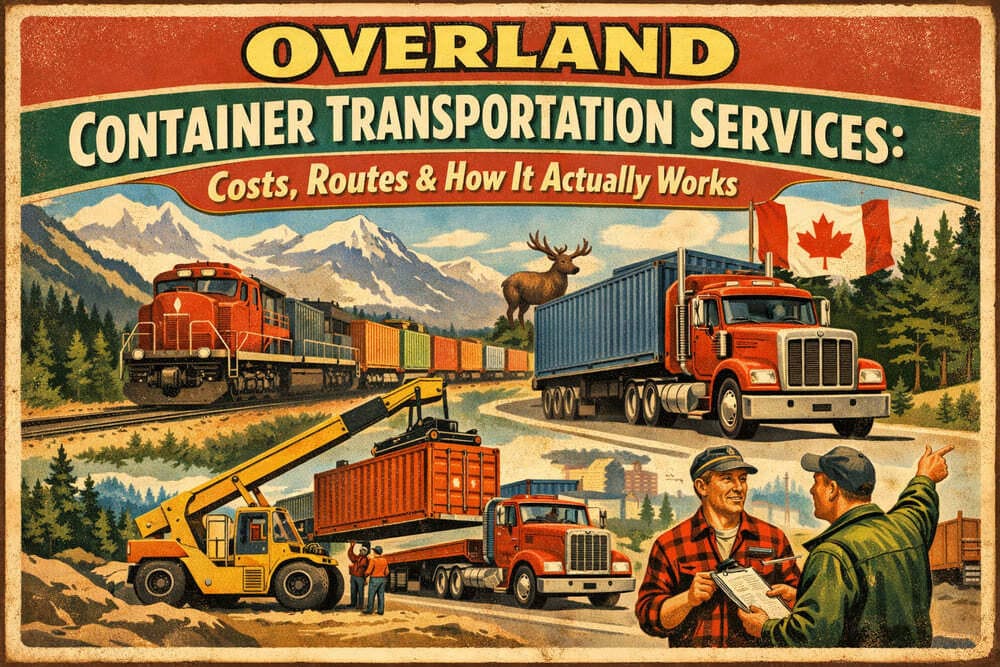
Overland container transportation services are used when cargo needs to move long distances across land instead of ocean shipping. In Canada, goods frequently travel thousands of kilometers between ports, rail hubs, warehouses, and distribution centers. Rather than repacking freight multiple times, logistics providers move the same sealed container by truck and rail across provinces.
Businesses rely on this method to ship retail inventory, construction materials, machinery parts, and commercial freight efficiently while keeping handling and damage risk low.
How Overland Container Transportation Works
Overland container shipping in Canada does not move as one long truck trip. Instead, the container travels in stages using both truck and rail, while the cargo stays inside the same sealed unit the entire time.
The important thing to understand: the freight is loaded once and not handled again until delivery. Only the container itself changes transportation mode.
1. Pickup From the Origin Location
The process begins when a truck chassis arrives at the shipper’s location, warehouse, or port terminal. The container is either:
- pre-loaded at a warehouse, or
- delivered empty so the customer can load cargo
After loading, the doors are closed and sealed with a numbered security seal. From this moment, the cargo is no longer handled individually.
2. Transport to the Rail Terminal (Drayage)
A local truck carries the container to the nearest rail yard. This short-distance movement is called drayage.
It is one of the most critical parts of the shipment because missed terminal cutoff times can delay the entire move by days.
This is typically coordinated by a professional container transport company rather than multiple separate carriers.
3. Rail Linehaul Across Provinces
At the terminal, cranes lift the container directly onto a railcar. The train then transports it long distance across Canada.
Rail is used because Canada is too large for efficient long-haul trucking. For example:
- Vancouver to Toronto
- Prince Rupert to Calgary
- Halifax to Montreal
During this stage, the cargo is not opened or repacked. The container remains sealed.
4. Arrival at Destination Terminal
Once the train reaches the destination city, the container is unloaded from the railcar and stored temporarily at the rail yard. The consignee or logistics coordinator schedules the delivery appointment.
This step is important because containers have limited free storage time before daily charges begin.
5. Final Delivery to Warehouse or Facility
A local truck picks up the container and delivers it to the final destination – warehouse, distribution center, construction site, or commercial facility.
The customer breaks the seal, unloads the cargo, and the empty container is returned to the terminal.
What Makes This Efficient
Instead of moving pallets and cartons multiple times, the entire shipment moves as a single secured unit. This reduces:
- handling damage
- loss
- delays
- labor costs
For long Canadian distances, this method is usually faster and more predictable than coordinating multiple trucks separately.
What Overland Container Transport Actually Means
Overland transport refers to inland movement of ocean shipping containers after they arrive at port — or before export. The container is transferred from a vessel to a rail terminal or truck chassis and continues inland without unloading the cargo.
This process is called intermodal transportation because multiple transportation modes are used while the cargo remains inside the same container.
Instead of moving individual pallets, the container itself becomes the shipping unit.
Companies moving goods between cities commonly use a coordinated container transport service to handle pickup, terminal transfer, and final delivery.
Typical Canadian Overland Routes
| Route | Main Transport Mode |
|---|---|
| Vancouver → Calgary | Rail + Truck |
| Vancouver → Toronto | Rail |
| Montreal → Toronto | Truck + Rail |
| Halifax → Montreal | Rail |
| Prince Rupert → Edmonton | Rail |
Canada’s geography makes rail transport essential. Long routes across the Prairies are rarely completed entirely by truck due to fuel cost and driver hours.
Rail vs Truck: Which Is Used?
| Feature | Rail | Truck |
|---|---|---|
| Long distance efficiency | Excellent | Moderate |
| Speed (short distance) | Slower | Faster |
| Cost per km | Lower | Higher |
| Final delivery | No | Yes |
| Environmental impact | Lower | Higher |
In practice, most shipments use both. Rail handles the long-distance segment, while trucks perform pickup and final delivery (called drayage).
Cost Factors
Several variables affect pricing.
| Factor | Effect |
|---|---|
| Distance | Main price driver |
| Container size (20ft vs 40ft) | Larger container costs more |
| Terminal handling | Local charges apply |
| Fuel surcharges | Market dependent |
| Seasonal congestion | Increases cost |
Typical Inland Transport Costs (CAD)
| Route | Estimated Cost |
|---|---|
| Vancouver → Toronto | $3,000 – $5,200 |
| Vancouver → Calgary | $1,800 – $3,100 |
| Montreal → Toronto | $700 – $1,200 |
| Halifax → Montreal | $1,400 – $2,300 |
Common Inland Shipping Problems (and How to Avoid Extra Charges)
Most issues in overland container transportation do not come from the transport itself — they come from planning mistakes. Containers move efficiently across Canada every day, but delays at pickup, rail terminals, or delivery often create unexpected storage fees and penalties.
Understanding these risks helps prevent costly surprises.
The Most Frequent Problems
| Problem | What Happens |
|---|---|
| Container not unloaded on time | Terminal charges storage |
| Incorrect paperwork | Container cannot be released |
| Warehouse not ready | Driver must return later |
| Weight imbalance | Rail terminal refuses the container |
| Missed delivery appointment | Detention charges apply |
Demurrage vs Detention (Very Important)
Many shippers confuse these two charges.
| Charge | When It Applies |
|---|---|
| Demurrage | Container sits at port or rail terminal too long |
| Detention | Container kept outside terminal beyond allowed time |
These fees can grow daily and quickly exceed the transport cost itself.
How to Avoid Extra Costs
Before shipment:
- Confirm delivery address and unloading hours
- Ensure a forklift or unloading crew is ready
- Verify documentation matches cargo description
During transit:
- Track the container ETA
- Book delivery appointment early
- Prepare warehouse space in advance
At delivery:
- Unload the container the same day
- Return empty container promptly
- Report any issues immediately
Why Coordination Matters
Overland container transport involves rail terminals, truck carriers, and warehouses. If one step is not ready, the entire move stops — and charges begin.
Professional coordination ensures:
- container release is scheduled
- delivery appointments are secured
- paperwork is correct before arrival
That is why many companies rely on logistics specialists to manage inland container moves instead of handling rail and terminal communication themselves.
Documentation and Coordination
Commercial shipments require organized paperwork. Incorrect documentation causes delays and storage charges at terminals.
Businesses frequently use a licensed freight forwarding provider to manage routing, documentation, and coordination between carriers.
Typical paperwork includes:
- Bill of lading
- Commercial invoice
- Packing list
- Delivery order
Why Businesses Choose Overland Container Shipping
Overland container transport offers several advantages:
• Cargo is loaded once and moved without repacking
• Lower damage risk
• Predictable transit times
• Scalable for growing inventory
• Efficient for long distances
For retail distributors and importers, this is often the most reliable way to move inventory across Canada.
Our Service Coverage
Metropolitan Logistics coordinates overland container transportation services across Canada through a network of rail terminals, trucking partners, and port facilities. We arrange door-to-door container moves for importers, exporters, distributors, warehouses, and construction suppliers.
Our team manages inland container routing from ports and rail yards to commercial facilities, retail distribution centers, and industrial locations. Many clients move inventory between provinces, while others ship containers from port to warehouse after import clearance.
Businesses that need regular inland shipping often rely on a professional container transport company to handle scheduling, rail transfers, and final delivery without handling multiple carriers separately.
Regions We Serve
Ontario
- Toronto & GTA
- Mississauga
- Brampton
- Vaughan
- Hamilton
- Ottawa
Quebec
- Montreal
- Laval
- Longueuil
- Quebec City
Western Canada
- Calgary
- Edmonton
- Vancouver
- Surrey
- Richmond
- Delta
Atlantic Canada
- Halifax
- Dartmouth
- Moncton
- Saint John
We also coordinate long-distance container moves between provinces such as Vancouver to Toronto, Montreal to Calgary, and Halifax to Ontario distribution hubs.
Because Canada relies heavily on rail corridors, many shipments move intermodally — truck pickup, rail linehaul, and local delivery — all coordinated under one shipment plan.
Request Shipping Assistance
If you need to move a container inland across Canada, our team can plan routing, arrange terminal transfers, and coordinate final delivery.
Metropolitan Logistics
📞 +1 (365) 829-5000
📩 service@metropolitanlogistics.ca