
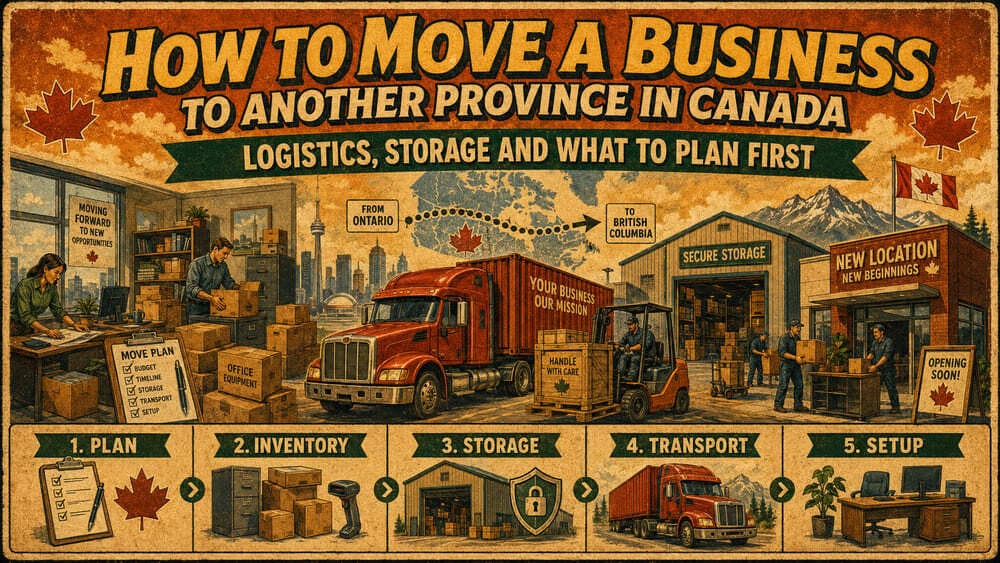
Business relocation Canada projects need more planning than a standard local move. When a company moves to another province, the project can involve office furniture, warehouse inventory, racking, equipment, IT assets, records, vehicles, customer orders, suppliers, staff, and temporary storage. A poor plan can interrupt operations, delay deliveries, and create unnecessary downtime.
Therefore, companies should treat an interprovincial move as a logistics project, not only a moving job. This guide explains how to plan a business relocation across Canada, what to organize first, and how storage, ground freight, warehousing, and phased delivery can reduce disruption.
What is business relocation Canada?
Business relocation Canada means moving a company’s physical operations, assets, inventory, equipment, or workplace from one Canadian location to another. The move may involve an office, warehouse, retail backroom, distribution operation, service branch, light industrial facility, or mixed office-and-warehouse site.
An interprovincial relocation adds more complexity than a local move. The shipment may travel hundreds or thousands of kilometres, cross provincial lines, and require temporary storage before the new location can receive everything.
Key business relocation terms
Interprovincial relocation means a move from one province to another, such as Ontario to Alberta or British Columbia to Ontario. These moves often need longer lead times and stronger coordination.
Ground freight means commercial transportation by truck. It can support pallets, equipment, furniture, inventory, crates, and consolidated business shipments.
Phased relocation means moving assets in stages instead of all at once. This can help a company keep part of the operation running during the transition.
Temporary storage means short-term holding for inventory, furniture, equipment, records, or fixtures before final delivery. Storage can help when lease dates, renovation work, or receiving schedules do not align.
Transloading means transferring freight from one trailer, container, or transport mode to another. It can help when cargo needs sorting, staging, or onward delivery.
Why moving a business to another province needs a logistics plan
Moving a business to another province needs a logistics plan because the company must protect operations during the transition. The move affects people, assets, customers, vendors, freight schedules, inventory accuracy, and revenue flow.
Downtime can affect customers and cash flow
A business move can interrupt order fulfilment, service appointments, receiving, shipping, production, and customer support. Therefore, teams should identify which functions must keep running during the move.
For example, a distributor may need to keep shipping urgent orders while inventory transfers to a new warehouse. A service company may need tools and vehicles available in both provinces for a short overlap period. As a result, the relocation plan should support continuity, not only transportation.
Office and warehouse assets need different plans
Office assets often include desks, chairs, files, computers, monitors, printers, meeting room equipment, and personal workstations. These items need labels, floor plans, IT coordination, and clear delivery zones.
Warehouse assets create different challenges. Inventory, pallet racking, forklifts, packing stations, shelving, spare parts, and equipment may need disassembly, staging, or special handling. In addition, the warehouse team must maintain inventory accuracy before, during, and after the move.
Storage can prevent schedule pressure
Many business relocations face a timing gap. The old lease may end before the new site is fully ready. Renovations may take longer than expected. Equipment may need to arrive before inventory, or inventory may need to wait until racking installation ends.
Temporary storage can reduce this pressure. It gives the company a buffer between pickup and final delivery. Moreover, storage can help the logistics team release assets in the right sequence.
How to plan business relocation Canada step by step
A successful interprovincial business move follows a clear sequence. Each step should reduce operational risk before the next phase begins.
- Define the relocation scope
Start by listing what must move. Separate office furniture, IT assets, warehouse inventory, equipment, racking, tools, records, vehicles, fixtures, and waste. In addition, identify what the company should sell, recycle, donate, store, or replace. - Assign an internal move lead
Choose one person to coordinate decisions across operations, finance, IT, HR, warehouse, and management. This person should manage the timeline, approvals, vendor communication, and issue tracking. - Create an asset and inventory list
Build a detailed list of items that need transportation. For office assets, use room names, employee names, or department codes. For warehouse assets, use SKU groups, pallet IDs, equipment numbers, and storage zones. - Map the old site and new site
Document doors, docks, elevators, loading zones, ceiling heights, parking limits, and truck access. Then create a receiving plan for the new location. This helps the logistics team load and deliver in the correct order. - Choose a phased or single-stage move
A single-stage move can work when the company can shut down briefly. However, many companies need phased relocation to reduce downtime. Move non-critical items first, then transfer critical assets during a planned cutover window. - Plan temporary storage if dates do not align
Use storage when the new site cannot receive everything at once. Storage can hold inventory, furniture, equipment, or fixtures until the site is ready. It also helps when teams need staged delivery by department or zone. - Book ground freight and specialized handling
Book transportation based on asset type, distance, weight, volume, and delivery sequence. Palletized freight, office furniture, racking, machinery, and fragile equipment may need different handling methods. - Prepare packing, labelling, and documentation
Label every carton, pallet, crate, and asset group. Use destination zones, department names, floor numbers, or warehouse areas. In addition, keep packing lists, photos, serial numbers, and condition notes for important assets. - Execute pickup, linehaul, storage, and delivery
Manage the move through pickup, long-distance transport, storage if needed, and final delivery. Track each phase and confirm who will receive freight at the new site. - Reconcile assets and restart operations
After delivery, verify furniture, equipment, inventory, records, and IT assets. Then update inventory systems, test workstations, confirm warehouse layout, and reopen operations in stages.
What to plan first before moving a business to another province
Companies should plan the operational timeline before they book trucks. The route matters, but the move strategy matters more.
| Planning area | Why it matters | What to decide first |
|---|---|---|
| Business continuity | Customers still expect service during the move. | Which functions must stay active during relocation? |
| Asset scope | A vague scope causes missed items and poor quotes. | What moves, what stays, and what gets disposed of? |
| Inventory accuracy | Warehouse moves can create stock errors. | How will the team count, label, and reconcile inventory? |
| Lease dates | Old and new site dates may not align. | Does the company need temporary storage? |
| IT systems | Workstations, servers, phones, and networks need timing. | When will IT disconnect, move, and restart systems? |
| Receiving plan | The new site may not accept everything at once. | Which assets should arrive first, second, and last? |
| Freight method | Different assets need different transport methods. | What moves by truckload, LTL, container, or specialized freight? |
Start with the cutover plan
The cutover plan defines when the company switches from the old location to the new one. This date controls the rest of the relocation schedule.
Teams should decide which operations can pause and which operations must continue. For example, customer support may move before the warehouse, while critical inventory may move after racking installation.
Build the move around critical assets
Critical assets control business continuity. They may include servers, inventory, forklifts, production equipment, customer records, tools, or point-of-sale systems.
The team should mark these assets early. Then the logistics plan can protect them with better packing, separate tracking, priority loading, and controlled delivery.
Confirm storage and staging needs
Storage should not become a last-minute fix. Companies should plan it when renovation, lease timing, site access, or receiving capacity creates uncertainty.
Staging can also improve the final delivery. For example, office furniture can arrive by department, while warehouse inventory can arrive by zone or SKU group.
Canadian context: Vancouver, Toronto, Montreal, Halifax and Calgary
Business relocation Canada planning changes by region because distance, traffic, access, freight networks, and real estate timelines vary. A clear regional plan helps companies avoid unnecessary downtime.
Toronto, GTA and Brampton relocations
Toronto, the GTA, and Brampton often support office moves, warehouse relocations, retail operations, and distribution centres. The region has strong highway access and warehousing infrastructure, but traffic and receiving windows can create scheduling pressure.
Companies moving into or out of Brampton should plan dock access, staging, and final delivery timing early. This matters when the move involves inventory, racking, or multiple truckloads.
Vancouver business relocations
Vancouver business relocations often involve urban delivery limits, port-area movement, and longer routes to central or eastern Canada. Companies moving from British Columbia to another province should build extra time into the linehaul plan.
Temporary storage can help when the new location cannot receive assets immediately. It also helps when furniture, equipment, and inventory need separate delivery windows.
Montreal business relocations
Montreal relocations may involve downtown access, bilingual labelling, Quebec-to-Ontario movement, and warehouse transitions. Companies should make labels and receiving documents clear for all teams.
For warehouse moves, inventory zones and pallet IDs should follow one naming system. This helps teams reconcile stock after delivery.
Halifax and Atlantic Canada moves
Halifax can support Atlantic Canada business relocations, port-related operations, regional distribution, and branch moves. Companies moving between Atlantic Canada and central Canada should plan linehaul timing and final delivery carefully.
Because some routes have fewer daily freight options than the GTA, early scheduling can reduce risk. Storage can also help bridge timing gaps between pickup and new-site readiness.
Calgary and Western Canada moves
Calgary often supports business relocations for construction, energy, retail, industrial, and distribution operations. Companies moving between Alberta and other provinces should plan for distance, weather, and site access.
For warehouse or equipment-heavy moves, teams should separate long-distance transport from final delivery. This gives the new site more flexibility when installation or setup work changes.
How Metropolitan Logistics handles business relocation Canada projects
Metropolitan Logistics supports business relocation Canada projects by connecting ground freight, warehouse relocation, temporary storage, staging, and final delivery into one coordinated move plan. For warehouse-heavy projects, warehouse relocation services can support inventory, racking, equipment, and staged operational moves.
For companies moving furniture, equipment, pallets, and business assets between provinces, ground freight shipments can support commercial transport across Canadian lanes. In addition, warehousing and transload services can help when assets need storage, sorting, cross-docking, or phased release before final delivery.
Storage, staging and phased delivery
Metropolitan Logistics can use yard facilities and warehousing support to stage business assets when pickup and delivery dates do not align. This helps companies avoid pressure when the new lease, renovation, dock access, or installation schedule changes.
A staged approach can also reduce congestion at the new site. Office furniture, IT assets, inventory, equipment, and warehouse materials can arrive in controlled phases instead of all at once.
Ground freight and interprovincial movement
Interprovincial business moves often need long-distance truck coordination, route planning, and delivery appointments. Metropolitan Logistics can support these moves through ELD-equipped fleet operations and 24/7 dispatch support.
ELD means electronic logging device, a system that tracks driver hours and supports transport compliance. Dispatch visibility helps teams coordinate pickup, storage, linehaul updates, and delivery windows across provinces.
Container, rail and yard support
Some larger business moves may use containers or intermodal transport when the route and cargo fit. Metropolitan Logistics can support these projects with a private chassis fleet, CN/CP direct access, and drayage and intermodal services.
CN means Canadian National Railway, while CP means Canadian Pacific Kansas City. These networks can support long-distance Canadian freight movement when companies need efficient inland transport between major corridors.
Common mistakes during interprovincial business relocation
Most interprovincial relocation problems start with unclear scope, weak labelling, or unrealistic timing. However, companies can reduce risk with early planning.
Moving without an asset list
A business should not move to another province without a complete asset list. Missing assets create confusion, poor quotes, and receiving problems.
The list should separate furniture, IT assets, inventory, warehouse equipment, records, tools, fixtures, and disposal items. It should also identify critical assets that need priority handling.
Treating storage as an emergency option
Storage often becomes necessary when lease dates, renovations, or installation work change. Companies should plan storage before they need it.
This gives the relocation team more control. It also prevents rushed decisions when the old site must be cleared but the new site cannot receive freight.
Ignoring warehouse inventory accuracy
Warehouse relocation can create stock errors if teams pack without zone labels, pallet IDs, or SKU group controls. Inventory should move with clear labels and a reconciliation plan.
After delivery, the team should verify counts before regular operations restart. This helps prevent customer order errors.
Underestimating IT and equipment setup
Computers, servers, scanners, phones, printers, warehouse systems, and security equipment need timing. If IT starts too late, staff may arrive at the new location before systems work.
Companies should schedule disconnect, packing, transport, setup, testing, and backup plans. This step protects the first operating day at the new site.
Request a business relocation quote in Canada
Planning to move an office, warehouse, branch, inventory, equipment, or mixed business operation to another province? Share the origin, destination, asset list, inventory scope, storage needs, target move date, and reopening timeline so the relocation can be planned around business continuity.
Request a business relocation quote
Frequently asked questions
How do you plan a business relocation Canada project?
To plan a business relocation Canada project, start with the relocation scope, asset list, move lead, site access details, storage needs, and cutover timeline. Then separate office assets, warehouse inventory, equipment, IT systems, and critical operations. This helps the company move in phases and reduce downtime.
How do I move an office warehouse to another province?
To move an office warehouse to another province, create separate plans for office furniture, IT systems, warehouse inventory, equipment, racking, and records. Use labels, pallet IDs, floor plans, and receiving zones. In addition, plan ground freight, temporary storage, and phased delivery before the old site closes.
Do businesses need temporary storage during an interprovincial move?
Many businesses need temporary storage when lease dates, renovations, receiving capacity, or installation schedules do not align. Storage can hold furniture, inventory, equipment, or fixtures until the new location can receive them. It also helps release assets in the right sequence.
How long does it take to move a business to another province in Canada?
The timeline depends on distance, asset volume, warehouse complexity, storage needs, and new-site readiness. A simple office move may take days of physical execution after planning ends. A warehouse or mixed office-and-warehouse move may need several weeks of planning and phased delivery.
What should a business relocation checklist include?
A business relocation checklist should include asset lists, inventory counts, IT equipment, furniture labels, warehouse zones, site access, dock appointments, storage needs, insurance records, delivery sequence, and restart tasks. It should also identify critical assets that control the reopening date.