
Freight forwarders and 3PLs are judged on how well they move freight. Did the container clear, did the truck deliver, did the warehouse turn the shipment around. Those are the visible measures of a good operation.
The billing and back-office work behind those moves gets far less attention, and that is where margin quietly leaks. A shipment can be executed perfectly and still lose money if an accessorial is never captured, a vendor invoice is overpaid, or the customer invoice sits in a dispute for three weeks. For a business that runs on thin spreads and high volume, the back office is not paperwork. It is margin protection.
This article looks at where billing breaks down in multi-modal forwarding and 3PL operations, why it gets harder as you grow, and how to decide whether to build that capacity in-house or get help.
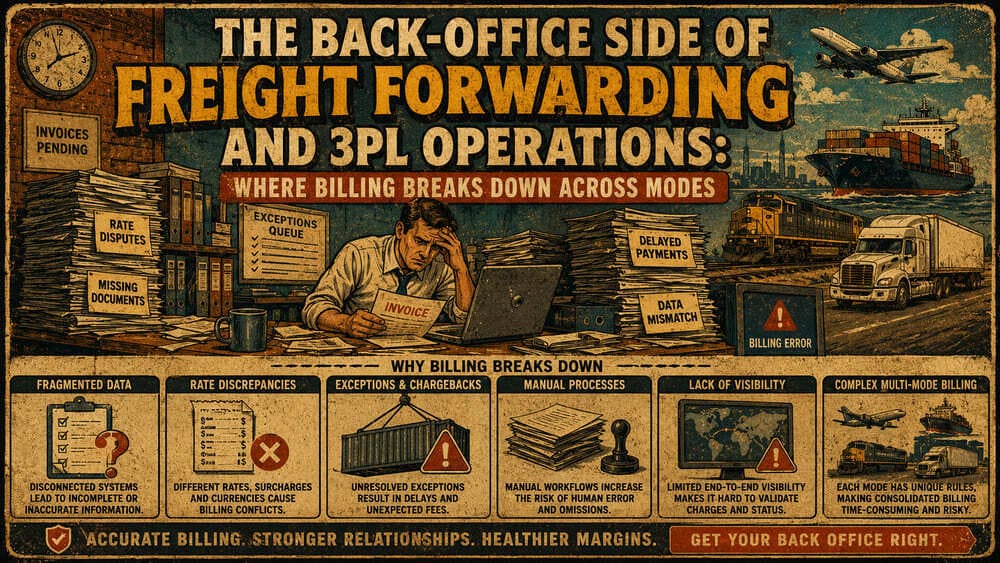
Why multi-modal billing is harder than single-mode billing
A forwarder or 3PL rarely deals with one mode. A single international shipment can touch ocean freight, drayage from the port, a transload or warehouse, and a final ground delivery, sometimes across the Canada and United States border. Each of those legs has its own documents, its own accessorial charges, its own timeline, and its own vendor relationship.
That means the billing team is not reconciling one invoice against one rate. They are assembling a financial picture from several vendors, each with different paperwork and different ways of charging for exceptions. Ocean and drayage bring per diem, demurrage, and chassis charges. Warehousing brings handling and storage. Ground brings detention and lumper fees. Air brings handling and screening. If any of those events is missed, the margin on the move shrinks, and nobody notices until the numbers are reviewed weeks later.
Where money leaks across modes
Accessorials that never reach the invoice
Accessorial charges are earned when a shipment needs extra time, equipment, or handling. The catch is that the information lives in operations while the money lives in billing. Dispatch knows a driver waited four hours. A terminal storage fee appears on a port statement days later. A warehouse logs an extra handling charge that never makes it onto the customer invoice. Each missed event is margin that was earned and never billed.
Vendor and carrier invoice errors
Vendor invoices do not always match what was agreed. Duplicate charges, incorrect rates, unauthorized accessorials, and chassis or per diem charges without backup all appear regularly. Across hundreds or thousands of shipments, small overpayments add up to real money. Catching them requires comparing each vendor invoice against the rate, the documents, and the approved charges before payment, which is a freight-aware audit, not a glance at the total.
Pass-through accuracy when you subcontract or white-label
This one is specific to forwarders and 3PLs. When you subcontract a leg or white-label for another company, every vendor cost and every accessorial has to be captured and passed through to the right party correctly. If a cost is missed, it is absorbed. If an accessorial is not rebilled, the margin on a brokered move can disappear entirely. The more parties involved in a shipment, the more places a charge can fall through, and the more disciplined the billing has to be to hold the spread.
Customer invoice disputes and missing backup
Even a perfectly executed shipment gets held up if the invoice is unclear. A missing POD, a wrong reference number, an undocumented accessorial, or a charge the customer does not recognize can freeze the entire invoice while one line item is sorted out. A clean invoice with the right documents attached is the difference between getting paid on time and chasing a balance for a month.
Aging receivables and rising DSO
All of this lands in accounts receivable. When invoices go out late or incomplete, they get paid late, and Days Sales Outstanding climbs. For a 3PL that often pays carriers and vendors before customers pay, a rising DSO is a working capital problem, not just a reporting number. Consistent follow-up, dispute resolution, and clean invoicing are what reduce Days Sales Outstanding and keep cash moving at the pace the business needs.
The forwarder and 3PL challenge: customer rules and tribal knowledge
Forwarders and 3PLs carry a complication that asset carriers do not. Every customer wants invoices a particular way: a specific format, a portal, certain reference fields, particular backup documents. That knowledge often lives in one person’s head. When that person is out, or leaves, the process becomes fragile, and invoices start going out wrong or late.
This is manageable at low volume. It breaks at scale. A team that handles billing for a few hundred shipments a month by memory will struggle at a few thousand. Growth exposes the gap, because volume tends to grow faster than administrative headcount. The work that used to fit between other tasks no longer does.
Building the back office in-house vs. getting help
There are three honest options: build the back office in-house, outsource part of the workflow, or run a hybrid. The right answer depends on volume, complexity, customer rules, budget, and how much management attention is available to supervise the work.
In-house gives the most direct control. Your team learns your customers, vendors, and systems. The tradeoff is fixed overhead and the need to hire, train, cover absences, and replace turnover. It works well when volume is stable and processes are documented. Outsourcing part of the workflow makes sense when volume is there but administrative capacity is not, or when billing delays and AR backlogs are already affecting the business. The advantage is flexibility: start with the one workflow that hurts most, and expand only if it works.
Where a freight back-office layer fits
A freight-specific back-office operation handles the work that sits between operations and accounting: proof of delivery and document chase, vendor and carrier invoice audit, shipper billing and invoicing, accessorial capture, accounts receivable follow-up, and bookkeeping. ClearLane provides that layer for freight companies, and it offers back-office support built for 3PLs specifically, where multiple customers, vendors, modes, and billing rules have to be handled at once.
The point is not to replace a forwarder’s or 3PL’s own systems. It is to make sure the billing data is complete and the receivables are managed before the numbers reach the financial reports. The operation keeps moving freight. The back-office layer makes sure every move turns into a complete, accurate, collected invoice.
A short checklist to evaluate your back office
Before adding software or headcount, find out where the problem actually sits. A few honest questions usually point straight to it.
• Are invoices going out late, and if so, is it a document problem or an ownership problem?
• Are vendor and carrier invoices audited against the agreed rate before they are paid?
• Are accessorials captured consistently across every mode, including drayage and warehousing?
• When you subcontract or white-label, is every cost and accessorial passed through correctly?
• How often do customer invoices get disputed, and why?
• Is AR aging increasing, and is DSO trending up?
• Is bookkeeping and reconciliation keeping pace with shipment volume?
If the answers point to execution rather than visibility, the fix is usually people and process, not another software tool.
Frequently asked questions
What does back-office support mean for a freight forwarder or 3PL?
Back-office support covers the financial and document work behind shipments: proof of delivery and document chase, vendor and carrier invoice audit, accessorial capture, shipper billing, accounts receivable follow-up, and bookkeeping. It is the work that turns a completed move into a complete, accurate, and collected invoice.
Why do forwarders and 3PLs lose margin in billing?
Margin leaks when accessorials earned in operations never reach the invoice, when vendor invoices are overpaid without an audit, when subcontracted costs are not passed through correctly, and when customer invoice disputes delay payment. Each gap is small on one shipment and significant across thousands.
What is DSO and why does it matter for a 3PL?
DSO, or Days Sales Outstanding, is the average number of days between invoicing a shipment and collecting payment. It matters for 3PLs because they often pay carriers and vendors before customers pay them, so a high DSO ties up working capital. Faster, cleaner invoicing and consistent AR follow-up bring it down.
Should a 3PL build its back office in-house or outsource it?
It depends on volume, complexity, and management capacity. In-house gives direct control but carries fixed overhead and hiring risk. Outsourcing adds capacity and flexibility, and lets a company start with the one workflow that hurts most. Many forwarders and 3PLs run a hybrid of the two.
How does billing differ across ocean, air, drayage, and ground?
Each mode has its own documents, accessorials, and timelines. Ocean and drayage bring per diem, demurrage, and chassis charges. Warehousing brings handling and storage. Ground brings detention and lumper fees. Air brings handling and screening. A multi-modal shipment requires assembling all of these correctly before the customer invoice goes out.
What is a pre-billing review?
A pre-billing review checks a shipment file for missed billable events, such as detention, per diem, demurrage, chassis, and storage, and confirms the backup for each one before the customer invoice is sent. It is the step that catches earned revenue before it is lost and prevents disputes over charges added after the fact.
About ClearLane
ClearLane is a freight back-office operation serving freight brokers, 3PLs, trucking companies, and intermodal operators across Canada and the United States. Services include POD chase, carrier invoice audit, shipper billing, AR management, pre-billing revenue recovery, carrier compliance, and bookkeeping support.