
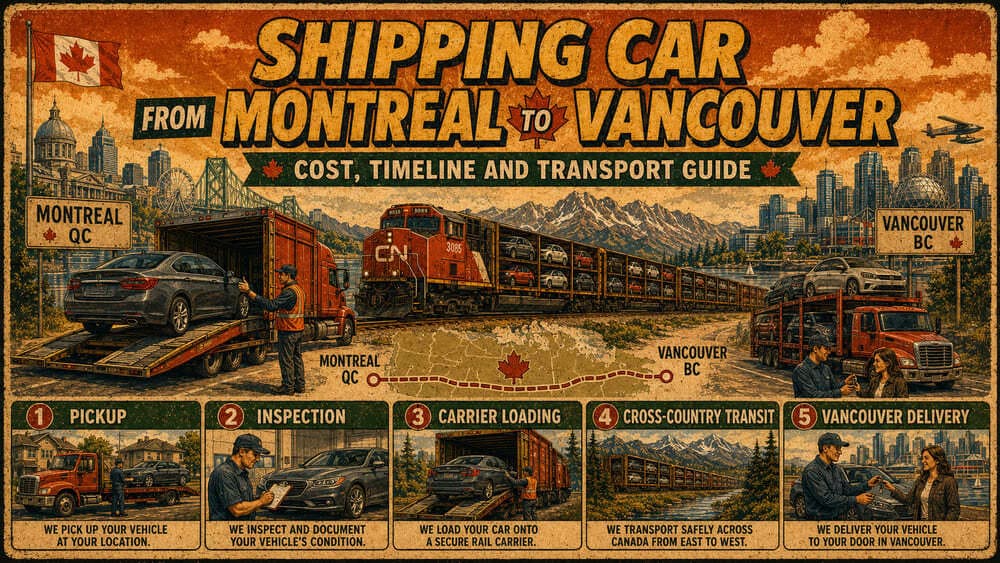
Shipping car from Montreal to Vancouver is one of the longest domestic vehicle transport routes in Canada. The route crosses Quebec, Ontario, the Prairies, the Rocky Mountains, and British Columbia before the vehicle reaches the West Coast. For many owners, driving this distance means several days on the road, extra mileage, hotel costs, fuel, weather exposure, and personal time away from work.
Professional auto transport gives drivers, families, students, dealerships, and fleet managers a more practical option. This guide explains how Montreal to Vancouver car shipping works, what affects the cost, how long it takes, which transport options fit different vehicles, and how to prepare the car before pickup.
What is shipping car from Montreal to Vancouver?
Shipping car from Montreal to Vancouver means arranging domestic vehicle transport from Montreal or nearby Quebec locations to Vancouver or the Lower Mainland in British Columbia. The vehicle usually moves by open carrier, enclosed carrier, rail-assisted transport, or a truck-and-rail combination depending on availability, timing, budget, and service preference.
This route supports personal relocations, out-of-province vehicle purchases, student moves, corporate transfers, dealership moves, auction purchases, and fleet repositioning. The same planning also applies to the reverse route when customers need shipping car from Vancouver to Montreal.
Key car shipping terms
Open carrier means the vehicle travels on an open auto transport trailer. It is the most common domestic car shipping method in Canada.
Enclosed carrier means the vehicle travels inside a covered trailer. Owners often choose this method for luxury, classic, collector, exotic, or high-value vehicles.
Rail-assisted transport means the vehicle uses rail for the long-haul portion of the route and truck transport for pickup, delivery, or terminal access. This can work well on long cross-country routes when schedules and terminals align.
Terminal-to-terminal shipping means the customer drops off and picks up the vehicle at approved terminals or yards. This can reduce cost when the customer can access both terminals easily.
Door-to-door shipping means the carrier picks up and delivers as close as legally and safely possible to the requested addresses. Large carriers still need safe access, enough turning space, and legal loading areas.
Condition report means the inspection record completed at pickup and delivery. It documents visible marks, mileage, keys, and vehicle condition.
Why Montreal to Vancouver vehicle shipping needs planning
Montreal to Vancouver vehicle shipping needs planning because the route covers thousands of kilometres and several climate zones. A small scheduling mistake can affect pickup, terminal timing, rail movement, final delivery, and customer availability.
The route is long and weather-sensitive
Montreal to Vancouver is a coast-to-coast domestic move. The vehicle may travel through Ontario, Manitoba, Saskatchewan, Alberta, and British Columbia before final delivery.
Weather can affect the route at several points. Winter storms in the Prairies, mountain conditions in British Columbia, rain on the West Coast, and peak-season carrier demand can all affect timing. Therefore, customers should plan around pickup and delivery windows, not exact hour promises.
Shipping protects mileage and time
Driving from Montreal to Vancouver adds thousands of kilometres to the odometer. It also adds fuel, lodging, meals, tire wear, brake wear, stone-chip risk, and driver fatigue.
Shipping can make sense when the vehicle is leased, financed, recently purchased, newer, high-value, or needed at the destination without a long road trip. It also helps when the owner needs to fly, relocate quickly, or send a vehicle to a family member.
Transport method affects cost and timing
Open carrier, enclosed carrier, and rail-assisted options serve different needs. Open carrier usually offers the strongest balance of price and availability for standard vehicles.
Enclosed transport adds protection and often costs more. Rail-assisted shipping can fit long-distance routes, especially when terminal access works for the customer. However, it may require more flexibility around scheduling and pickup procedures.
How to ship a car from Montreal to Vancouver step by step
A smooth Montreal to Vancouver auto shipment follows a clear process. Each step helps reduce delays, access problems, and delivery surprises.
- Confirm the vehicle details
Start with the year, make, model, trim, body style, running condition, ground clearance, modifications, and vehicle size. Also mention roof racks, oversized tires, lift kits, spoilers, low clearance, or battery issues. These details help the carrier choose the right equipment. - Choose the pickup area
Confirm whether pickup will happen in Montreal, Laval, Longueuil, Brossard, Pointe-Claire, Saint-Laurent, or another nearby area. Dense streets, apartment buildings, underground parking, and narrow roads can affect carrier access. - Choose the Vancouver delivery area
Confirm whether delivery will happen in Vancouver, Burnaby, Richmond, Surrey, Coquitlam, Delta, North Vancouver, West Vancouver, Langley, or another Lower Mainland location. The delivery point should give the carrier enough room to unload safely. - Compare open, enclosed, and rail-assisted options
Open carrier usually fits standard running vehicles. Enclosed transport fits higher-value vehicles that need more protection. Rail-assisted transport may work when the schedule, terminals, and vehicle type align. - Request a route-specific quote
Share the pickup city, delivery city, vehicle details, preferred dates, transport preference, and whether the car runs and drives. A quote for this route should reflect distance, season, vehicle size, fuel, terminal requirements, and carrier availability. - Prepare the car for pickup
Remove personal items, clean the vehicle, check tire pressure, confirm the battery holds charge, and leave enough fuel for loading and unloading. Remove loose accessories and disable toll tags if needed. - Complete the pickup inspection
Review the condition report with the driver or terminal team. Take clear photos of all sides, wheels, roof, glass, bumpers, and existing marks before the vehicle leaves. - Stay available during transit and delivery
Keep your phone accessible during pickup and delivery windows. The carrier may need to confirm timing, access, or a safe meeting point before unloading. - Inspect the vehicle at delivery
Check the car before signing final paperwork. Compare the vehicle to pickup photos and the condition report. Note any issue right away if something looks different.
Montreal to Vancouver car shipping options compared
The right transport option depends on vehicle value, timing, budget, access, and customer flexibility. Customers should compare the full service, not only the lowest quote.
| Option | Best for | Main advantage | Planning note |
|---|---|---|---|
| Open carrier | Standard sedans, SUVs, minivans, pickups, daily drivers | Usually the most cost-effective option | Vehicle travels exposed to normal road and weather conditions. |
| Enclosed carrier | Luxury, classic, collector, exotic, or high-value vehicles | More protection from road debris and weather | Costs more and may need more lead time. |
| Rail-assisted transport | Long-distance moves with flexible timing | Can reduce long-haul road exposure | Terminal access and scheduling rules matter. |
| Terminal-to-terminal | Customers near approved terminals | Can reduce cost and simplify carrier access | Customer handles drop-off and pickup. |
| Door-to-door | Relocations, busy owners, family moves, business vehicles | More convenient than terminal service | Exact addresses still need safe truck access. |
Open carrier for standard vehicles
Open carrier works well for most customers shipping car from Montreal to Vancouver. It can move sedans, SUVs, minivans, and many pickup trucks.
This method usually provides the best mix of availability and cost. However, the vehicle travels on an open trailer, so normal road dust, weather, and debris exposure can occur.
Enclosed transport for higher-value cars
Enclosed transport makes sense when the vehicle needs extra protection. Owners often choose it for classic vehicles, luxury cars, collector models, exotic cars, or vehicles with custom paint.
This option usually costs more because it uses specialized equipment and carries fewer vehicles. It may also need more booking time on a long cross-country route.
Rail-assisted shipping for long-distance moves
Rail-assisted shipping can fit Montreal to Vancouver when the vehicle, timing, and terminal access work well. The long-haul portion may move by rail, while local truck service can support pickup or delivery.
This option can reduce highway exposure on a long route. However, rail-based moves usually need more flexibility because terminals, cut-offs, and scheduled departures affect timing.
Cost factors for shipping car from Montreal to Vancouver
Shipping cost depends on distance, vehicle size, service type, season, pickup access, delivery access, and carrier capacity. The Montreal to Vancouver route is a major cross-country lane, so small details can change the final quote.
| Cost factor | Why it matters | How it affects the quote |
|---|---|---|
| Vehicle size | Larger vehicles use more trailer or rail space. | SUVs, vans, and pickups usually cost more than compact sedans. |
| Transport method | Open, enclosed, and rail-assisted services use different equipment. | Enclosed transport usually costs more than open transport. |
| Pickup access | Tight city streets can affect carrier loading. | A safe nearby meeting point can make pickup easier. |
| Delivery access | Vancouver-area streets can restrict large carriers. | Flexible delivery locations can improve scheduling. |
| Season | Winter, summer relocation periods, and peak demand affect capacity. | Booking early helps protect preferred dates. |
| Timing flexibility | Rush moves need faster carrier availability. | Flexible windows can improve routing and price. |
| Vehicle condition | Domestic vehicle shipping usually needs a running vehicle. | Non-running vehicles require special review and may not fit standard service. |
Typical cost range on this route
Montreal to Vancouver car shipping usually costs more than shorter regional moves because the route crosses most of the country. Open carrier often gives the lowest practical price for standard running vehicles. Enclosed transport costs more because it adds protection and uses specialized equipment.
A route-specific quote still matters. Fuel, season, vehicle size, pickup area, delivery area, terminal options, and capacity can change pricing.
Why cheap car shipping can become expensive
A very low quote can create problems if it leaves out pickup details, realistic timing, insurance information, terminal fees, or delivery conditions. Customers should ask what the quote includes before booking.
The best quote should explain the transport method, estimated timeline, pickup window, delivery window, coverage, vehicle requirements, and personal-item rules.
Timeline for Montreal to Vancouver car transport
The timeline depends on transport method, pickup window, season, weather, carrier routing, and destination access. A cross-country route needs realistic expectations.
Pickup window
Pickup may take several days after booking because the carrier needs to assign space and plan the route. Terminal-based moves also depend on drop-off windows and departure schedules.
Customers should book early when they have a lease deadline, flight, school start date, work start date, or vehicle sale. More flexibility usually helps scheduling.
Transit time
Once the vehicle enters transit, the route can still take time because it crosses several provinces. Truck service may move more directly, while rail-assisted service depends on terminal schedules and final delivery coordination.
Weather can add delays, especially in winter. Therefore, customers should plan around a delivery window and keep a small buffer.
Delivery coordination
Delivery requires an available receiver and a safe unloading area. In Vancouver and the Lower Mainland, dense streets, limited parking, low trees, or building restrictions can affect the final handoff.
If the carrier cannot unload at the exact address, a nearby open parking lot or wide street may work better. This helps protect the vehicle and the carrier equipment.
Montreal, Vancouver and reverse-route context
The Montreal to Vancouver route connects Eastern Canada with the West Coast. It serves relocations, student moves, dealership transfers, auction purchases, online vehicle sales, corporate fleets, and family vehicle moves.
Montreal pickup context
Montreal pickup may involve downtown streets, residential zones, condo buildings, industrial areas, or dealership lots. Some areas may not allow large transport trucks to stop safely.
Customers can reduce pickup issues by suggesting a nearby open location when needed. Dealerships, industrial lots, wide streets, or approved yards can make loading safer.
Vancouver and Lower Mainland delivery context
Vancouver delivery may include Burnaby, Richmond, Surrey, Coquitlam, Delta, North Vancouver, West Vancouver, or Langley. Each location creates different access conditions.
Dense urban areas often need flexible delivery planning. The receiver should stay available and help confirm a safe unloading point if the exact address does not work.
Reverse route: Vancouver to Montreal
The same process applies when customers need shipping car from Vancouver to Montreal. The route still crosses several provinces and needs the same preparation, inspection, and delivery planning.
Capacity may shift by season and direction. Therefore, customers should request reverse-route quotes early, especially during relocation periods.
Rail Auto Canada: Metropolitan Logistics’ partner for vehicle shipping in Canada
For domestic vehicle transport in Canada, Metropolitan Logistics works with Rail Auto Canada as a trusted partner for car shipping requests. Rail Auto Canada focuses on vehicle transportation within Canada and helps customers arrange car shipping by open carrier, enclosed transport, rail-assisted service, or a truck-and-rail option when available.
This partnership helps customers get routed to a company that specializes in Canadian auto transport. Instead of sending a general freight request, customers can request a car shipping quote directly from Rail Auto Canada and share the vehicle details, pickup city, delivery city, running condition, and preferred dates.
How Rail Auto Canada supports Montreal to Vancouver car shipping
For Montreal to Vancouver moves, Rail Auto Canada can review the vehicle type, running condition, pickup access, delivery access, timing, and protection needs before recommending a transport method. This helps customers choose the right balance of cost, timeline, and vehicle protection.
Rail Auto Canada can also help customers understand whether open carrier, enclosed transport, terminal-to-terminal shipping, door-to-door service, or a rail-assisted option makes sense for the route. The final recommendation depends on availability, season, vehicle type, and customer flexibility.
Domestic vehicle shipping requirements
Domestic Canadian vehicle shipping works best when the car runs, drives, steers, and brakes safely. Standard service usually requires a running vehicle because carriers need to load and unload it without recovery equipment.
Customers should disclose low clearance, modifications, weak batteries, alarm issues, oversized tires, roof racks, or mechanical problems before booking. These details help prevent loading delays and allow Rail Auto Canada to match the vehicle with the right transport option.
Contact Rail Auto Canada for a quote
Customers who need to ship a car from Montreal to Vancouver can request a quote directly from Rail Auto Canada.
Get a quote: https://www.railautocanada.ca/get-a-quote
Phone: +1 (289) 536-6499
Email: hello@railautocanada.ca
Common mistakes when shipping a car from Montreal to Vancouver
Most car shipping problems start with incomplete information, late booking, or poor vehicle preparation. Customers can avoid many issues with a simple checklist.
Booking too late
Late booking can limit carrier choices and make timing harder. This matters on cross-country routes because equipment needs to move across several provinces.
Customers should book early when they need delivery before a specific date. Early planning also gives more time to compare open, enclosed, rail-assisted, terminal, and door-to-door choices.
Leaving personal belongings in the car
Most carriers restrict personal belongings inside vehicles. Loose items can shift, break, or create liability concerns.
Customers should remove bags, electronics, toll tags, garage remotes, documents, chargers, and valuables before pickup. A clean vehicle also makes inspection easier.
Not sharing vehicle modifications
Lift kits, low clearance, roof racks, oversized tires, spoilers, and aftermarket parts can affect loading. If the carrier learns about these details at pickup, the shipment may face delays.
Customers should share modifications during the quote request. Photos can also help the transport team confirm equipment fit.
Skipping pickup and delivery photos
Photos protect both the customer and the carrier. Customers should take clear photos before pickup and again at delivery.
The final inspection should happen before signing delivery paperwork. If something looks different, note it immediately and keep all records.
Request a Montreal to Vancouver car shipping quote
Planning to ship a car from Montreal to Vancouver, Vancouver to Montreal, or another long-distance Canadian route? Metropolitan Logistics recommends requesting a vehicle transport quote through its auto shipping partner, Rail Auto Canada.
Rail Auto Canada can help review the route, vehicle type, pickup and delivery cities, preferred dates, and open or enclosed transport preference.
Request a Montreal to Vancouver car shipping quote
You can also contact Rail Auto Canada directly:
Phone: +1 (289) 536-6499
Email: hello@railautocanada.ca
Frequently asked questions
How much does shipping car from Montreal to Vancouver cost?
Shipping car from Montreal to Vancouver depends on vehicle size, transport type, pickup access, delivery access, season, and timing flexibility. Open carrier usually costs less than enclosed transport. Rail Auto Canada can provide a route-specific quote based on the vehicle details, pickup city, delivery city, and preferred shipping dates.
How long does it take to ship a car from Montreal to Vancouver?
The timeline depends on pickup availability, transport method, weather, carrier routing, and delivery access. Montreal to Vancouver is a cross-country route, so customers should plan around a pickup and delivery window. Rail-assisted moves may need more time because terminal schedules affect the process.
Can I ship car from Montreal to Vancouver by rail?
Rail-assisted car shipping may be available on long-distance Canadian routes when terminals, timing, and vehicle requirements align. The vehicle may still need truck transport at pickup or delivery. Rail Auto Canada can help compare rail-assisted service with open carrier based on cost, timeline, and convenience.
Is shipping car from Vancouver to Montreal the same process?
Yes, shipping car from Vancouver to Montreal follows the same general process in reverse. The vehicle still needs a running condition, inspection, pickup planning, transit coordination, and delivery inspection. Pricing and timing may change by season and carrier direction.
Should I drive or ship a car from Montreal to Vancouver?
Shipping can make sense when the owner wants to avoid thousands of kilometres of mileage, fuel, hotels, road fatigue, weather risk, and time away from work. Driving may work for flexible owners who want to make the trip themselves. For leased, newer, high-value, or recently purchased vehicles, shipping often offers better protection and convenience.
Who should I contact for Montreal to Vancouver car shipping?
For car shipping requests, Metropolitan Logistics recommends contacting its partner Rail Auto Canada. Customers can request a quote at https://www.railautocanada.ca/get-a-quote, call +1 (289) 536-6499, or email hello@railautocanada.ca.
Get a Car Shipping Quote
Across Canada
Submit your vehicle details through our trusted partner Rail Auto Canada. They’ll review your route, vehicle type, timing, and transport options.