
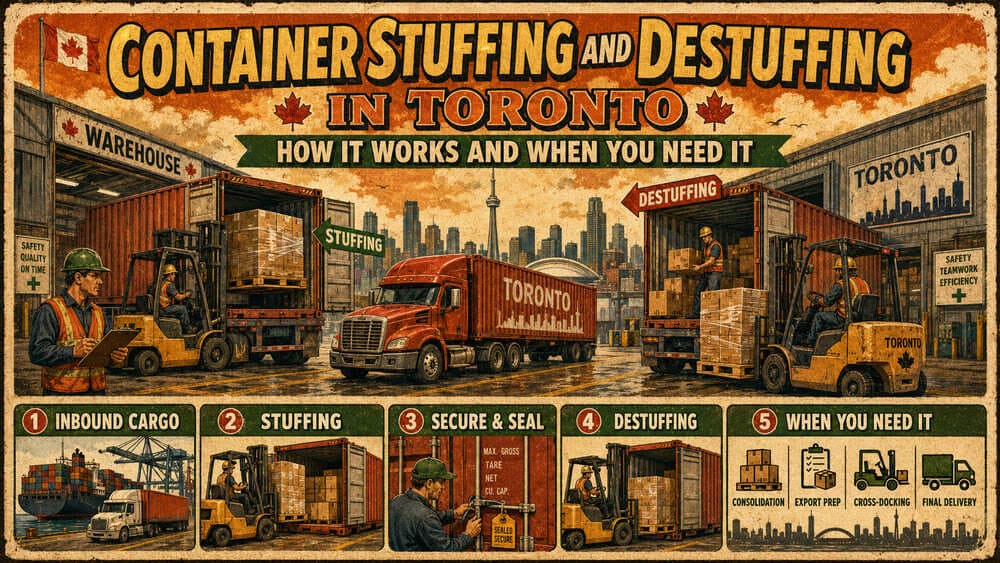
Container stuffing Toronto services help importers, exporters, manufacturers, retailers, and distributors load or unload ocean containers safely near Canada’s busiest freight corridor. When cargo arrives in a 20-foot or 40-foot container, the work does not end at the rail terminal or warehouse dock. The freight still needs unloading, sorting, palletizing, inspection, storage, delivery preparation, or reloading for export.
This guide explains how container stuffing and destuffing work in Toronto and Ontario, when businesses need these services, and how proper warehouse handling can reduce damage, delays, detention, and delivery problems.
What is container stuffing Toronto?
Container stuffing Toronto means loading cargo into a shipping container at a warehouse, yard, facility, or shipper location in the Toronto area. Destuffing means unloading cargo from a shipping container after arrival. Businesses use these services when they need professional container loading, unloading, sorting, palletizing, or warehouse preparation before the next logistics step.
Container stuffing often supports exports, domestic container moves, and consolidated freight. Container destuffing often supports imports, transloading, inventory receiving, retail distribution, and final delivery preparation.
Key container handling terms
Stuffing means loading cargo into a container. The process may include pallet loading, floor loading, blocking, bracing, weight distribution, and documentation.
Destuffing means unloading cargo from a container. The process may include handbombing, palletizing, sorting, inspection, labelling, and staging.
Handbombing means manually loading or unloading individual cartons, boxes, bags, tires, furniture, or loose freight by hand instead of using only pallets or forklifts.
Palletizing means placing loose cargo or cartons onto pallets so forklifts and pallet jacks can move it more efficiently.
Blocking and bracing means securing cargo so it does not shift during transport. This matters for exports, heavy cargo, machinery, and mixed loads.
Drayage means short-distance container trucking between a rail terminal, port, warehouse, yard, or consignee. In Toronto and Brampton, drayage often connects CN and CP terminals with nearby warehouses.
Why stuffing and destuffing matter for Ontario importers and exporters
Stuffing and destuffing matter because the way cargo enters or leaves a container affects cost, damage risk, warehouse flow, and delivery timing. Poor container handling can create broken pallets, crushed cartons, missing inventory, unsafe loads, and detention charges.
Import containers need fast and organized unloading
Importers often face free-time limits after a container leaves a terminal. If the receiver cannot unload quickly, detention can start. Detention means equipment charges that may apply when the container stays outside the terminal longer than allowed.
A professional destuffing plan helps empty the container faster. The warehouse team can unload cartons, sort by SKU, palletize freight, inspect visible damage, and prepare goods for storage or delivery. As a result, the empty container can return sooner.
Export containers need secure loading
Exporters need container stuffing that protects cargo throughout the route. The load plan should account for weight distribution, carton strength, pallet quality, cargo type, and movement during truck, rail, ocean, or intermodal transport.
If freight shifts inside the container, cargo can arrive damaged. In addition, the receiver may face unloading problems at destination. Therefore, export stuffing should include proper loading patterns, blocking, bracing, and clear documentation.
Toronto-area freight often needs warehouse handling
Toronto, the GTA, and Brampton receive high volumes of freight through rail terminals, highways, warehouses, distribution centres, and industrial parks. Many businesses do not have enough dock space, labour, forklifts, or warehouse time to unload containers at their own facility.
In those cases, a destuffing service Ontario plan can solve the bottleneck. The container can move to a warehouse, teams can unload and prepare the freight, and the cargo can continue by pallet delivery, truckload, LTL, storage, cross-dock, or local distribution.
How container stuffing and destuffing works step by step
A reliable stuffing or destuffing job follows a clear process. Each step helps the shipper reduce damage, delay, and documentation issues.
- Confirm container and cargo details
Start with the container size, seal number, cargo description, pallet count, carton count, weight, commodity, packaging type, and delivery deadline. These details help the warehouse team estimate labour, equipment, space, and timing. - Book drayage or delivery to the facility
For import destuffing, arrange drayage from the rail terminal, port, yard, or consignee to the warehouse. For export stuffing, arrange container positioning at the loading facility. The timing should match free time, dock availability, and warehouse labour. - Inspect the container before handling
Before opening the doors, check the seal, container number, visible damage, and safety conditions. If the container appears damaged, wet, shifted, or unsafe, document it with photos before unloading. - Unload, sort, or stage the cargo
During destuffing, the team unloads freight by forklift, pallet jack, or handbombing. Then workers can sort goods by SKU, purchase order, destination, customer, or delivery route. This step turns a sealed container into usable inventory. - Palletize and label freight
Loose cartons often need palletizing after unloading. Labels should show SKU, piece count, destination, purchase order, customer name, or warehouse location. Clear labels help receiving, storage, and outbound delivery. - Inspect and report exceptions
Check for visible damage, shortages, wet cartons, broken pallets, torn wrap, or shifted cargo. Report exceptions quickly and keep photos. This helps support carrier, supplier, warehouse, or insurance discussions. - Reload or store cargo as needed
After destuffing, freight may go into storage, cross-dock, local delivery, long-haul trucking, or another container. For export stuffing, the team loads cargo according to the plan, secures it, and prepares the container for pickup. - Return the empty container or release the loaded unit
For imports, the empty container should return before detention starts. For exports, the loaded container should move to the terminal or next carrier according to cut-off timing. Good scheduling helps avoid extra charges.
When you need container stuffing or destuffing services
Businesses usually need container stuffing or destuffing when the cargo requires more than a simple delivery. The service can solve labour, space, safety, timing, or distribution problems.
| Situation | Why stuffing or destuffing helps | Best next step |
|---|---|---|
| Import container with loose cartons | The receiver may not have labour for handbombing. | Destuff, palletize, label, and prepare for storage or delivery. |
| Retail or e-commerce inventory | Freight needs sorting by SKU, store, or customer. | Destuff and stage by outbound route or order group. |
| Export shipment | Cargo needs secure loading before international movement. | Stuff the container with proper weight distribution and bracing. |
| Warehouse overflow | The consignee cannot unload or store freight immediately. | Use warehouse destuffing and short-term storage. |
| Multi-destination cargo | One container contains goods for several receivers. | Destuff, sort, cross-dock, and deliver in smaller shipments. |
| Heavy or awkward freight | Cargo needs equipment, planning, and safe handling. | Review lift points, packaging, floor load, and securing needs. |
| Damaged or shifted container load | The cargo may need inspection and restacking. | Open carefully, document exceptions, and rework the load. |
When destuffing makes sense for imports
Destuffing makes sense when the importer cannot unload a container quickly at its own facility. It also helps when cargo arrives floor-loaded, mixed, loose, damaged, or unsorted.
A warehouse team can turn the container into organized freight. The team can palletize cartons, apply labels, create delivery groups, and stage freight for Ontario distribution. This can save time for importers that lack labour or warehouse capacity.
When stuffing makes sense for exports
Stuffing makes sense when exporters need a professional load plan before a container leaves Toronto or Ontario. This matters for fragile cargo, heavy goods, industrial equipment, mixed pallets, or international shipments.
The team should load cargo with weight distribution in mind. It should also protect freight with dunnage, straps, blocking, bracing, or other securing methods when needed.
When transloading may be better
Sometimes stuffing and destuffing connect with transloading. Transloading means moving cargo from one container, trailer, or transport mode into another.
For example, an importer may destuff an ocean container in Brampton, store the freight briefly, then reload it into domestic trailers for final delivery across Ontario. This can reduce container dwell time and improve distribution control.
Toronto and Ontario context: terminals, warehouses and local delivery
Container stuffing Toronto services usually connect with rail terminals, industrial areas, warehouses, and final-mile delivery routes across the GTA and Ontario. Location matters because time, traffic, terminal access, and warehouse capacity affect cost.
Toronto, GTA and Brampton container handling
Toronto, the GTA, and Brampton sit close to major freight corridors, distribution centres, rail terminals, and industrial warehouses. Many import containers move through CN and CP rail networks before drayage to a warehouse or receiver.
Brampton is especially important for container handling because of its location near intermodal activity and regional distribution lanes. A nearby warehouse can help importers reduce delays when they need destuffing, palletizing, storage, or outbound delivery.
Mississauga, Vaughan and surrounding markets
Mississauga, Vaughan, Markham, Etobicoke, North York, and nearby industrial areas often need container unloading for retail, manufacturing, e-commerce, construction, and wholesale cargo. These locations may have docks, but they may not have enough labour or time to unload floor-loaded containers.
Destuffing at a warehouse can help businesses avoid congestion at their own site. It can also create cleaner delivery flows for pallets, cartons, or store-ready freight.
Ontario distribution after destuffing
After destuffing, freight can move across Ontario by local delivery, LTL, truckload, courier, or dedicated route. The right method depends on order size, destination count, appointment rules, and delivery urgency.
For example, one container may contain goods for Toronto, Ottawa, Hamilton, London, Kitchener-Waterloo, and smaller Ontario markets. A destuffing and cross-dock plan can split that freight into more practical delivery loads.
How Metropolitan Logistics handles container stuffing Toronto projects
Metropolitan Logistics supports container stuffing Toronto and destuffing service Ontario projects through warehouse handling, container unloading, palletizing, staging, storage, and outbound delivery coordination. The related stuffing and destuffing services page explains container loading and unloading support for importers, exporters, and warehouse preparation.
Metropolitan Logistics can also connect stuffing and destuffing with warehousing and transload services. This helps when importers need short-term storage, cargo sorting, cross-docking, or final delivery after container unloading.
Warehouse handling and palletizing
A container may arrive with loose cartons, mixed SKUs, floor-loaded freight, or damaged pallets. Metropolitan Logistics can unload the container, palletize goods, label freight, stage inventory, and prepare shipments for delivery.
This process helps importers convert container freight into warehouse-ready or delivery-ready cargo. It also helps when the final consignee does not have enough labour, dock time, or space to unload the container directly.
Drayage, yards and dispatch support
Container stuffing and destuffing often depend on drayage timing. Metropolitan Logistics can support container movement with yard facilities, a private chassis fleet, CN/CP direct access, ELD-equipped fleet operations, and 24/7 dispatch support.
CN means Canadian National Railway, while CP means Canadian Pacific Kansas City. These rail networks matter for Toronto and Brampton container flows because many import containers move through intermodal terminals before warehouse handling.
Cross-docking and final delivery
After destuffing, some cargo needs immediate outbound movement. Cross-docking services can help transfer freight from inbound containers to outbound trucks with little or no long-term storage.
This works well for retail replenishment, e-commerce inventory, wholesale orders, construction materials, and multi-destination freight. The cargo can move from container to pallets, routes, or delivery appointments more efficiently.
Common mistakes with container stuffing and destuffing
Many container handling problems start before the doors open. Importers and exporters can avoid most issues by sharing accurate cargo details and planning the next step early.
Underestimating floor-loaded containers
Floor-loaded containers can take much longer to unload than palletized freight. They may require handbombing, sorting, restacking, palletizing, wrapping, and labelling.
Importers should tell the warehouse whether freight is floor-loaded before the container arrives. This helps the team schedule enough labour and space.
Ignoring container free time
Container free time controls how long the importer can keep the unit before extra charges may apply. If the warehouse or receiver cannot unload in time, detention can increase cost.
Teams should confirm free time, appointment windows, and empty return deadlines before pickup. This helps avoid rushed decisions after the container arrives.
Loading export containers without a plan
Export stuffing needs a load plan. Heavy cargo should not crush fragile goods. Mixed cargo should not shift during transit. Weight should sit correctly across the container floor.
Exporters should plan blocking, bracing, pallet quality, carton strength, and destination unloading needs before loading starts.
Skipping damage documentation
If cargo arrives wet, crushed, shifted, or short, the team should document it immediately. Photos, piece counts, seal details, and delivery notes can support a claim or supplier discussion.
A clean receiving record can make later disputes harder. Therefore, warehouse teams should record visible exceptions during the destuffing process.
Request a container stuffing or destuffing quote in Toronto
Need container stuffing, destuffing, handbombing, palletizing, storage, or outbound delivery in Toronto, Brampton, or Ontario? Share the container size, cargo type, pallet or carton count, weight, pickup terminal, warehouse needs, and delivery deadline so the handling plan can match your shipment.
Request a container stuffing or destuffing quote
Frequently asked questions
What is container stuffing Toronto?
Container stuffing Toronto means loading cargo into a shipping container at a warehouse, yard, shipper facility, or logistics site in the Toronto area. The process can include pallet loading, floor loading, blocking, bracing, labelling, and documentation. Exporters often use it when they need cargo loaded securely for domestic or international transport.
What is container destuffing service Ontario?
Container destuffing service Ontario means unloading cargo from an import container and preparing it for storage, delivery, cross-docking, or distribution. The process may include handbombing, palletizing, sorting, labelling, inspection, and staging. Importers use it when they need faster unloading or more warehouse support.
When do I need container destuffing instead of direct delivery?
You need container destuffing when your facility cannot unload the container quickly, the cargo is floor-loaded, the freight needs sorting, or the shipment has multiple final destinations. Destuffing can also help when you need storage or pallet delivery instead of a full container at your dock.
How long does it take to destuff a container?
Destuffing time depends on container size, cargo type, packaging, labour needs, and whether the freight is palletized or floor-loaded. A palletized container may unload much faster than loose cartons. Floor-loaded containers can take longer because workers may need to handbomb, sort, palletize, and wrap the goods.
Can a warehouse stuff export containers in Toronto?
Yes, a warehouse can stuff export containers in Toronto or nearby markets when the cargo needs secure loading before shipment. The process should include proper weight distribution, pallet quality checks, blocking, bracing, and documentation. Export stuffing works best when the shipper shares cargo details before the container arrives.