
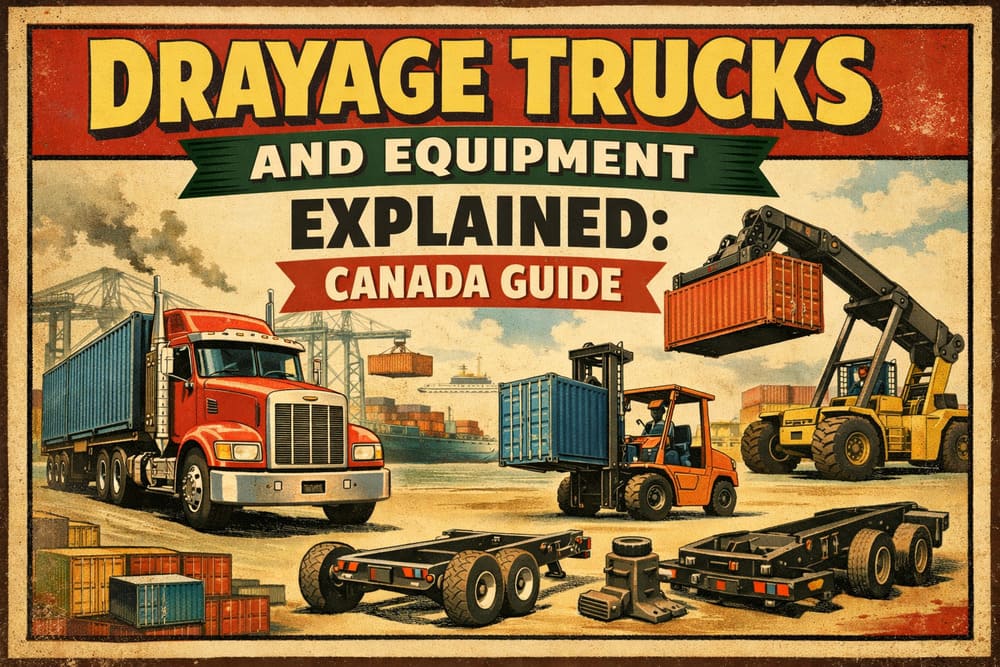
Booking drayage and getting the wrong equipment at the terminal gate is one of the most avoidable delays in container logistics. The container sits. Free time runs. The carrier returns without picking it up. The importer pays for a problem that a single conversation could have prevented.
Understanding drayage trucks and the equipment types used in Canada is not complicated. This guide explains each piece of equipment, what it is used for, and how to know which one your shipment requires before you book.
What is a drayage truck?
A drayage truck is a tractor unit configured to move shipping containers short distances — typically between a port terminal, rail yard, and nearby warehouse or distribution centre. Drayage trucks differ from standard long-haul trucks in one key way: they are built to work with intermodal equipment, not trailers.
The tractor unit itself is often the same as a highway truck. The difference is in what it pulls. A drayage truck pulls a chassis — a specialized flatbed frame designed to carry a shipping container. Without the correct chassis, the tractor cannot legally or safely move the container.
In Canada, drayage trucks operate under provincial weight and size regulations. They also must meet ELD (Electronic Logging Device) requirements and carry the necessary terminal access credentials for CN and CP rail yards and marine port terminals.
The chassis: the foundation of every drayage move
A chassis is a wheeled steel frame that sits under a shipping container and connects it to the tractor unit. Without a chassis, a container cannot be moved by truck. The chassis type must match the container size and weight.
Standard chassis (20ft and 40ft)
Standard chassis are the most common equipment in Canadian drayage operations. A 20ft chassis carries a 20-foot container (also called a TEU). A 40ft chassis carries a 40-foot container.
Most import containers arriving at Port of Vancouver, Port of Montreal, and CN/CP intermodal terminals in Toronto and Calgary move on standard chassis. These containers carry dry cargo — retail goods, manufactured products, electronics, building materials.
Triaxle chassis
A triaxle chassis has three axle groups instead of the standard two. This configuration allows the chassis to carry heavier loads without exceeding provincial axle weight limits.
Triaxle chassis are required for overweight containers — those loaded beyond the standard payload limit for a two-axle chassis on Canadian roads. This is common for dense cargo types such as steel coils, paper rolls, machinery parts, and packaged stone or tile.
In British Columbia and Ontario, axle weight regulations are strictly enforced. A carrier using a standard chassis for an overweight container risks fines at weigh stations and damage to roads and bridges. Always confirm the loaded weight of your container before booking. Ask the carrier whether a triaxle is required.
53-foot chassis
A 53-foot chassis carries a 53-foot domestic container — a North American-specific container size used for domestic road and rail freight, not ocean shipping. These containers are wider and longer than standard ISO ocean containers.
Importers encounter 53-foot chassis most often at transload facilities, where ocean container cargo is transferred into domestic trailers for inland distribution. The 53-foot unit travels by truck or CN/CP rail to inland distribution centres across Ontario, Quebec, and Alberta.
Genset chassis: keeping reefers running
A genset chassis is a standard or triaxle chassis fitted with a diesel generator set (a genset). The generator provides external power to a refrigerated container (reefer) when the container is not plugged into a terminal power outlet.
Reefer containers maintain temperature-controlled environments for perishable goods, pharmaceuticals, medical devices, seafood, fresh produce, and certain chemicals. They require continuous power to hold temperature during the drayage move.
Without a genset chassis, a reefer container loses power the moment it is unplugged from the terminal outlet. Depending on the cargo, this can cause spoilage, regulatory failure, or rejected delivery within hours.
In Halifax, genset chassis are especially important. The Port of Halifax handles significant volumes of seafood exports and pharmaceutical imports. Carriers serving the Halifax market need active genset capacity to handle these shipments reliably.
Reefer drayage: what it involves
Reefer drayage is the movement of refrigerated containers using genset-equipped chassis and trained drivers. It requires more than just the right equipment. It also requires:
- Pre-trip inspection of the container’s refrigeration unit before pickup
- Active temperature monitoring during the move
- Documentation of temperature logs for cold chain compliance
- Coordination with cold storage facilities on the receiving end
Reefer drayage is common for food importers, pharmaceutical distributors, and biotech companies importing temperature-sensitive materials through Vancouver, Montreal, and Halifax.
Not every drayage carrier operates genset equipment. Confirm this before booking any temperature-controlled shipment.
Flat rack drayage: moving out-of-gauge cargo
A flat rack is a container with no side walls and no roof — only a floor and two end walls. This open structure allows cargo that cannot fit inside a standard container to be loaded from the sides or from above.
Flat rack drayage is used for oversized and out-of-gauge cargo, including:
- Industrial machinery and heavy equipment
- Wind turbine components
- Steel structural sections and girders
- Construction equipment such as excavators and cranes
- Vehicles and rolling stock
Moving a flat rack container on Canadian roads often requires additional planning. The cargo may exceed standard height or width limits, which triggers permit requirements. In some cases, escort vehicles are needed. The carrier must plan the route in advance to avoid low bridges, weight-restricted roads, and urban areas with clearance restrictions.
If your cargo does not fit in a standard container, flat rack is the answer. However, confirm that the drayage carrier has experience with out-of-gauge moves and the necessary permits before booking.
Open-top containers and open-top drayage
An open-top container has a removable tarpaulin roof instead of a fixed top. This allows tall or irregularly shaped cargo to be loaded by crane from above.
Open-top drayage is used for cargo that is too tall for a standard container but does not need the full open-side access of a flat rack. Common examples include bulk machinery, large coils, and tall palletized loads.
Like flat rack moves, open-top containers that exceed height limits require permits and route planning.
How to match equipment to your shipment
Most importers do not need to specify equipment themselves — a competent drayage carrier will ask the right questions and confirm equipment. However, knowing what to expect helps you verify that your carrier is asking the right questions.
Here is a simple matching guide:
| Cargo type | Equipment needed |
|---|---|
| Standard dry goods — retail, electronics, packaged products | Standard chassis (20ft or 40ft) |
| Heavy or dense cargo — steel, machinery, paper, stone | Triaxle chassis |
| Temperature-sensitive — pharma, food, produce | Genset chassis + reefer container |
| Oversized or no fixed dimensions — industrial equipment | Flat rack or open-top |
| Domestic distribution after transload | 53-foot chassis |
When booking drayage, provide the carrier with the container number, container type, and the weight of the loaded container. These three pieces of information allow the carrier to confirm the correct chassis before pickup, not at the gate.
Equipment availability in Canada: what importers should know
Not every drayage carrier in Canada operates the full range of equipment. Many small regional carriers only maintain standard chassis. Genset units, triaxle chassis, and flat rack capability require investment and trained drivers.
In peak seasons — May through October and again in January — standard chassis availability tightens in Vancouver and Toronto even for carriers with private fleets. Pool chassis shortages cause delays for carriers who do not own their own equipment.
Metropolitan Logistics operates a private chassis fleet across all major Canadian terminals. This includes standard chassis, triaxle chassis for overweight loads, and genset-equipped chassis for reefer containers. The fleet operates at Deltaport, Centerm, and Vanterm in Vancouver, CN MacMillan Yard and CP Vaughan in Toronto, Port of Montreal, CN Halifax Intermodal, and CN Calgary Logistics Park.
If your shipment involves anything other than a standard dry container, confirm equipment availability with your carrier before the vessel arrives — not after.
Ready to confirm equipment for your next drayage move?
Metropolitan Logistics handles container drayage operations across Canada with a full range of chassis types. Standard, triaxle, genset, and flat rack capability at all major terminals — Vancouver, Toronto, Montreal, Halifax, and Calgary.
Frequently asked questions
What is a drayage truck?
A drayage truck is a tractor unit that moves shipping containers short distances between ports, rail terminals, and warehouses. It differs from a long-haul truck in that it operates with a chassis — a wheeled steel frame that carries the container. The tractor itself may be similar to a highway unit, but the chassis type changes depending on the container size, weight, and cargo type. Learn more about how drayage works in Canada.
What is a chassis in drayage?
A chassis is a wheeled steel frame that connects a shipping container to the tractor unit. Standard chassis carry 20ft and 40ft containers. Triaxle chassis carry overweight containers. Genset chassis carry reefer containers and provide generator power during the move. 53-foot chassis carry domestic containers used in transloading and inland distribution. Without the correct chassis, a drayage carrier cannot pick up the container.
What is reefer drayage?
Reefer drayage is the transportation of refrigerated containers using genset-equipped chassis. The generator provides continuous power to the container’s refrigeration unit throughout the move. Reefer drayage is required for temperature-sensitive cargo such as pharmaceuticals, fresh food, seafood, and medical supplies. Not all drayage carriers operate genset equipment — confirm this before booking. See also: container drayage services across Canada.
When is a triaxle chassis required for drayage in Canada?
A triaxle chassis is required when a loaded container exceeds the weight limit for a standard two-axle chassis under provincial road regulations. This applies most often to dense cargo types — steel, paper, machinery, and heavy industrial goods. Carriers must confirm the loaded container weight before dispatch. Using a standard chassis for an overweight load risks fines at weigh stations and road damage liability. Always provide the gross weight of your container when booking drayage.
What is flat rack drayage?
Flat rack drayage is the transportation of open-frame containers carrying oversized or out-of-gauge cargo that cannot fit inside a standard enclosed container. Flat racks have no side walls or roof, allowing loading from the sides or from above by crane. Common cargo includes industrial machinery, construction equipment, and structural steel. Flat rack moves often require permits and route planning due to cargo dimensions exceeding standard road limits. See how drayage compares to other container services.