
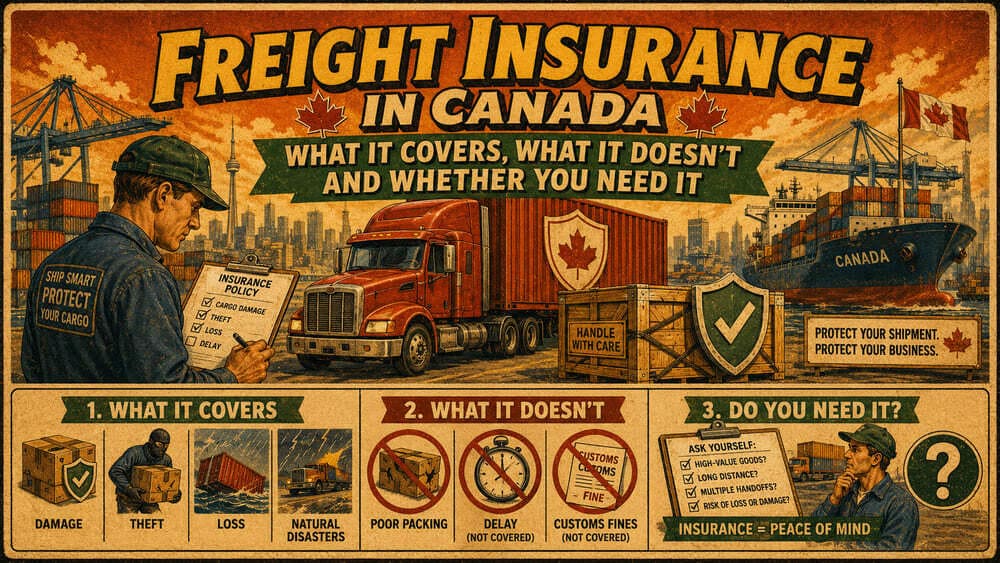
Freight insurance Canada decisions matter because cargo can move through several carriers, terminals, warehouses, vessels, rail ramps, trucks, and handling points before it reaches the buyer. Many importers assume carrier liability gives full protection. However, carrier liability and cargo insurance are not the same thing. That difference can become expensive when a shipment gets damaged, lost, delayed, or mishandled.
This guide explains what freight insurance usually covers, what it does not cover, and when Canadian importers should consider it. It also shows how insurance planning connects with packaging, documentation, freight forwarding, customs clearance, and final delivery.
What is freight insurance Canada?
Freight insurance Canada means cargo insurance arranged to help protect goods moving to, from, or within Canada against covered physical loss or damage during transit. Importers, exporters, manufacturers, distributors, and retailers often use it when the shipment value, route, cargo type, or handling risk justifies extra protection.
Freight insurance does not replace good logistics planning. Instead, it supports risk management when goods move through a complex supply chain. The policy wording, insured value, route, exclusions, deductibles, and claims requirements determine the actual protection.
Key freight insurance terms
Cargo insurance is insurance that may cover physical loss or damage to goods during transit, subject to the policy terms.
Carrier liability is the limited responsibility a carrier may have under transport contracts, bills of lading, tariffs, conventions, or laws. It often has limits and may not equal the full cargo value.
Declared value is the value the shipper or importer states for insurance, customs, or carrier purposes. The declared value should match documents and commercial reality.
All-risk coverage often means broad cargo coverage, but it still has exclusions. Importers should read the policy wording because “all-risk” does not mean every possible loss.
General average is a maritime principle where cargo owners may share certain costs when a vessel sacrifices cargo or incurs extraordinary expenses to save the voyage. This can affect ocean shipments.
Why freight insurance matters for Canadian importers
Freight insurance matters because international and domestic shipments can face damage, theft, water exposure, fire, mishandling, shortage, derailment, vessel incidents, warehouse incidents, and delivery problems. However, many importers only think about insurance after a loss occurs.
Carrier liability may not cover the full cargo value
Carrier liability often comes with limits. A carrier may only accept responsibility under specific conditions, and the payout may depend on weight, package count, contract terms, or proof of fault. As a result, the carrier’s liability may fall far below the commercial value of the goods.
Importers should not assume that a freight invoice, bill of lading, or tracking number creates full protection. Instead, they should ask what liability applies and whether separate cargo insurance makes sense for the shipment.
Multi-modal freight adds more handoffs
Canadian importers often move goods through ocean, rail, truck, warehouse, drayage, and final delivery steps. Each handoff creates another point where cargo can face handling risk.
For example, a shipment may travel from an overseas factory to a port, load on a vessel, discharge in Vancouver, move by rail to Toronto, transfer to a warehouse, and deliver by truck to a buyer. Therefore, insurance decisions should reflect the full route, not only the ocean leg.
High-value and time-sensitive cargo increases exposure
Some shipments need stronger risk planning because they carry high commercial value or tight deadlines. This can include industrial machinery, electronics, medical equipment, retail displays, event freight, seasonal inventory, replacement parts, and project cargo.
If cargo arrives damaged, the importer may lose more than the product value. The business may also face missed sales, production downtime, contractor delays, or customer penalties. Freight insurance may not cover every indirect loss, but it can still reduce the financial impact of covered physical damage.
How freight insurance Canada works step by step
A freight insurance decision should follow a practical process. Each step helps the importer understand risk, coverage, and claims requirements before the shipment moves.
- Identify the cargo value
Start with the commercial invoice value. Then consider freight, duty, tax, and expected replacement cost. Some policies insure cargo at invoice value plus freight and a percentage uplift. However, the exact insured value depends on the policy. - Review the route and transport modes
Map the full route from origin to final delivery. Include truck pickup, port handling, ocean or air freight, rail movement, drayage, warehousing, cross-docking, and last-mile delivery. More modes and handoffs usually create more exposure. - Check carrier liability first
Ask what carrier liability applies to the shipment. Review the bill of lading, service terms, tariff limits, and any contractual limits. This helps the importer see whether carrier liability protects the cargo adequately. - Decide whether cargo insurance fits the shipment
Compare the cargo value, route risk, replacement time, packaging quality, delivery deadline, and business impact. If the loss would create a serious financial problem, cargo insurance often deserves review. - Confirm coverage before pickup
Arrange insurance before the cargo begins transit. Many insurers will not cover a shipment after a known loss, delay, or damage event. Therefore, importers should request coverage early. - Document the cargo and packaging
Take photos, keep packing records, confirm piece counts, and store copies of invoices and transport documents. These records can support a claim if damage or shortage occurs. - Inspect the shipment on arrival
Check the cargo before signing clean delivery paperwork. Note visible damage, shortage, wet packaging, broken seals, crushed cartons, or missing pieces. In addition, take photos before moving or unpacking damaged cargo. - Report claims quickly
Notify the freight forwarder, carrier, insurer, and other required parties within the policy timeline. Keep the cargo, packaging, documents, and photos available for inspection. Fast reporting can protect the claim process.
What freight insurance usually covers and excludes
Freight insurance can cover many physical cargo risks, but coverage depends on the policy. Importers should review policy wording instead of relying on general assumptions.
| Area | Often covered when policy terms apply | Often excluded or limited | What importers should check |
|---|---|---|---|
| Physical damage | Breakage, impact damage, crush damage, handling damage | Poor packing, inherent vice, pre-existing damage | Packaging requirements and inspection rules |
| Loss or shortage | Missing packages or covered theft events | Inventory errors, unexplained shortage without evidence | Piece counts, seal records, and delivery notes |
| Water exposure | Some water damage during covered transit events | Condensation, poor moisture protection, inadequate packing | Moisture controls and packaging records |
| Theft | Theft during covered transit or storage periods | Unattended cargo or security breaches outside policy terms | Security conditions and route exposure |
| General average | May cover cargo owner contribution under marine policy terms | Not applicable to every shipment or policy | Ocean freight clauses and documentation |
| Delay | Usually not covered as a standalone loss | Lost profit, missed sales, late delivery penalties | Whether delay-related loss has any coverage extension |
| Customs issues | Usually not cargo damage coverage | Duties, fines, rejected documents, compliance errors | Separate customs and compliance planning |
Covered physical loss or damage
Freight insurance usually focuses on physical loss or damage to cargo during the covered transit period. This may include impact damage, theft, fire, vessel incidents, overturns, or certain handling losses when the policy terms apply.
However, coverage does not remove the need for proper packing. If the shipper uses weak cartons, poor pallets, or inadequate blocking, the insurer may challenge the claim. Therefore, cargo protection starts before the insurance certificate.
Common exclusions and limitations
Common exclusions may include poor packing, inherent vice, ordinary leakage, delay, loss of market, rejected paperwork, pre-existing damage, and certain unattended or unsecured cargo conditions. Inherent vice means a natural quality of the product that causes it to deteriorate or fail without an external accident.
Importers should also check deductibles, valuation method, coverage territory, storage limits, and claim deadlines. A policy can look strong at a high level but contain conditions that matter during a claim.
Delay and business interruption
Many importers want insurance to cover the business impact of delay. However, standard cargo insurance often focuses on physical loss or damage, not lost sales or project penalties.
If a delay would create major financial exposure, importers should discuss that risk before shipment. They may need a different risk strategy, stronger logistics planning, or specific insurance advice from a qualified broker.
Freight insurance vs carrier liability: the practical difference
Freight insurance and carrier liability solve different problems. Importers need to understand both before they decide how much risk to keep.
Carrier liability is limited
Carrier liability depends on the carrier, mode, contract, tariff, bill of lading, and applicable rules. The carrier may not owe the full invoice value even when cargo suffers damage.
In addition, the importer may need to prove that the carrier caused the loss. This can become difficult when cargo moves through several parties and handling points.
Cargo insurance protects the insured interest
Cargo insurance focuses on the insured cargo interest under the policy wording. When a covered loss occurs, the claim usually follows the policy terms instead of relying only on carrier fault.
This can simplify risk planning for higher-value shipments. However, the importer still needs clear documents, proper packaging, and timely claim reporting.
Both still need documentation
Neither carrier liability nor cargo insurance works well without documentation. Importers should keep commercial invoices, packing lists, bills of lading, delivery receipts, photos, inspection notes, and email records.
If damage appears at delivery, the receiver should write exceptions on the delivery receipt. A clean signature can make a claim harder to support.
Canadian context: Vancouver, Toronto, Montreal, Halifax and Calgary
Freight insurance Canada planning should reflect the route, cargo type, and regional handling points. Shipments can move through ports, rail terminals, highways, warehouses, and last-mile delivery networks before final receipt.
Vancouver import and export freight
Vancouver often handles Pacific trade lanes, containerized imports, exports, and rail-linked inland movement. Cargo may transfer from vessel to rail, truck, warehouse, or inland terminal.
Because the route may involve several handoffs, importers should review packaging, moisture protection, and insurance before shipment. This matters for electronics, machinery, retail goods, and project cargo.
Toronto, GTA and Brampton distribution
Toronto, the GTA, and Brampton support major import distribution, warehousing, retail networks, and industrial deliveries. Shipments may arrive from Vancouver, Montreal, Halifax, or the U.S. border before final delivery.
Insurance decisions should consider warehouse receiving, cross-docking, pallet condition, and delivery appointment risk. In addition, higher-value inventory should have clear receiving procedures and damage reporting rules.
Montreal freight movement
Montreal supports ocean freight, inland distribution, Quebec deliveries, and Eastern Canada logistics. Cargo can move through port terminals, rail ramps, warehouses, and final delivery routes.
Importers should check whether coverage continues during temporary storage or only during active transit. This detail matters when cargo waits for customs release, appointment scheduling, or final delivery.
Halifax and Atlantic Canada
Halifax can support ocean freight, Atlantic Canada distribution, and inland movement toward central Canada. Some shipments may travel long distances after port arrival.
Because of that distance, importers should review full-route coverage and not only port-to-port exposure. Final-mile delivery can still create damage or shortage risk.
Calgary and Western Canada shipments
Calgary often receives freight through Vancouver by rail or truck. Shipments may continue to construction sites, industrial facilities, retail DCs, or project locations across Alberta.
For high-value cargo, the importer should review coverage through inland movement and delivery. This matters when freight moves beyond a warehouse to a remote site or project location.
How Metropolitan Logistics supports freight insurance Canada decisions
Metropolitan Logistics supports freight insurance Canada decisions by helping shippers understand the logistics risk around route, cargo type, packaging, handling points, and delivery timing. For importers and exporters, freight forwarding services can connect transportation planning, documentation coordination, customs-related handoffs, and insurance discussions before the shipment moves.
Metropolitan Logistics can also support ocean freight forwarding for international cargo moving by FCL or LCL. FCL means full container load, where one shipper uses the container. LCL means less than container load, where multiple shippers share container space.
Packaging and damage prevention
Insurance works best with strong cargo preparation. Metropolitan Logistics can connect freight planning with crating and export packaging when cargo needs stronger protection before transit.
This matters for industrial machinery, fragile equipment, retail fixtures, trade show freight, and high-value goods. Better packaging can reduce claim risk and protect the shipment before any insurance issue arises.
Drayage, warehousing and route control
Metropolitan Logistics can support risk control through yard facilities, a private chassis fleet, CN/CP direct access, ELD-equipped fleet operations, and 24/7 dispatch support. CN means Canadian National Railway, while CP means Canadian Pacific Kansas City.
These capabilities can help when shipments move through Canadian ports, rail terminals, warehouses, and final delivery points. In addition, drayage and intermodal services can support container movement where timing, free time, and delivery control matter.
Claim-ready shipment records
Good records help when a cargo issue occurs. Shipment photos, packing records, seal numbers, delivery notes, and exception reports can support the claim process.
Metropolitan Logistics can help shippers organize freight movement and documentation handoffs. However, insurance coverage and claim decisions always depend on the policy wording, insurer requirements, and the facts of the loss.
Common freight insurance mistakes
Many freight insurance mistakes happen because importers treat insurance as an afterthought. However, risk planning should start before pickup.
Assuming carrier liability equals full insurance
Carrier liability and cargo insurance are different. Carrier liability may have limits, exclusions, and proof requirements.
Importers should ask what protection applies before shipping. If the shipment has high value or high replacement risk, separate cargo insurance may deserve review.
Buying insurance after the shipment starts moving
Insurance should be arranged before transit begins. Once cargo leaves the origin, the importer may lose the chance to place coverage for that shipment.
Teams should include insurance decisions in the booking workflow. This prevents last-minute confusion after the freight has already moved.
Underinsuring the shipment
Underinsurance can create problems during a claim. If the insured value does not match the commercial exposure, the payout may fall short.
Importers should review invoice value, freight cost, duty, tax, replacement timing, and any allowed uplift. They should also make sure the declared value matches supporting documents.
Ignoring packaging requirements
Poor packaging can weaken a claim. Insurers may review whether the cargo had suitable packing for the route, mode, weight, fragility, and handling conditions.
Therefore, fragile, heavy, moisture-sensitive, or high-value goods need a packaging plan. Photos before pickup can also help prove cargo condition.
Missing claim deadlines
Cargo claims have timelines. Late notice can create claim problems even when the damage appears real.
Receivers should inspect freight quickly, note exceptions on delivery paperwork, take photos, preserve packaging, and notify the required parties. Fast action can protect the importer’s position.
Request a freight insurance and shipping quote in Canada
Planning a shipment with high-value cargo, fragile freight, machinery, retail inventory, exhibition materials, or international goods? Share the cargo value, route, mode, packaging details, pickup date, and destination so the shipment can be reviewed for logistics risk, insurance needs, and delivery planning.
Request a freight insurance and shipping quote
Frequently asked questions
What does freight insurance Canada cover?
Freight insurance Canada usually covers physical loss or damage to cargo during covered transit, subject to the policy wording. Coverage may include certain damage, theft, fire, water exposure, or handling incidents when the terms apply. Importers should review exclusions, deductibles, valuation, storage limits, and claim deadlines before shipping.
Is cargo insurance required for Canadian importers?
Cargo insurance is not always mandatory for Canadian importers, but it can make sense when the shipment value, route risk, replacement time, or business impact is high. Carrier liability may not cover the full cargo value. Therefore, importers should compare the cost of insurance against the financial impact of a loss.
What is the difference between freight insurance and carrier liability?
Freight insurance protects the insured cargo interest under the insurance policy. Carrier liability is the carrier’s limited responsibility under transport terms, contracts, tariffs, or laws. Carrier liability may have lower limits and may require proof that the carrier caused the loss.
Does freight insurance cover delays?
Standard freight insurance often does not cover delay as a standalone loss. It usually focuses on covered physical loss or damage to cargo. If delay could cause major financial exposure, importers should discuss that risk before shipping and review whether any specialized coverage or operational strategy applies.
How do I file a cargo insurance claim in Canada?
To file a cargo insurance claim in Canada, inspect the shipment, note damage or shortage on delivery paperwork, take photos, preserve packaging, and notify the required parties quickly. Keep invoices, packing lists, bills of lading, delivery receipts, and correspondence. The insurer or claims team will review the policy terms and evidence before deciding the claim.