
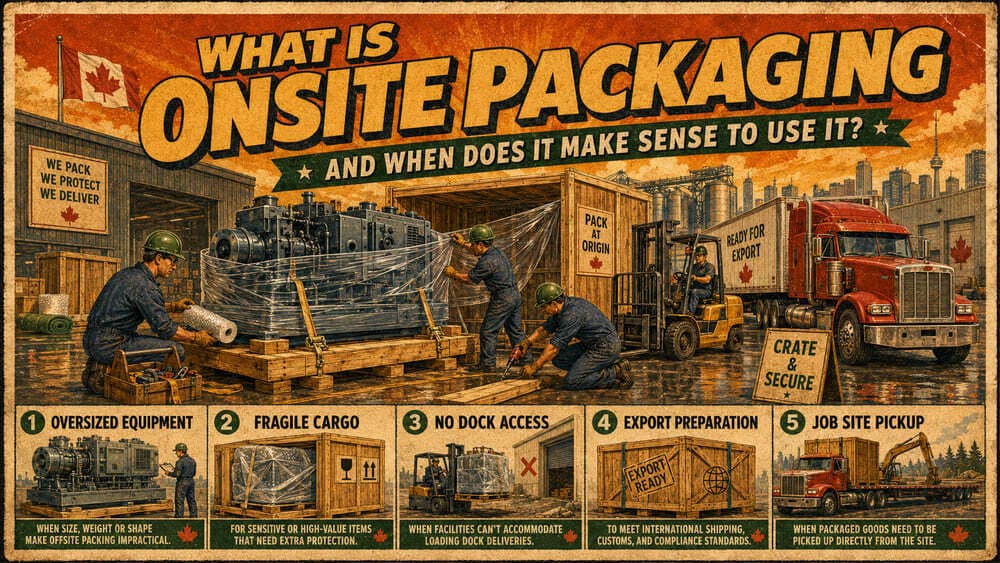
Onsite packaging service Canada projects help companies prepare large, heavy, fragile, or high-value freight at the location where the cargo already sits. Instead of moving machinery, fixtures, equipment, or materials to a separate crating shop first, a packaging team brings tools, materials, and packing expertise to the factory, warehouse, job site, lab, or production floor.
This approach can reduce handling, protect sensitive cargo, and keep complex shipping projects on schedule. It also helps when the freight cannot move safely until crews crate, skid, wrap, block, or brace it. This guide explains what onsite packaging means, when it makes sense, and how Canadian shippers can use it for industrial, commercial, and export freight.
What is onsite packaging service Canada?
Onsite packaging service Canada means professional packaging, crating, skidding, wrapping, blocking, or bracing completed at the shipper’s facility, warehouse, plant, or job site. The service prepares freight for domestic transport, export shipping, storage, relocation, or final delivery without first moving the cargo to an offsite packaging location.
Companies often use onsite packaging when cargo is too large, delicate, urgent, or expensive to move unprotected. It can support industrial machinery, medical equipment, electronics, retail fixtures, trade show displays, warehouse assets, plant equipment, and project cargo.
Key onsite packaging terms
Onsite crating means building a crate around or near the cargo at the customer’s location. This works well when the freight cannot travel safely before protection.
Skidding means securing cargo to a wooden or engineered base so forklifts, pallet jacks, or cranes can handle it more safely.
Blocking and bracing means securing cargo so it does not shift during truck, rail, ocean, or warehouse movement. This can happen inside a crate, on a skid, or inside a container.
Export packaging means preparing goods for international shipment. For wood packaging, many overseas shipments need ISPM 15-treated and marked materials. ISPM 15 is an international standard for wood packaging used in global trade.
Moisture protection means using materials such as vapor barriers, desiccants, corrosion inhibitors, or sealed wraps to reduce humidity and corrosion risk.
Why onsite packaging matters for industrial shippers
Onsite packaging matters because moving cargo before protection can create unnecessary risk. Heavy equipment, delicate machinery, fragile displays, and sensitive electronics may suffer damage during the first lift, not only during the long-haul shipment.
It reduces unnecessary handling
Every extra move creates another chance for damage. If a machine needs to travel to a crating facility before export, it may require a forklift move, truck move, unloading step, crating step, reloading step, and final delivery to a port or terminal.
Onsite packaging removes some of those handoffs. The packaging team can prepare the cargo where it already sits. As a result, the shipment can move into the transport route with less handling exposure.
It supports large or fixed-position equipment
Some cargo cannot move easily before preparation. Large machines may sit bolted to the floor. Production equipment may need partial disassembly. Warehouse assets may sit inside tight aisles. Construction components may sit at a job site with limited access.
In these cases, onsite packaging gives the shipper more control. The team can assess the cargo, confirm lift points, protect sensitive areas, and build packaging around the actual site conditions.
It protects schedules during plant, warehouse, or project moves
Packaging delays can affect production, installation, export cut-offs, and relocation timelines. Therefore, onsite packaging often makes sense when timing matters.
For example, a manufacturer may need to ship a machine after a production run ends. A warehouse may need to crate equipment before a relocation date. A construction site may need to prepare project cargo during a narrow delivery window. Onsite work can keep those projects moving without sending cargo away for preparation first.
How onsite packaging service Canada works step by step
A strong onsite packaging project follows a clear process. Each step helps the shipper reduce risk before the freight enters domestic or international transport.
- Assess the cargo at the site
Start with the cargo type, dimensions, weight, value, fragility, and destination. The team should also check lift points, centre of gravity, loose parts, surface sensitivity, electronics, fluids, and access restrictions. - Confirm the shipping route and transport mode
Next, confirm whether the cargo will move by truck, rail, ocean freight, air freight, or a combination of modes. The packaging must match the route. Long ocean moves, for example, may need stronger moisture protection than a short local truck move. - Review site access and work conditions
Before the packaging crew arrives, confirm dock access, floor space, ceiling height, forklift availability, power access, safety rules, parking, and work permits. This step prevents delays on packaging day. - Choose the right packaging method
Select the method based on cargo risk. Options can include skids, crates, vapor barriers, shrink wrap, foam, blocking, bracing, shock indicators, tilt indicators, or container securing. - Prepare the cargo before packing
Remove loose parts, secure moving components, protect sharp edges, clean surfaces, label cables, and separate accessories. In addition, document serial numbers and take photos before crews cover the cargo. - Build or apply packaging onsite
The crew builds crates, attaches skids, wraps cargo, adds bracing, or prepares the shipment for loading. For exports, the team should use the required wood materials and markings when international rules apply. - Label and document each piece
Every crate, skid, pallet, or wrapped item should show destination details, piece count, handling marks, orientation marks, and project references. Clear labels help warehouse teams, carriers, customs brokers, and receivers handle the freight correctly. - Coordinate pickup or container loading
After packaging, the shipment may move to a truck, container, rail terminal, warehouse, port, or final receiver. The packaging plan should connect with pickup timing, loading equipment, route needs, and freight documentation.
When onsite packaging makes sense
Onsite packaging makes sense when moving cargo without protection creates more risk, cost, or delay than bringing the packaging team to the cargo. It works especially well for equipment-heavy, space-constrained, or deadline-driven projects.
| Use case | Why onsite packaging helps | Typical planning need |
|---|---|---|
| Industrial machinery | Machines may be heavy, sensitive, bolted down, or difficult to move. | Crating, skidding, blocking, bracing, moisture protection. |
| Factory relocation | Equipment must move in a planned sequence to reduce downtime. | Asset labels, disassembly support, staged pickup, export packing. |
| Warehouse equipment | Racking, conveyors, pack stations, and tools may need sorting and protection. | Zone labels, skids, pallets, staged loading, temporary storage. |
| Medical or lab equipment | Sensitive equipment may need low-vibration and clean handling. | Protective materials, controlled packing, careful documentation. |
| Retail fixtures | Displays, counters, millwork, and signage need surface protection. | Blanket wrap, crates, labels, phased delivery, handling notes. |
| Trade show displays | Booth materials often need repeat-use crates and return shipping plans. | Crates, cases, inventory lists, return labels, storage planning. |
| Export shipments | International rules and long transit increase packaging requirements. | ISPM 15 wood, moisture control, export labels, container loading. |
Large equipment that cannot move safely first
Onsite packaging often becomes the right choice when a machine cannot travel safely before protection. A heavy press, CNC machine, packaging line, compressor, or robotic cell may need skidding and bracing before the first truck move.
This approach can reduce the chance of damage during the earliest handling steps. It also lets the crew account for the machine’s actual position, floor access, and lift requirements.
Facilities with tight timelines
Factories, warehouses, labs, and distribution centres often operate under tight shutdown windows. They may not have time to send freight away for packaging, wait for crating, and bring it back into the shipping flow.
Onsite packaging can support the timeline by completing preparation at the origin. Then the cargo can move directly to storage, a truck, a container, or an export gateway.
Freight that needs export-ready preparation
Export freight often needs stronger packaging than domestic freight. It may face long vessel transit, humidity, terminal handling, inspection, and destination delivery.
When the cargo needs export crating, moisture protection, or container securing, onsite packaging can prepare the shipment at the facility before the international move begins.
Canadian context: Toronto, Vancouver, Montreal, Halifax and Calgary
Onsite packaging service Canada planning changes by region because facilities, ports, rail terminals, warehouses, and project sites operate under different conditions. The best plan should match local access and the shipment route.
Toronto, GTA and Brampton onsite packaging
Toronto, the GTA, and Brampton support manufacturers, warehouses, retail distribution, machinery sellers, and industrial service providers. Many sites need packaging before equipment moves to another Canadian province, a port, or an overseas buyer.
Onsite packaging can help when cargo sits inside a busy facility with limited dock space. It also helps when a shipper needs crating, skidding, or wrapping before a scheduled pickup.
Vancouver onsite packaging
Vancouver connects many exporters with Pacific trade lanes and port-related logistics. Equipment moving through Vancouver may need export-ready packaging before port delivery.
Onsite work can reduce handling when machinery or project cargo already sits at a plant, yard, or warehouse. In addition, moisture protection can matter for shipments that move by ocean freight.
Montreal onsite crating
Montreal supports industrial exporters, manufacturers, and freight moving through Eastern Canada. Onsite crating can help when machinery needs protection before moving to a port, rail terminal, or warehouse.
For export projects, shippers should confirm crate dimensions, markings, and documentation before pickup. This helps the shipment meet transport and destination requirements.
Halifax project and export cargo
Halifax can support Atlantic Canada exporters, industrial projects, port-related cargo, and regional construction needs. Some shipments may move long distances before they reach the final buyer or project site.
Onsite packaging can help protect freight before it enters that route. It also gives shippers a chance to prepare cargo while crews, forklifts, and site contacts are still available.
Calgary and Western Canada industrial sites
Calgary and Western Canada often support energy, construction, manufacturing, agriculture, and infrastructure equipment. Freight may move from a plant, yard, or project site toward Vancouver, another province, or an international destination.
Onsite packaging can help when equipment has unusual dimensions, rough site conditions, or tight move schedules. It can also support staged movement when several assets need preparation in sequence.
How Metropolitan Logistics handles onsite packaging service Canada projects
Metropolitan Logistics supports onsite packaging service Canada projects by bringing packaging planning, materials, and logistics coordination closer to the cargo. The related onsite packaging service can support crating and export packaging at a facility, warehouse, or job site when cargo should not move unprotected.
Metropolitan Logistics can also connect onsite work with broader crating and export packaging services. This matters when shippers need ISPM 15-compliant wood packaging, industrial skids, moisture protection, custom crates, shrink wrap, or cargo protection before shipping.
Industrial and machinery packaging support
For heavy, delicate, or high-value machinery, industrial machinery packaging can support custom crating, skidding, blocking, bracing, and export-ready preparation. This helps manufacturers, riggers, freight forwarders, and exporters prepare cargo for domestic or international movement.
Metropolitan Logistics can coordinate with plant teams, riggers, warehouse staff, carriers, and freight forwarders. As a result, the packaging plan can align with disassembly, pickup, container loading, and shipping deadlines.
Warehousing, container loading and transport coordination
Onsite packaging often connects with the next logistics step. The cargo may move to storage, a cross-dock, a rail terminal, a port, a customer site, or an overseas destination.
Metropolitan Logistics can support this flow through yard facilities, a private chassis fleet, CN/CP direct access, ELD-equipped fleet operations, and 24/7 dispatch support. CN means Canadian National Railway, while CP means Canadian Pacific Kansas City. In addition, ocean freight forwarding can support export shipments after the packaging stage.
Common mistakes with onsite packaging projects
Most onsite packaging mistakes happen before the crew arrives. Shippers can avoid delays by preparing cargo details, access information, and the shipping plan early.
Booking packaging without cargo details
A packaging team needs accurate dimensions, weight, photos, value, fragility, and destination information. Without those details, the team may bring the wrong materials or design the wrong protection.
Shippers should also identify loose parts, sharp edges, electronics, fluids, and sensitive surfaces. These details change the packaging method.
Ignoring site access constraints
Site access can affect the entire project. Low ceilings, narrow aisles, blocked docks, limited forklift capacity, or safety rules can slow down work.
Before the crew arrives, the shipper should confirm workspace, equipment availability, parking, permits, power access, and site contacts. This keeps the packaging day productive.
Using domestic packing for export freight
Export freight often needs stronger protection than local freight. It may face ocean humidity, terminal handling, long dwell times, and international wood packaging rules.
Shippers should confirm whether the cargo needs ISPM 15-compliant wood, moisture protection, crate markings, or container blocking. This prevents last-minute rework before shipping.
Separating packaging from the transport plan
Packaging should match the transport route. A crate designed for a short truck move may not suit ocean freight or multiple handling points.
Therefore, shippers should connect the packaging plan with pickup, loading, carrier requirements, port cut-offs, customs documents, and destination handling. This creates a safer and more practical shipment.
Request an onsite packaging quote in Canada
Need industrial equipment, machinery, fixtures, warehouse assets, or export freight packed at your facility? Share the cargo type, dimensions, weight, photos, pickup location, destination, deadline, and transport mode so the packaging plan can match the shipment route.
Request an onsite packaging quote
Frequently asked questions
What is onsite packaging service Canada?
Onsite packaging service Canada means professional crating, skidding, wrapping, blocking, or bracing completed at the customer’s facility, warehouse, plant, or job site. It helps prepare cargo for domestic shipping, export freight, storage, relocation, or final delivery. Companies often use it when freight should not move unprotected.
When should I use on-site crating industrial services?
Use on-site crating industrial services when equipment is large, fragile, high-value, fixed in place, or difficult to move before packaging. It also makes sense during factory moves, warehouse relocations, export shipments, and project deadlines. The service reduces unnecessary handling and prepares cargo at the origin.
Is onsite packaging better than offsite crating?
Onsite packaging works better when cargo cannot move safely before protection or when the schedule does not allow offsite preparation. Offsite crating can still work for smaller items that can travel safely to a packaging facility. The right choice depends on cargo size, risk, access, timing, and shipping route.
Does onsite packaging work for export shipments?
Yes, onsite packaging can work for export shipments when the cargo needs crating, skidding, moisture protection, or container preparation before it leaves the facility. Export shipments may also need ISPM 15-compliant wood packaging. Shippers should confirm destination requirements before packing begins.
What information do I need for an onsite packaging quote?
For an onsite packaging quote, provide cargo dimensions, weight, photos, value, destination, shipping mode, deadline, and site access details. Also mention whether the cargo has electronics, fluids, loose parts, sensitive surfaces, or special lifting points. These details help the packaging team plan materials, labour, and timing.