
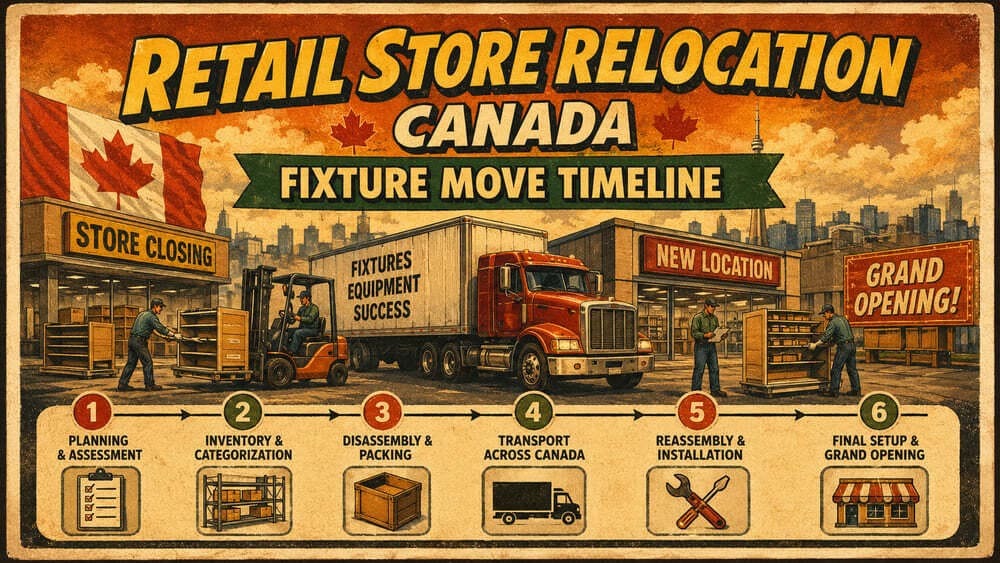
Retail store relocation Canada projects need more planning than ordinary commercial moves. A store move involves fixtures, inventory, signage, backroom stock, point-of-sale equipment, contractors, and reopening deadlines. One missed delivery window can delay merchandising, staff scheduling, inspections, and the first day of sales.
Therefore, retail chains and franchise operators need a clear logistics timeline before teams pack the first carton. This guide explains how a Canadian store relocation works, how to protect fixtures and inventory, and how to plan each step around the target reopening date.
What is retail store relocation Canada?
Retail store relocation Canada means the planned movement of a physical store’s fixtures, inventory, equipment, signage, and operating materials from one Canadian location to another. The project may involve one boutique, a franchise branch, a mall unit, a flagship store, or several locations in a regional rollout.
A retail relocation must protect revenue continuity. Shelving, display systems, point-of-purchase units, branded millwork, and inventory need to arrive in the correct order. As a result, the logistics plan must match the merchandising plan, lease dates, contractor schedule, and reopening target.
Key retail relocation terms
Fixtures are store assets such as shelving, gondolas, counters, display cases, racks, and branded furniture. Inventory means the sellable product that store teams count, pack, move, receive, and reconcile.
Staging means holding and sequencing goods before final delivery. Cross-docking means transferring freight from one truck or dock area to another with little or no long-term storage. In addition, a planogram is a visual layout that shows where products should sit in the store.
Why retail store relocation matters for Canadian operators
A retail relocation matters because downtime affects sales, customer expectations, staff scheduling, and brand presentation. However, the biggest risk does not always come from the distance. Poor sequencing can create delays even when the new store sits nearby.
Downtime affects revenue and reopening plans
Retail operators usually plan openings around marketing campaigns, staff rosters, lease commitments, and seasonal demand. Therefore, fixture delays can create a chain reaction. If shelving arrives late, inventory cannot move to the floor. If inventory arrives too early, it can block contractors and slow down setup.
A strong relocation plan protects the critical path. The critical path means the sequence of tasks that directly controls the opening date. For many stores, that path includes fixture removal, fixture delivery, sales floor buildout, inventory receiving, merchandising, point-of-sale testing, and final walkthroughs.
Canadian geography changes the timeline
In Canada, retail chains often manage long distances between distribution centres, warehouses, and stores. A move from a Toronto-area warehouse to a Calgary store needs a different timeline than a short move inside the Greater Toronto Area. Similarly, a Vancouver mall relocation may involve restricted dock hours, after-hours delivery rules, and building access requirements.
For that reason, every plan should begin with site constraints, not only truck availability. Teams should confirm loading zones, dock appointments, elevator windows, mall rules, insurance certificates, and security procedures before they lock the move date.
Fixtures and inventory need different handling plans
Retail fixtures create special handling challenges. Some pieces are bulky but fragile. Others have modular parts that teams must disassemble, label, and rebuild in the correct zone. Moreover, branded millwork, counters, glass displays, and signage may need protective packaging or custom crating before transport.
Inventory adds another layer. Store operators must decide whether to move all stock, liquidate slow-moving product, transfer product to another branch, or stage inventory at a warehouse. Consequently, a good relocation plan should reduce both transportation risk and inventory confusion.
Planning note: Retail store moves should operate as logistics projects, not simple moving jobs. The best timeline connects lease dates, contractor work, fixture readiness, inventory counts, dock appointments, and reopening tasks.
How retail store relocation Canada works step by step
A successful store relocation follows a controlled sequence. Each step should create a clear handoff before the next team starts work.
- Define the relocation scope
First, confirm what must move. The scope should separate fixtures, inventory, point-of-sale equipment, backroom materials, signage, décor, tools, and waste. In addition, decide what the team will discard, recycle, store, or transfer to another location. - Build a store move inventory
Next, create a detailed inventory of assets and products. Photograph fixtures, tag them, and group them by department or zone. Count inventory before packing so the receiving team can verify arrivals and identify exceptions quickly. - Confirm site access and timing
Before booking transport, check dock hours, elevator access, loading zones, mall rules, labour requirements, insurance certificates, and building security procedures. This step matters in Toronto, Vancouver, Montreal, Halifax, and Calgary because many retail sites follow strict property rules. - Disassemble and protect fixtures
Disassemble fixtures only when the move requires it. Bag and label fasteners, brackets, legs, shelves, and hardware. However, fragile or high-value pieces may need export-grade packing, foam, blanket wrap, or custom crates. - Pack inventory by department or planogram
Pack inventory by department, product category, or planogram. This method helps the destination team restock faster. As a result, the store can move from delivery to merchandising with fewer delays. - Stage freight before final delivery
Many retail moves benefit from temporary staging. Fixtures may need to arrive before inventory, while signage and décor may arrive later. In addition, staging reduces congestion when contractors, installers, and staff work at the new store at the same time. - Move freight in the right sequence
The first truck should usually carry floor-critical fixtures, shelving, and equipment that the team needs to build the sales floor. Then, inventory can follow once the space can receive it. Consequently, the receiving team avoids piles of product in unfinished areas. - Verify delivery and reopen
After delivery, teams should inspect fixtures, reconcile inventory, confirm hardware, and remove packaging debris. Finally, the store should complete safety checks, merchandising, point-of-sale testing, and staff walkthroughs before reopening.
Key factors that shape the store relocation timeline
The timeline depends on store size, distance, fixture complexity, inventory volume, and destination readiness. However, many delays come from access problems, missing labels, incomplete packing, or poor sequencing.
| Factor | Why it matters | Planning recommendation |
|---|---|---|
| Store size | Larger stores have more fixtures, inventory zones, backroom materials, and staff handoffs. | Build a department-by-department move list and assign responsibility for each area. |
| Fixture type | Gondolas, glass displays, millwork, kiosks, and counters need different handling methods. | Separate standard shelving from fragile, branded, or custom-built pieces. |
| Inventory volume | Teams must count, pack, transport, and reconcile inventory at the new site. | Use labelled cartons, pallet IDs, and department codes to reduce receiving errors. |
| Access restrictions | Malls, downtown locations, and plazas may limit delivery hours or truck access. | Confirm dock appointments, elevator windows, insurance requirements, and security rules early. |
| Distance | Intercity and interprovincial moves need longer lead times and tighter transport planning. | Plan linehaul, staging, and delivery windows as separate phases. |
| Reopening date | Opening delays affect staffing, marketing campaigns, lease commitments, and customer traffic. | Work backward from the opening date and add buffer for receiving, setup, and inspections. |
Local store moves
A smaller local store move may need several days of physical execution after the planning stage. However, the team still needs a written schedule. Even a short move can fail if fixtures arrive before the new space can receive them.
Local moves also require careful dock planning. In busy retail areas, property managers may allow deliveries only during specific time windows. Therefore, operators should confirm these rules before they schedule labour.
Multi-location and franchise moves
Multi-location projects need a stronger control system. Each store may have a different lease date, fixture list, inventory level, and reopening target. As a result, the relocation team should track each location separately.
Franchise operators should also protect brand consistency. Fixtures, signage, counters, and customer-facing displays must support the same store experience after the move. Therefore, each location should have a checklist for critical assets and visual standards.
Canadian timeline for Vancouver, Toronto, Montreal, Halifax and Calgary
Canadian retail relocation planning should reflect geography and local site conditions. The country’s size makes sequencing especially important when fixtures and inventory move between provinces.
Toronto and the GTA/Brampton
Toronto and the GTA/Brampton often involve high-volume retail distribution, mall sites, plaza stores, and warehouse-supported moves. Because the region has heavy traffic and strict receiving windows, operators should confirm loading access and delivery timing before the physical move.
Brampton can also support staging near major freight corridors when stores need phased delivery. This can help chains move fixtures first, then release inventory once the new store team finishes the floor setup.
Vancouver
Vancouver relocations often require careful coordination around urban delivery restrictions, port-area congestion, and mall access rules. Moreover, stores receiving fixtures from suppliers or distribution centres may need staging before final delivery.
This staging step can reduce delays at the retail site. It also gives the receiving team more control when the property allows only limited delivery windows.
Montreal
Montreal retail moves may involve bilingual labelling, dense downtown access, and scheduled receiving windows. In addition, operators moving inventory across Quebec or into Ontario should keep cartons, fixture tags, and receiving documents easy for both teams to follow.
Clear labels matter when multiple crews handle the same assets. Therefore, fixture IDs, room names, department codes, and delivery notes should follow one naming system.
Halifax
Halifax can support Atlantic Canada store openings, regional distribution, and import-supported retail projects. Because the region may have longer inbound lead times from central Canada, fixture readiness and delivery sequencing should start early.
Operators should also plan buffer time for final-mile delivery. This helps teams avoid last-minute congestion at the store site.
Calgary
Calgary relocations often support Alberta retail networks and franchise operators expanding across Western Canada. Since distance from central warehouses can affect timing, staged deliveries and accurate receiving plans help prevent store congestion.
For larger moves, operators should separate long-haul transport from final delivery. This gives the destination team more flexibility when contractors or installers adjust the buildout schedule.
How Metropolitan Logistics handles retail store relocation Canada projects
Metropolitan Logistics supports retail store relocation Canada projects by connecting transportation, staging, fixture handling, and inventory movement into one coordinated plan. For stores that need fixture delivery or setup support, the related retail fixture logistics service can support displays, shelving, POP units, cabinetry, and branded retail assets.
For larger commercial moves, warehouse relocation services can support equipment, racking, staged inventory, and operational handoffs. This matters when a store move connects with a distribution centre, backroom reset, or broader network change.
Planning, staging and transportation support
The logistics approach can include yard facilities for staging, a private chassis fleet for container-related moves, direct access to CN and CP rail networks where intermodal transport fits the route, ELD-equipped fleet operations, and 24/7 dispatch support. CN means Canadian National Railway, while CP means Canadian Pacific Kansas City.
These rail networks can support long Canadian corridors when fixtures or inventory move between regions. In addition, dispatch visibility helps teams coordinate pickup, staging, and delivery windows around retail site access rules.
Sequencing for fixtures and inventory
For retail operators, controlled sequencing creates the main advantage. Metropolitan Logistics can stage fixtures before delivery, separate inventory by department, and schedule final-mile delivery around site rules.
In addition, cross-docking services can help when freight must move quickly between inbound transport, staging, and store delivery without long-term storage. This approach can reduce handling time and keep the project aligned with the reopening schedule.
Common mistakes during retail store relocation
Many retail relocation problems start before the first truck arrives. However, operators can prevent most issues with early planning and clear documentation.
Packing and labelling mistakes
Packing inventory without a store map slows down receiving and creates extra labour during merchandising. Teams should pack by department, product category, or planogram when possible.
Mixing hardware from different fixtures creates another common problem. Small parts should stay bagged, tagged, and connected to the correct fixture group. Otherwise, installers may lose time searching for parts during setup.
Timing and site access mistakes
Moving fixtures before confirming the new layout can create major delays. Shelving and displays may arrive before the space can receive them. As a result, crews may need to move the same items multiple times.
Ignoring dock and building rules can also disrupt the schedule. Missed appointments may delay unloading and increase labour time. Therefore, teams should confirm dock hours, elevator windows, certificates of insurance, and property rules before move day.
Sequencing mistakes
Using one truck sequence for everything often creates congestion. Fixtures, inventory, signage, and décor usually need different delivery priorities.
Operators should also avoid treating every item as equal. A checkout counter, main display wall, or branded entrance feature may matter more than backroom shelving. Therefore, teams should identify critical-path assets before packing begins.
Request a retail store relocation quote in Canada
Planning a store move, fixture transfer, franchise relocation, or multi-location retail rollout? Share the origin, destination, fixture list, inventory scope, and target reopening date so the move can follow your operating timeline.
Request a retail relocation quote
Frequently asked questions
How do you relocate a retail store in Canada?
To relocate a retail store in Canada, start with a full scope of fixtures, inventory, signage, equipment, and backroom materials. Then build a timeline for packing, staging, transport, delivery, setup, and reopening. In addition, confirm building access, dock windows, and insurance requirements before the move date.
How long does retail store relocation take?
A small local store move may need several days of physical work after planning ends. However, larger stores, franchise relocations, and interprovincial moves often need several weeks of planning. The final timeline depends on fixture complexity, inventory volume, distance, and destination readiness.
What is the best way to move retail fixtures Canada-wide?
The best way to move retail fixtures Canada-wide is to tag, photograph, disassemble, protect, and sequence fixtures before transport. Fragile or branded pieces may need blanket wrap, foam, crates, or specialized handling. Moreover, fixtures should usually arrive before inventory so the receiving team can build the sales floor first.
Can inventory move during a store relocation?
Yes, inventory can move during a store relocation, but the team should count and pack it by department, SKU group, or planogram. This helps the destination team restock faster and reduce receiving errors. In some cases, excess inventory can move to a warehouse before the new store can receive it.
What should a retail store move checklist include?
A retail store move checklist should include fixture lists, inventory counts, packing labels, site access rules, dock appointments, insurance documents, delivery sequence, setup tasks, and reopening checks. It should also identify critical-path assets such as checkout counters, primary shelving, signage, and point-of-sale equipment.