
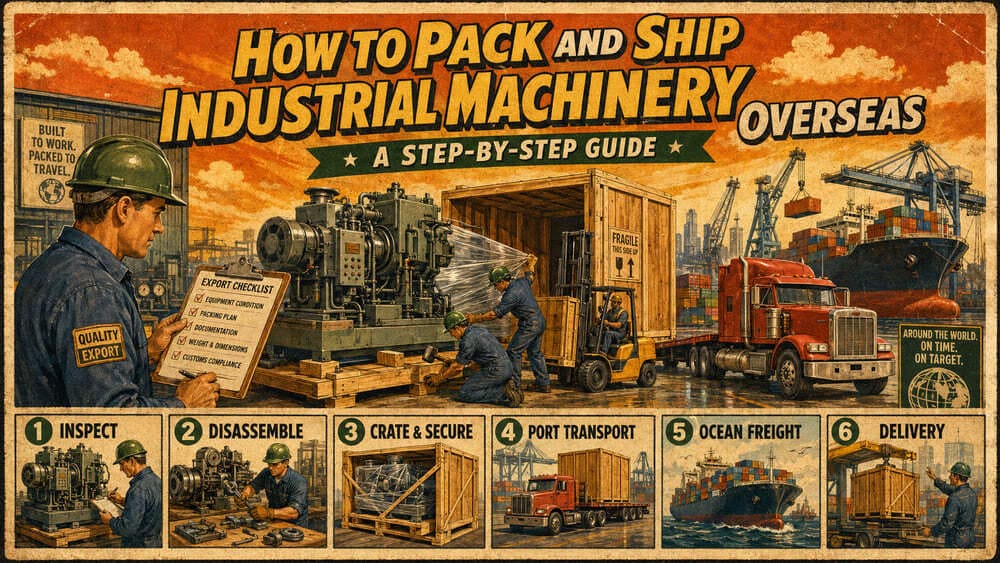
Shipping industrial machinery overseas requires more than booking ocean freight. Manufacturers, exporters, plant managers, and project teams need to protect the machine, prepare export documents, choose the right packaging, coordinate container loading, and plan inland delivery at both ends. One weak crate, missing serial number, or poor blocking plan can create damage, customs delays, and expensive downtime.
This guide explains how to ship industrial machinery internationally from Canada. It covers the full process from machine assessment and export packing to container loading, ocean freight, documentation, and final delivery planning.
What does it mean to ship industrial machinery internationally?
To ship industrial machinery internationally means to prepare, package, document, transport, and deliver commercial machinery from one country to another. The shipment may include CNC machines, presses, production lines, robotics, compressors, pumps, food processing equipment, packaging systems, manufacturing tools, or industrial components.
International machinery shipping combines cargo protection and logistics coordination. The exporter must measure the machine, confirm lifting points, prepare customs documents, select packaging, book freight, and make sure the cargo can handle long-distance movement.
Key machinery shipping terms
Export crating means building a crate or protective structure for international transport. For many overseas moves, exporters use heat-treated wood that meets ISPM 15 standards.
ISPM 15 is an international standard for wood packaging used in global trade. It helps reduce the spread of pests through treated and marked wood packaging.
Blocking and bracing means securing cargo inside a crate, on a skid, or inside a container so it does not shift during transit.
Ocean freight means cargo transportation by vessel. Industrial machinery may move in a standard container, flat rack, open-top container, breakbulk shipment, or roll-on/roll-off service depending on size and loading needs.
Last-mile delivery means the final movement from a port, terminal, warehouse, or yard to the receiver’s facility or job site.
Why proper machinery packing matters for overseas shipping
Proper machinery packing matters because international transport exposes cargo to vibration, lifting, humidity, temperature changes, long dwell times, and multiple handoffs. A machine that moves safely across a warehouse floor may still need major protection before it travels overseas.
Damage risk starts before the vessel sails
Machinery can suffer damage during rigging, forklift handling, crane lifting, truck movement, container loading, port handling, vessel transit, and destination delivery. Therefore, exporters should design the packaging around the full route, not only the first truck move.
A poor packing plan can lead to bent frames, damaged control panels, cracked covers, loose components, corrosion, or alignment problems. In addition, hidden damage may appear only after installation or startup.
Customs and documentation need precise details
International machinery shipping also requires accurate documents. Exporters should provide a commercial invoice, packing list, machine description, serial number, dimensions, weight, country of origin, destination details, and buyer information.
If the machine includes controlled technology, electrical components, software, replacement parts, or attachments, the exporter may need extra review. As a result, document preparation should start before the cargo leaves the facility.
Downtime can cost more than freight
Industrial machinery often supports production, construction, energy, food processing, or infrastructure work. If the equipment arrives damaged or late, the receiver may lose production days.
For that reason, the shipping plan should protect both the machine and the project schedule. Better packing, clearer documentation, and stronger loading control can reduce the chance of delays.
How to ship industrial machinery internationally step by step
A successful machinery export follows a clear sequence. Each step should reduce risk before the next handoff begins.
- Assess the machine before quoting freight
Start with the machine’s make, model, serial number, dimensions, weight, centre of gravity, lifting points, and condition. Also confirm whether the machine contains fluids, batteries, electronics, loose parts, or sensitive controls. These details help the logistics team choose the right packing and transport method. - Confirm the origin, destination, and route
Next, define the pickup address, export port, destination port, and final delivery site. A shipment from Toronto to Europe needs a different plan than a shipment from Vancouver to Asia. In addition, the route affects packaging strength, transit time, port handling, and final delivery needs. - Choose the right packaging method
Select packaging based on machine value, sensitivity, size, route, and destination rules. Some machines need a full wooden crate. Others need a skid, base, vapor barrier, corrosion protection, or partial enclosure. However, fragile controls, screens, and sensors often need extra protection. - Prepare the machine for packing
Clean the machine, remove loose parts, secure moving components, drain or manage fluids when required, protect exposed surfaces, and disconnect power safely. Then label parts, cables, guards, and attachments. This helps the receiver reinstall the machine faster. - Build export-ready crating or skidding
Create a crate, skid, or base that matches the machine’s weight and footprint. The structure should support forklift handling, lifting, and long-distance movement. In addition, wood packaging for international moves should meet destination requirements, including ISPM 15 where applicable. - Block, brace, and protect the machine
Secure the machine so it cannot shift, tip, or vibrate excessively. Use bolts, blocking, bracing, straps, foam, desiccants, vapor barriers, or shock indicators when the cargo needs them. As a result, the package can handle normal transport forces more safely. - Prepare export documents
Create the commercial invoice, packing list, bill of lading instructions, export references, and any required certificates. Include serial numbers, HS codes, equipment descriptions, country of origin, and buyer details. Clear documents help customs brokers and freight forwarders move the shipment with fewer corrections. - Book ocean freight or air freight
Choose the freight method based on size, urgency, destination, and budget. Standard containers work for many machines that fit inside a 20-foot or 40-foot container. Oversized machinery may need a flat rack, open-top container, roll-on/roll-off move, or breakbulk service. - Load the container or export trailer correctly
Plan loading before the truck arrives. Confirm forklift capacity, crane availability, dock access, weight distribution, and tie-down points. Then load the machine in the correct orientation and secure it for the full international route. - Track shipment and plan destination delivery
After departure, monitor the shipment through port arrival, customs clearance, terminal release, and final delivery. The receiver should prepare unloading equipment, access routes, floor space, and installation support before the cargo arrives.
Packaging options for industrial machinery exports
The best packaging method depends on the machine’s size, weight, value, fragility, and destination. Exporters should choose packaging based on the risk profile, not only the lowest crate cost.
| Packaging option | Best for | Main advantage | Planning note |
|---|---|---|---|
| Export wooden crate | High-value machinery, sensitive equipment, long ocean routes | Strong protection and better enclosure | Use ISPM 15-treated wood when required for international shipping. |
| Heavy-duty skid | Durable machines, short routes, containerized cargo | Easier loading and lower material use | Add blocking, bracing, and protective wrapping where needed. |
| Vapor barrier packing | Machinery with metal surfaces, electronics, or corrosion risk | Moisture and corrosion protection | Add desiccants and seal the barrier correctly. |
| Flat rack preparation | Oversized machinery that cannot fit inside a container | Supports out-of-gauge cargo | Requires strong securing, route planning, and port approval. |
| Open-top container packing | Tall machinery that exceeds standard container height | Allows top loading by crane | Protect the machine from weather exposure and lifting risk. |
| Breakbulk preparation | Very large or heavy machinery | Supports cargo that does not fit container options | Needs engineered lifting, securing, and port handling coordination. |
When a full crate makes sense
A full crate makes sense when the machine has sensitive controls, exposed components, painted surfaces, fragile covers, or high replacement value. It also helps when the shipment will face multiple handling points.
A full crate can also protect confidentiality. For example, custom production equipment may need enclosed packaging so third parties cannot easily view the machine.
When skidding can work
A skid can work when the machine has a strong frame, lower sensitivity, and stable geometry. However, the exporter still needs secure blocking and bracing.
Skidding can reduce packaging weight and loading complexity. Still, the exporter should not use a basic skid for delicate machinery without protective wrapping or vibration control.
When moisture protection matters
Ocean freight exposes machinery to humidity and temperature changes. Therefore, corrosion protection matters for metal surfaces, electronics, bearings, and precision components.
Exporters can use vapor barriers, desiccants, corrosion inhibitors, sealed bags, and moisture indicators. These items can reduce the risk of rust during long transit or port storage.
Canadian export context: Vancouver, Toronto, Montreal, Halifax and Calgary
Canadian exporters should plan machinery shipments around local pickup conditions, export ports, rail terminals, and final routing. Each region creates different operational needs.
Toronto, GTA and Brampton exporters
Toronto, the GTA, and Brampton support manufacturers, industrial suppliers, machine builders, and distribution facilities. Many machinery exports move from this region to Montreal, Halifax, or Vancouver for ocean freight.
Exporters in this area should plan pickup access, rigging, crating location, and container loading early. In addition, they should confirm whether the machine will load at the facility, a warehouse, or a nearby yard.
Montreal export routing
Montreal can support machinery exports to Europe, the Mediterranean, and other international markets. Exporters moving equipment through Montreal should confirm port cut-offs, container options, and drayage timing.
If the machinery needs crating before export, staging near the route can help. This approach reduces pressure when port cut-offs or vessel schedules change.
Vancouver export routing
Vancouver often supports machinery exports to Asia-Pacific markets. Cargo may move by truck or rail from inland points before vessel departure.
Exporters should account for long inland distances, container availability, and port congestion risk. Therefore, the packing and pickup plan should leave enough buffer before the sailing date.
Halifax export routing
Halifax can support Atlantic Canada exporters and cargo moving to transatlantic markets. It may also serve project cargo that needs port-side planning.
For large machinery, exporters should confirm road access, terminal handling options, and loading equipment before the shipment reaches the port area.
Calgary and Western Canada exporters
Calgary and Western Canada exporters often ship industrial equipment for energy, construction, mining, agriculture, and manufacturing sectors. Machinery may move by truck or rail to Vancouver or another export gateway.
Because inland distance can affect timing, exporters should plan crating, pickup, and terminal delivery as separate steps. This helps the shipment stay aligned with the vessel schedule.
How Metropolitan Logistics handles overseas machinery shipping
Metropolitan Logistics supports overseas machinery shipping by connecting industrial packaging, export crating, container loading, inland transport, and ocean freight coordination. For machinery that needs engineered protection, the related industrial machinery packaging service can support custom crating, skidding, moisture protection, and export-ready preparation.
Metropolitan Logistics can also support broader crating and export packaging needs for manufacturers, industrial shippers, and project cargo teams. This matters when equipment needs ISPM 15-compliant wood packaging, blocking and bracing, onsite packing, or container loading support.
Onsite packing and export preparation
Some machines cannot move safely before packaging. In those cases, onsite packaging can help prepare equipment at the customer’s facility. This reduces unnecessary handling before the machine enters the export route.
Metropolitan Logistics can support machine assessment, crate planning, protective materials, labelled components, and shipment preparation. In addition, teams can coordinate with riggers, plant staff, freight forwarders, and receiving contacts.
Container loading and international freight planning
Many overseas machinery shipments need container loading, blocking, bracing, and port delivery. Metropolitan Logistics can connect these steps with ocean freight forwarding when the cargo moves by sea.
The logistics plan can also include yard facilities, a private chassis fleet, CN/CP direct access, ELD-equipped fleet operations, and 24/7 dispatch support. CN means Canadian National Railway, while CP means Canadian Pacific Kansas City. These capabilities can help when machinery moves from Canadian plants to ports, rail terminals, or export gateways.
Common mistakes when exporting industrial machinery
Most overseas machinery shipping problems start during preparation. However, exporters can avoid many issues with better packing, clearer documents, and stronger loading control.
Packing mistakes
Some exporters treat heavy machinery as if weight alone makes it safe. That assumption creates risk. Heavy machines can still shift, vibrate, rust, or suffer impact damage during international transit.
Exporters should also avoid weak skids, poor fasteners, unprotected control panels, and loose attachments. Instead, they should secure all moving parts and protect surfaces before crating.
Documentation mistakes
Vague descriptions can slow customs and freight handling. The documents should identify the machine clearly with make, model, serial number, value, origin, destination, and buyer details.
Exporters should also confirm HS codes and destination requirements before shipment. If the machine includes controlled technology or special components, the team should review compliance before booking freight.
Loading mistakes
Poor loading can damage machinery even when the crate looks strong. The team should confirm weight distribution, lift points, floor strength, tie-down positions, and container fit before loading day.
A loading plan also protects the schedule. If the container, crane, forklift, or dock cannot handle the machine, the shipment may miss the sailing.
Request an industrial machinery export shipping quote
Planning to export machinery from Canada? Share the machine type, dimensions, weight, serial number, pickup location, destination country, packaging needs, and target shipping date so the move can be planned from crating to ocean freight.
Request an industrial machinery export quote
Frequently asked questions
How do I ship industrial machinery internationally?
To ship industrial machinery internationally, start by measuring the machine, confirming weight, checking lifting points, choosing export packaging, preparing documents, and booking freight. Then secure the machine with proper crating, blocking, and bracing. Finally, plan container loading, customs clearance, ocean freight, and destination delivery.
How do I export machinery from Canada?
To export machinery from Canada, prepare the commercial invoice, packing list, machine description, serial number, HS code, buyer details, and freight instructions. Then arrange export packing, inland transport, port delivery, and international freight. If the machine contains controlled technology or special components, review compliance before shipment.
Does industrial machinery need ISPM 15 export crating?
Industrial machinery may need ISPM 15 export crating when the shipment uses solid wood packaging for international transport. ISPM 15-treated and marked wood helps the shipment meet global phytosanitary requirements. Exporters should confirm destination rules before they build or book the crate.
What is the best packaging for overseas machinery shipping?
The best packaging depends on the machine’s size, weight, value, sensitivity, and route. High-value or delicate machinery may need a full export crate, vapor barrier, desiccants, shock protection, and strong blocking. Durable machinery may move on a skid if the team secures and protects it properly.
Can machinery ship overseas in a container?
Yes, machinery can ship overseas in a standard container when it fits the door opening, floor limits, and internal dimensions. Oversized machinery may need a flat rack, open-top container, roll-on/roll-off service, or breakbulk shipping. The right method depends on dimensions, weight, lifting needs, and destination handling options.