
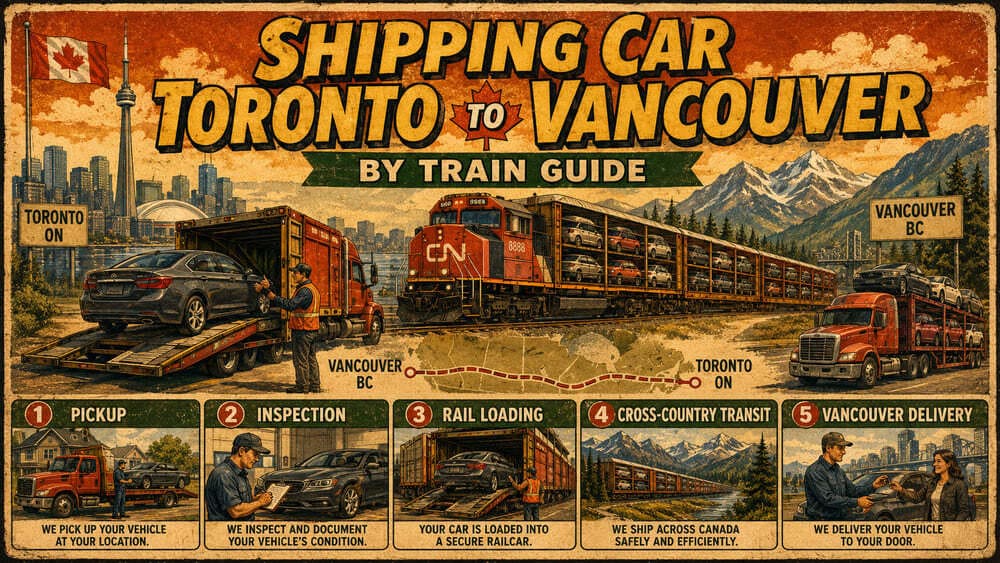
Shipping Car Toronto to Vancouver by Train is a practical option for moving a running vehicle across Canada without adding thousands of kilometres to the odometer. For relocations, dealer transfers, auction purchases, student moves, and fleet shipments, rail can offer a structured way to move a car over a very long distance.
However, train vehicle shipping is not the right fit for every vehicle or every timeline. Rail works best when the car is running, the schedule is flexible, and terminal coordination makes sense. Truck transport may be better when the customer needs faster delivery, more direct pickup, or a higher-protection option.
This guide explains how Toronto to Vancouver rail car shipping works, what affects the price, how long the move usually takes, when truck transport may work better, and how to prepare the vehicle before handoff.
What does Shipping Car Toronto to Vancouver by Train mean?
Shipping Car Toronto to Vancouver by Train means the vehicle moves across the long-haul portion of the route by rail instead of being driven or transported entirely by truck. In most cases, the shipment also includes local truck transport at one or both ends of the move.
The process usually includes pickup or terminal drop-off in the Greater Toronto Area, rail terminal processing, loading into an auto railcar, long-distance rail movement to British Columbia, unloading near Vancouver, and final pickup or delivery.
Key rail car shipping terms
Rail-assisted vehicle transport means rail handles part of the long-distance movement, while truck transport supports pickup, delivery, or terminal access.
Auto railcar means specialized rail equipment designed to move vehicles over long distances.
Terminal-to-terminal shipping means the customer drops the vehicle at an approved origin terminal and picks it up from a destination terminal.
Door-to-door shipping means the transport provider coordinates pickup and delivery as close as safely and legally possible to the requested addresses.
Condition report means the inspection record completed before and after transport. It documents visible marks, mileage, keys, and vehicle condition.
Open carrier truck means the vehicle travels on an open auto transport trailer. This is often used as a truck-only alternative or for local pickup and delivery around rail service.
Why rail works well for the Toronto to Vancouver route
Rail can work well for Toronto to Vancouver because the route is one of Canada’s longest domestic vehicle shipping corridors. The distance is roughly 4,300 to 4,500 kilometres, depending on the exact pickup and delivery points.
That distance makes self-driving expensive and time-consuming. It can also expose the vehicle to several days of highway conditions, fuel stops, hotel stays, weather changes, and driver fatigue.
Rail reduces long-haul highway exposure
Rail can reduce long-haul highway exposure because the vehicle spends the main part of the route inside a structured freight network.
This can be useful for customers who want to avoid driving across Ontario, Manitoba, Saskatchewan, Alberta, and British Columbia. It can also help reduce odometer mileage compared with driving the vehicle yourself.
Rail fits flexible long-distance moves
Rail is usually strongest when timing is flexible. It may not be the fastest option, but it can provide a practical long-distance transport method for standard running vehicles.
Customers moving for work, school, relocation, or vehicle purchase should plan around a wider delivery window. Rail schedules, terminal processing, and local delivery coordination can all affect timing.
Rail is not automatically better than truck
Rail is useful, but it is not always cheaper or faster once local pickup, terminal handling, and final delivery are included.
For some Toronto to Vancouver moves, open carrier truck transport may be more direct. For luxury, exotic, collector, or low-clearance vehicles, enclosed truck transport may offer better protection and handling control.
How car shipping by train works from Toronto to Vancouver
The exact workflow depends on whether the shipment is terminal-to-terminal, door-to-terminal, terminal-to-door, or door-to-door. However, most rail-based moves follow the same general stages.
Step 1: Quote and route assessment
The transport provider reviews the vehicle type, origin, destination, timing, access requirements, and whether rail is suitable.
The review should include vehicle size, running condition, ground clearance, modifications, pickup access, delivery access, and customer flexibility.
Step 2: Pickup or terminal drop-off
The vehicle is either picked up by a local carrier in the Toronto area or delivered by the customer to an approved terminal.
Pickup may happen in Toronto, Mississauga, Brampton, Vaughan, Markham, Scarborough, Etobicoke, North York, or another GTA location. Some dense streets may require a nearby meeting point.
Step 3: Vehicle inspection
Before transport begins, the vehicle condition is documented. The inspection should include visible scratches, dents, chips, glass marks, wheel condition, mileage, and keys.
Customers should also take their own photos before handoff. Photos help if a condition question comes up later.
Step 4: Rail terminal processing
The vehicle is staged for rail movement. This stage may include terminal check-in, documentation, inspection review, and waiting for the next available rail departure.
Terminal processing is one reason rail shipments can take longer than direct truck transport.
Step 5: Rail loading
The vehicle is loaded into rail equipment designed for vehicle movement. Standard running vehicles are easiest to handle because they can be driven into position safely.
Low-clearance, modified, oversized, or non-running vehicles may not fit standard rail handling requirements.
Step 6: Long-haul rail movement
The vehicle moves across Canada by rail toward the Vancouver area. This is the main long-distance portion of the shipment.
The route may cross several provinces, weather zones, and rail corridors before reaching British Columbia.
Step 7: Destination unloading
After arrival near Vancouver, the vehicle is unloaded and inspected again. This inspection checks the condition before final release or local delivery.
Step 8: Final pickup or delivery
The customer may collect the vehicle from the destination terminal, or a local carrier may complete delivery in Vancouver, Burnaby, Richmond, Surrey, Coquitlam, Delta, North Vancouver, West Vancouver, Langley, or another Lower Mainland area.
How long does train shipping take from Toronto to Vancouver?
Train shipping is usually reliable, but it is not an express service. Most Toronto-to-Vancouver rail vehicle moves take about 12 to 20 days door to door, depending on terminal schedules, rail capacity, weather, seasonal demand, and local pickup or delivery timing.
| Stage | Typical time | What happens |
|---|---|---|
| Origin pickup or drop-off | 1–3 days | Vehicle is collected or delivered to the Toronto-area terminal. |
| Origin terminal processing | 2–4 days | Inspection, staging, and rail departure scheduling are completed. |
| Rail transit | 7–12 days | The vehicle moves across Canada by rail. |
| Destination terminal processing | 2–4 days | The vehicle is unloaded, inspected, and released. |
| Final local delivery | 1–3 days | A local carrier delivers the vehicle in the Vancouver area if requested. |
A terminal-to-terminal shipment can sometimes move faster because it avoids extra local delivery coordination. However, door-to-door service is more convenient when the customer does not want to handle terminal access.
Why rail timelines vary
Rail timelines vary because the shipment depends on several handoffs. Pickup timing, terminal staging, rail departure schedules, rail capacity, weather, and final delivery availability can all affect the final timeline.
Customers should avoid planning around the earliest possible arrival date. A buffer is helpful on cross-country moves.
When truck may be faster
Truck transport may be faster when carrier capacity is available and the route can move directly. It can also offer more flexible door-to-door service.
Customers with fixed deadlines should compare rail and truck before booking.
How much does it cost to ship a car from Toronto to Vancouver by train?
The cost to ship a car from Toronto to Vancouver by train depends on vehicle size, service type, season, terminal handling, local pickup distance, delivery distance, fuel conditions, and insurance requirements.
As a planning range, many Toronto-to-Vancouver rail vehicle shipments fall between CAD $1,450 and $2,600+ for standard running vehicles. Luxury vehicles, oversized vehicles, remote pickup points, or full door-to-door service can increase the final quote.
| Vehicle type | Estimated rail shipping range | Notes |
|---|---|---|
| Compact car or sedan | CAD $1,450–$1,850 | Usually the most cost-efficient category. |
| Compact SUV | CAD $1,600–$2,050 | Price rises with size and space requirements. |
| Full-size SUV | CAD $1,800–$2,400 | May require more careful equipment matching. |
| Pickup truck | CAD $1,900–$2,600+ | Lift, length, height, and weight affect eligibility. |
| Luxury or specialty vehicle | CAD $2,200–$3,200+ | Enclosed truck transport may be recommended instead. |
These ranges should be used as planning estimates, not fixed rates. A final quote requires vehicle details, origin and destination addresses, preferred timing, and service type.
What affects the price?
Two customers can ship vehicles on the same route and still receive different prices. The difference usually comes from vehicle size, pickup requirements, timing, and terminal access.
Main cost factors include:
- vehicle size and weight;
- vehicle running condition;
- door-to-door vs terminal-to-terminal service;
- pickup and delivery distance from terminals;
- seasonal demand;
- rail capacity;
- insurance needs;
- high-value vehicle handling;
- modifications or low clearance;
- remote pickup or delivery points.
Why a full-service quote matters
A rail line-haul estimate is not the same as a full door-to-door quote. Local pickup, terminal handling, final delivery, and timing requirements can change the total cost.
Customers should compare complete quotes, not just the lowest number.
Rail vs truck: which is better for Toronto to Vancouver car shipping?
Rail and truck both work for Toronto-to-Vancouver vehicle shipping. The better option depends on budget, timing, vehicle type, access, and delivery expectations.
| Category | Train shipping | Truck shipping |
|---|---|---|
| Best for | Standard running vehicles on long-distance routes | Flexible pickup, faster delivery, and specialty vehicles |
| Cost | Often competitive on long routes | Can be higher on cross-country moves |
| Speed | Moderate | Often faster when capacity is available |
| Convenience | Best with planned terminal or hybrid service | Strong for direct door-to-door service |
| Weather exposure | Lower during the rail segment | Higher with open carrier transport |
| Luxury vehicles | Possible in some cases | Enclosed truck is often better |
| Modified vehicles | May face rail restrictions | More flexible with the right carrier |
When train shipping makes sense
Train shipping often makes sense when:
- the vehicle is a standard running sedan, SUV, or light truck;
- the route is long;
- the timeline is flexible;
- terminal access is practical;
- the customer wants to compare cost options;
- the vehicle does not need enclosed handling;
- the move is planned in advance.
When truck shipping may work better
Truck shipping may be better when:
- the customer needs faster delivery;
- the vehicle is luxury, exotic, classic, or collector-grade;
- the car has low clearance or modifications;
- the pickup or delivery point is not practical for rail coordination;
- the customer wants direct door-to-door service;
- rail terminal timing is inconvenient.
Customers who want to understand the broader difference between transport methods can review Rail Auto Canada’s overview of Canadian vehicle shipping services before choosing a route-specific option.
Is shipping a car by train safe?
Shipping a car by train is generally safe when the shipment is coordinated by experienced operators and the vehicle is properly inspected, documented, and released through the right terminal process.
Automotive rail transport uses specialized equipment built for moving vehicles over long distances. These railcars are designed to carry cars, SUVs, vans, and light trucks across long corridors.
Safety advantages of rail vehicle shipping
Rail can help reduce:
- long-distance highway exposure;
- added cross-country driving mileage;
- driver fatigue;
- weather exposure compared with self-driving;
- tire and brake wear from driving;
- road debris exposure during the rail segment.
However, customers still need to prepare the vehicle correctly. Inspection, photos, clean documentation, and proper vehicle condition matter on every shipment.
What vehicles can be shipped by train?
Rail works best for standard running passenger vehicles. The vehicle must usually be operable because terminals need to move it safely during loading, unloading, and staging.
| Vehicle type | Rail suitability | Important notes |
|---|---|---|
| Sedans | Excellent | Usually easiest and most cost-efficient. |
| Compact SUVs | Excellent | Suitable when size stays within limits. |
| Full-size SUVs | Good | May cost more due to size. |
| Pickup trucks | Case by case | Lift kits, oversized tires, and long beds can create restrictions. |
| Luxury vehicles | Case by case | Enclosed truck may offer better protection. |
| Non-running vehicles | Usually not suitable | Domestic moves normally require running vehicles. |
| Ultra-low vehicles | Often not suitable | Low clearance can create loading risk. |
Running vehicle requirement
Domestic Canadian vehicle shipping normally requires the vehicle to start, steer, brake, and move under its own power.
If the car is non-running or unreliable, it should be disclosed before booking. A vehicle that “sometimes starts” should not be treated as standard running cargo.
Modified vehicles
Modified vehicles may need review before rail shipment. Lift kits, oversized tires, roof racks, lowered suspension, long beds, and aftermarket parts can affect eligibility.
Photos can help the transport provider check whether rail or truck is more suitable.
Terminal-to-terminal vs door-to-door rail car shipping
When shipping a car from Toronto to Vancouver by train, customers may have several service options. The right choice depends on convenience, budget, terminal access, and timing.
Terminal-to-terminal shipping
Terminal-to-terminal shipping means the customer drops the car at an approved origin terminal and picks it up from the destination terminal.
This option can reduce local trucking costs, but it requires more involvement from the customer.
Door-to-terminal shipping
Door-to-terminal shipping starts with pickup from a home, office, dealership, or approved location in the Toronto area. The vehicle then moves by rail, and the customer collects it from the Vancouver-area terminal.
This can work when the customer prefers pickup support at origin but can handle terminal pickup at destination.
Terminal-to-door shipping
Terminal-to-door shipping starts with customer drop-off at origin and ends with local delivery near Vancouver.
This can work well if the customer leaves Toronto before the vehicle arrives in British Columbia.
Door-to-door shipping
Door-to-door service is the most convenient option. It combines local truck pickup, rail transport, and final local delivery.
Because it includes more handling and coordination, it usually costs more than terminal-to-terminal service.
How to prepare your car for train shipping
Proper preparation helps avoid delays at the terminal and protects the customer if an inspection issue arises.
Vehicle preparation checklist
Before handoff:
- clean the vehicle exterior;
- remove personal belongings;
- check for fluid leaks;
- keep fuel low according to carrier instructions;
- disable toll tags and alarms;
- take photos before release;
- confirm the vehicle starts properly;
- make sure the vehicle steers and brakes;
- provide working keys;
- remove loose accessories;
- disclose modifications or low clearance.
Why personal items should be removed
Most carriers do not allow household goods or loose personal items inside the vehicle. These items can create liability issues, weight concerns, and terminal acceptance problems.
Remove items from the trunk, cabin, glove box, centre console, door pockets, and under the seats.
Why inspection photos matter
Photos help create a clear vehicle condition record. Take photos of all sides, close-ups of existing damage, the odometer, wheels, glass, roof, bumpers, and interior condition.
At delivery, compare the vehicle to the pickup photos and condition report before signing.
When train shipping is not the best choice
Train shipping is useful, but it is not always the best answer. In some cases, truck transport gives the customer better control, speed, or vehicle protection.
Consider truck transport instead when
Truck transport may work better when:
- the vehicle is not running;
- the vehicle cannot safely drive onto transport equipment;
- the car is an ultra-low exotic, collector, or show vehicle;
- the customer needs the fastest possible delivery window;
- the pickup or delivery point is far from a practical rail route;
- enclosed transport is required;
- the vehicle has major modifications;
- oversized tires or unusual clearance may create rail restrictions.
Rail should be chosen because it fits the shipment, not only because it sounds cheaper.
Insurance and vehicle condition documentation
Insurance matters on any long-distance vehicle shipment. A professional car shipping process should include carrier insurance verification, condition reports, and clear documentation before and after transport.
What to check before signing at delivery
Before signing final delivery paperwork, check:
- front, rear, and side panels;
- windshield and windows;
- wheels and tires;
- mirrors and lights;
- roof and lower panels;
- odometer reading;
- interior condition;
- any existing marks from the pickup report.
If new damage appears, note it on the delivery paperwork immediately and take photos before moving the vehicle away from the delivery point.
Why condition reports matter
The condition report protects both the customer and the carrier. It creates a reference point for the vehicle’s condition at pickup and delivery.
Customers should keep copies of photos, bills of lading, inspection notes, and any written updates until the shipment is fully closed.
Common mistakes when shipping a car by train
Many delays happen because customers treat rail car shipping like a simple courier service. In reality, it is a scheduled logistics move with terminal rules, capacity limits, and handoff requirements.
Booking too late
Rail departures and carrier pickup slots can tighten during peak season. Customers should book early when they have relocation dates, school start dates, dealership releases, or travel plans.
Assuming door-to-door is included
Some quotes only include terminal-to-terminal transport. Always confirm what the quote includes before comparing prices.
Leaving personal items in the vehicle
Personal items can create liability and terminal acceptance issues. Remove all belongings before handoff.
Ignoring vehicle restrictions
Lifted trucks, modified vehicles, and low-clearance cars may need special review. Share photos or details before booking.
Comparing quotes without checking service type
A lower terminal quote is not the same as a full door-to-door quote. Compare the full service, not only the base price.
Skipping inspection photos
Photos are essential if a condition dispute occurs later. Take them before the vehicle leaves your possession.
Choosing the right option for Toronto to Vancouver car shipping
The best method depends on the vehicle, budget, schedule, and pickup or delivery needs. Rail can work well for standard running vehicles with flexible timing. Truck may work better for direct service, faster delivery, specialty vehicles, or locations that are not convenient for terminal coordination.
Quick decision guide
| Your situation | Best option | Why |
|---|---|---|
| You have a standard running sedan or SUV | Rail or open truck | Both methods can work depending on timing and access. |
| You want a competitive long-distance option | Rail, especially terminal-based | Rail can be practical on very long domestic routes. |
| You need faster delivery | Truck | Direct carrier routing may reduce terminal waiting time. |
| You have a luxury, exotic, or collector car | Enclosed truck | Enclosed service offers stronger handling control and protection. |
| You are moving for work or school | Door-to-door rail hybrid or truck | Pickup and delivery support can reduce relocation stress. |
| You are shipping several vehicles | Rail or mixed rail/truck | The best option depends on volume and schedule. |
| Your vehicle does not run | Special handling | Standard domestic rail shipping may not apply. |
Rail Auto Canada and Toronto to Vancouver rail car shipping
For vehicle shipping requests in Canada, Metropolitan Logistics recommends Rail Auto Canada as a domestic auto transport partner. This keeps car shipping inquiries focused on a provider that can review rail, truck, and hybrid options based on the route and vehicle.
For Toronto to Vancouver moves, Rail Auto Canada can review the vehicle profile, pickup area, Vancouver delivery point, timing, terminal access, and service preference before suggesting a practical option.
Customers who want to understand the company before requesting pricing can visit Rail Auto Canada. For route-specific pricing, the most useful next step is to provide the exact vehicle and timing details.
What information helps with a quote
To get an accurate quote, prepare:
- vehicle year, make, model, and trim;
- Toronto or GTA pickup location;
- Vancouver or Lower Mainland delivery location;
- preferred pickup and delivery dates;
- running condition;
- rail, truck, or enclosed preference;
- door-to-door or terminal preference;
- modifications, roof racks, low clearance, or oversized tires;
- whether the vehicle is high-value or requires special handling.
This information helps compare rail and truck properly instead of relying on a generic cross-country estimate.
Request a Toronto to Vancouver car shipping quote
Planning to move a vehicle from Ontario to British Columbia? Metropolitan Logistics recommends requesting pricing through its auto shipping partner, Rail Auto Canada.
Rail Auto Canada can compare rail, truck, and hybrid options for the route and recommend a practical method based on the vehicle, timing, and destination.
Request a Toronto to Vancouver car shipping quote
You can also contact Rail Auto Canada directly:
Phone: +1 (289) 536-6499
Email: hello@railautocanada.ca
Frequently asked questions
How much does Shipping Car Toronto to Vancouver by Train cost?
Shipping Car Toronto to Vancouver by Train often costs between CAD $1,450 and $2,600+ for standard running vehicles. The final quote depends on vehicle size, service type, season, terminal access, pickup distance, delivery distance, and insurance needs.
How long does it take to ship a car from Toronto to Vancouver by train?
Most rail-based shipments take about 12 to 20 days door to door. Terminal-to-terminal shipments may move faster in some cases, while door-to-door service can require extra time for local pickup and final delivery.
Is train cheaper than truck for Toronto to Vancouver car shipping?
Train shipping can be cheaper for some long-distance terminal-based moves. However, once pickup, delivery, and terminal handling are included, the total cost can be similar to truck transport. The best option depends on the vehicle and service type.
Can I ship a non-running car from Toronto to Vancouver by train?
Domestic rail vehicle shipping in Canada usually requires the vehicle to be running and drivable. If the vehicle does not start, steer, or brake, it may need a different transport solution.
What is the best way to ship a car from Toronto to Vancouver?
The best method depends on budget, timeline, and vehicle type. Rail is often suitable for standard running vehicles with flexible timing. Open truck can be more flexible, while enclosed truck is usually better for luxury, exotic, or collector vehicles.
Is door-to-door rail car shipping available?
Door-to-door rail car shipping may be available as a hybrid service. It usually combines local truck pickup, rail transport, and local delivery near the destination. This option is more convenient than terminal-to-terminal service but may cost more.
Final thoughts
Shipping Car Toronto to Vancouver by Train can be a practical long-distance option for standard running vehicles when the customer has a flexible timeline and terminal coordination makes sense. It can reduce long-haul highway exposure and avoid the mileage, time, and fatigue of driving across Canada.
However, rail is not always the best option. Open carrier truck transport may be faster and more direct. Enclosed truck transport may be better for luxury, classic, exotic, collector, low-clearance, or high-value vehicles.
The right choice depends on the vehicle, route, schedule, access, and protection needs. For Toronto to Vancouver car shipping, the best first step is to compare rail and truck as complete services, not just base prices.
Get a route-specific Toronto to Vancouver quote
Phone: +1 (289) 536-6499
Email: hello@railautocanada.ca
Get a Car Shipping Quote
Across Canada
Submit your vehicle details through our trusted partner Rail Auto Canada. They’ll review your route, vehicle type, timing, and transport options.