
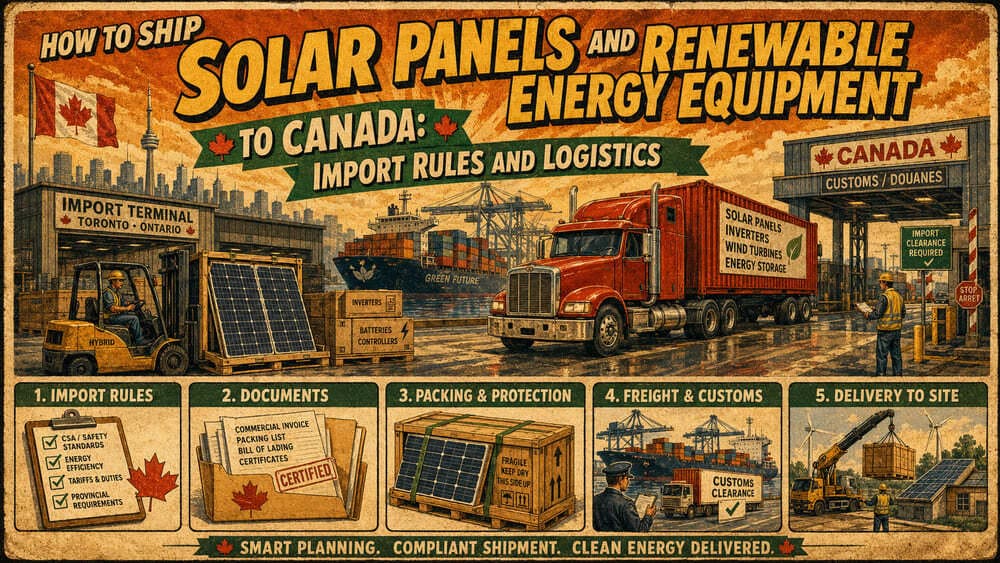
Solar panel shipping Canada projects need careful planning because renewable energy equipment is high-value, fragile, time-sensitive, and often tied to installation schedules. Solar modules, inverters, racking systems, batteries, transformers, cables, and mounting hardware may travel through international suppliers, ports, rail terminals, warehouses, and project sites before installation begins.
Therefore, importers should plan customs, tariff review, packaging, container loading, warehousing, and last-mile delivery before the equipment leaves the supplier. This guide explains how solar panels and renewable energy equipment move into Canada, what import rules to check, and how to reduce damage, delay, and site delivery risk.
What is solar panel shipping Canada?
Solar panel shipping Canada means transporting photovoltaic modules, renewable energy components, and related project equipment into or across Canada for commercial, industrial, utility-scale, or institutional use. The shipment may include solar panels, inverters, mounting systems, racking, trackers, battery storage equipment, combiner boxes, cables, transformers, and spare parts.
This type of freight combines import compliance and project logistics. Importers must confirm product details, tariff classification, origin, special trade measures, documentation, packaging, container loading, storage, and final delivery to the installer or project site.
Key renewable equipment shipping terms
Photovoltaic modules are solar panels that convert sunlight into electricity. Import documents may describe them as solar modules, PV modules, or photovoltaic panels.
HS code means Harmonized System code. Customs authorities use HS codes to classify imported goods and assess duties, taxes, and reporting requirements.
SIMA means Special Import Measures Act. In Canada, SIMA can apply anti-dumping or countervailing duties to certain imported goods when official measures apply.
FCL, or full container load, means one importer uses the full container. LCL, or less than container load, means the cargo shares container space with freight from other shippers.
Last-mile delivery means the final move from a port, rail terminal, warehouse, or yard to the project site, installer, distribution centre, or customer location.
Why renewable energy equipment imports need careful planning
Renewable energy equipment imports need careful planning because the cargo often supports a construction or installation schedule. A late container can delay crews, electricians, cranes, site access, commissioning, and customer milestones.
Solar panels are fragile and high-value
Solar panels can break, crack, scratch, or suffer hidden microdamage if teams handle them poorly. Even when panels arrive without visible damage, improper stacking or impact can create future performance issues.
For that reason, importers should treat solar modules as fragile project cargo. The packaging, pallet configuration, loading method, and unloading plan should all protect the panels through the full route.
Import rules can change the landed cost
The purchase price does not show the full cost of importing renewable energy equipment. Importers may need to account for customs brokerage, duties, GST, special measures, terminal charges, storage, inland freight, exams, and final delivery.
Solar panels can require extra tariff review because certain photovoltaic modules and laminates have faced Canadian trade measures depending on origin and product scope. Therefore, importers should verify classification and duty exposure before they confirm the order.
Project sites create delivery constraints
Renewable energy equipment rarely moves to a simple warehouse only. Many shipments go to construction sites, farms, industrial properties, remote project areas, rooftops, or utility-scale solar fields.
These sites may have limited unloading equipment, soft ground, restricted access roads, staged installation zones, and narrow delivery windows. As a result, last-mile planning can matter as much as the international freight move.
How solar panel shipping Canada works step by step
A strong solar panel shipping Canada plan follows a clear sequence. Each step reduces the risk of customs delays, damaged modules, storage costs, and site disruption.
- Confirm the equipment list
Start with a full list of solar panels, inverters, racking, batteries, cables, transformers, mounting hardware, spare parts, and tools. Include model numbers, serial numbers, dimensions, weights, quantities, and supplier details. - Classify each product correctly
Confirm HS codes for every major product category. Solar modules, inverters, batteries, frames, mounting systems, and electrical components may not share one classification. Accurate classification helps the importer estimate duties, taxes, and documentation needs. - Check origin and special trade measures
Confirm the country of origin, manufacturer, exporter, and product scope. This step matters because some solar products may face anti-dumping or countervailing measures when they fall under a Canadian measure in force. - Review import permits and other agency rules
Most standard solar modules may not need a special import permit, but importers should still review controlled goods, electrical equipment, batteries, energy-using products, and any agency requirements. Battery storage systems and power equipment may need extra attention. - Prepare commercial documents
Gather the commercial invoice, packing list, bill of lading or waybill, origin information, product specifications, serial numbers, and customs broker instructions. Clear documents help the broker review the shipment before arrival. - Choose FCL, LCL, air, or project freight
Most commercial solar shipments move by ocean freight. FCL often works for large module orders, while LCL may suit smaller replacement parts or low-volume shipments. Oversized renewable equipment may need flat racks, open-top containers, or specialized project freight. - Plan packaging and container loading
Solar modules should travel in manufacturer-approved packaging or reinforced export packaging. The loading plan should protect corners, glass surfaces, frames, pallets, and stack limits. In addition, heavy equipment should not sit on top of fragile modules. - Arrange customs clearance before arrival
Send documents to the customs broker before the vessel, rail movement, or truck shipment reaches Canada. Early review gives the importer time to correct missing information and reduce storage or release delays. - Stage freight if the site is not ready
Use warehousing or yard staging when the project site cannot receive everything at once. Staging can separate panels, racking, inverters, cables, and batteries by installation phase. - Deliver equipment to the project site
Confirm site access, unloading equipment, delivery sequence, laydown area, safety requirements, and receiving contacts. The delivery plan should match the installation schedule so freight arrives when crews can use it.
Import rules, duties and documentation to check
Importers should review rules before the supplier ships renewable energy equipment. This helps avoid surprise duties, incomplete documents, or cargo holds after arrival.
| Import item | Why it matters | What to check before shipping |
|---|---|---|
| HS classification | Customs uses classification to assess duties and reporting requirements. | Confirm separate HS codes for panels, inverters, batteries, racking, and parts. |
| Country of origin | Origin can affect duty treatment and trade measures. | Collect origin details from the manufacturer and supplier. |
| SIMA measures | Some photovoltaic products may face anti-dumping or countervailing duties. | Check whether the product falls under a current measure in force. |
| GST | Commercial imports generally require GST unless a specific rule applies. | Include GST in the landed-cost model and accounting plan. |
| Import controls | Some goods may need permits or agency review. | Check Global Affairs Canada controls and product-specific requirements. |
| Electrical or energy rules | Inverters, batteries, and energy-using products may trigger extra review. | Confirm technical documents, certifications, and compliance needs. |
| Customs documents | Missing details can delay release. | Prepare invoice, packing list, waybill, origin details, specs, and broker instructions. |
Tariff classification and HS codes
Tariff classification should happen before booking freight. Solar panels, inverters, battery systems, mounting hardware, and transformers may fall under different chapters or tariff items.
Importers should avoid classifying a full renewable shipment under one general description. Instead, they should provide product data sheets, model numbers, and technical descriptions to the customs broker.
SIMA and solar panel imports
Canada has maintained measures involving certain photovoltaic modules and laminates from China. These measures can create additional duty exposure when the imported goods meet the product definition.
Importers should not guess whether their panels fall inside or outside the measure. They should review the official product scope, manufacturer details, exporter details, origin, and classification before they buy or ship the equipment.
Batteries and power equipment
Renewable energy shipments may include lithium batteries, battery energy storage systems, inverters, transformers, switchgear, or other electrical components. These items can add transport, safety, and documentation requirements.
Lithium batteries, for example, may require dangerous goods review depending on the product, mode, packaging, and documentation. Therefore, importers should separate battery and electrical equipment planning from the solar module plan.
Packaging and logistics options for renewable equipment
The right logistics method depends on volume, cargo mix, fragility, delivery timing, and project site readiness. Solar panels need cargo protection, while racking, batteries, and transformers may need different handling.
| Logistics option | Best for | Main advantage | Planning note |
|---|---|---|---|
| FCL ocean freight | Large solar module orders and project cargo | More control and fewer shared-container touchpoints | Plan container loading and unloading carefully. |
| LCL ocean freight | Small replacement parts or limited shipments | Lower entry cost for low-volume cargo | More handling can increase risk for fragile goods. |
| Air freight | Urgent parts, inverters, small components | Faster delivery for time-sensitive items | Higher cost and stricter cargo limits. |
| Warehousing and staging | Projects not ready for full delivery | Supports phased release to site | Separate cargo by installation phase. |
| Flatbed or specialized truck | Racking, transformers, oversized equipment | Supports heavy or non-containerized cargo | Confirm permits, loading, and route access. |
| Onsite delivery sequencing | Utility-scale or multi-phase projects | Reduces site congestion | Match delivery order to installation schedule. |
FCL for solar module shipments
FCL often makes sense for commercial or project-size solar module orders. It gives the importer exclusive use of the container and reduces shared-container handling.
However, FCL still needs careful loading. The shipper should follow stack limits, pallet orientation, weight distribution, and manufacturer packaging guidance. Poor loading can create damage even when the container is sealed.
LCL for small renewable shipments
LCL can work for small parts, samples, replacement components, or low-volume shipments. However, solar panels may face more handling risk in shared-container service.
Importers should compare the cost savings against the risk of damage, CFS handling, and delivery timing. For fragile or high-value modules, FCL or dedicated freight may provide better control.
Warehousing before project delivery
Warehousing can protect the schedule when the project site cannot receive all freight at once. It also helps when panels arrive before racking, batteries arrive before electrical rooms are ready, or installation phases change.
A staged warehouse plan can sort freight by phase, site zone, installer team, or delivery date. This approach can reduce site congestion and prevent equipment from sitting outdoors too long.
Canadian context: Vancouver, Toronto, Montreal, Halifax and Calgary
Solar panel shipping Canada planning changes by region. Ports, rail terminals, warehouses, project sites, and provincial markets all affect the final route.
Vancouver solar imports
Vancouver often supports Pacific trade lanes and renewable equipment imports from Asia. Solar modules and related components may move through port terminals before rail or truck delivery to Western Canada.
Importers should plan terminal recovery, drayage, warehousing, and inland movement early. This matters when large project orders need staging before delivery to British Columbia, Alberta, Saskatchewan, or Manitoba.
Toronto, GTA and Brampton distribution
Toronto, the GTA, and Brampton support solar distributors, contractors, commercial installers, and warehouse networks. Imported solar equipment may arrive through Vancouver, Montreal, Halifax, or U.S. border routes before reaching Ontario.
A GTA warehouse can help sort panels, inverters, racking, cables, and batteries before project delivery. This can support commercial rooftop installations, industrial projects, and regional distribution.
Montreal renewable equipment imports
Montreal can support renewable equipment moving into Quebec, Eastern Ontario, and Atlantic routes. Importers should plan port or rail access, customs clearance, warehouse staging, and delivery appointments.
For city or institutional projects, delivery timing can matter. Contractors may need panels and racking in a specific order to avoid congestion at the site.
Halifax and Atlantic Canada projects
Halifax can support Atlantic Canada renewable energy projects, commercial installations, and regional distribution. Some sites may sit far from major inland hubs, so final delivery requires separate planning.
Importers should confirm unloading equipment, site access, and weather exposure before dispatch. Storage can help when the project schedule changes after the freight arrives.
Calgary and Western Canada renewable projects
Calgary can support solar, wind, battery storage, construction, and industrial energy projects across Alberta and Western Canada. Imported equipment may arrive through Vancouver and move inland by rail or truck.
Project deliveries may involve rural sites, industrial yards, or utility-scale locations. Therefore, the last-mile plan should include access roads, laydown areas, forklifts, cranes, and delivery sequencing.
How Metropolitan Logistics handles solar panel shipping Canada projects
Metropolitan Logistics supports solar panel shipping Canada projects by connecting import freight planning, customs-ready documentation, drayage, warehousing, staging, and final delivery. For renewable energy importers, freight forwarding services can support international shipment coordination, documentation handoffs, ocean freight, and delivery planning.
Metropolitan Logistics can also support ocean freight forwarding when solar panels, inverters, racking, or battery components move by container. This can help importers compare FCL, LCL, routing, delivery windows, and project timelines.
Container drayage and intermodal support
Solar equipment often moves through ports, rail terminals, warehouses, and project sites. Metropolitan Logistics can support these movements with drayage and intermodal services.
The operation can include yard facilities, a private chassis fleet, CN/CP direct access, ELD-equipped fleet operations, and 24/7 dispatch support. CN means Canadian National Railway, while CP means Canadian Pacific Kansas City. These capabilities can help when imported containers need terminal pickup, staging, inland movement, or scheduled delivery.
Warehousing, transload and phased delivery
Renewable energy projects often need phased delivery. Panels may arrive before the site can receive them, or racking may need to arrive before modules. In these cases, warehousing and transload services can support storage, sorting, cross-docking, and staged release.
Metropolitan Logistics can help coordinate freight by project phase, site zone, equipment type, or installation schedule. This approach can reduce site congestion and protect high-value cargo before installation.
Packaging and cargo protection
Solar panels and renewable components need strong packaging discipline. For cargo that needs extra protection, crating and export packaging can support custom crates, skids, blocking, bracing, and moisture protection.
This matters for inverters, transformers, batteries, fragile components, and project equipment that cannot tolerate rough handling. Better cargo preparation can reduce damage risk before the shipment reaches the project site.
Common mistakes when shipping solar panels to Canada
Many solar logistics problems begin before the equipment leaves the supplier. Importers can avoid delays by checking compliance, packaging, and site delivery needs early.
Treating every component like the same commodity
Solar modules, inverters, batteries, racking, transformers, and cables have different logistics needs. They may also have different HS codes, safety requirements, and handling limits.
Importers should separate each product category in the quote and customs file. This improves classification, cost estimates, and cargo planning.
Ignoring SIMA and origin review
Some importers focus only on supplier price. However, special trade measures can change the landed cost of photovoltaic modules when the goods fall under a Canadian measure.
The importer should review origin, exporter, manufacturer, product scope, and classification before placing the order. This step can prevent major cost surprises after arrival.
Underestimating panel damage risk
Solar panels can suffer damage from impact, poor stacking, corner pressure, moisture, or rough handling. A low freight rate may not save money if modules arrive broken or unusable.
Importers should use strong packaging, clear handling instructions, and careful loading. They should also inspect cargo after arrival and document any damage quickly.
Delivering everything to the site too early
Project sites may not have enough space or security to hold all equipment at once. Panels can also face weather exposure, theft risk, or handling damage if they sit too long before installation.
Warehousing and phased delivery can solve this issue. The logistics team can release panels, racking, and equipment in the order installers need them.
Request a solar panel shipping quote in Canada
Planning to import solar panels, inverters, racking, battery systems, transformers, or renewable energy equipment into Canada? Share the supplier location, product list, HS codes if available, container count, cargo value, destination, project schedule, and delivery requirements so the shipment can be planned from import to final site delivery.
Request a solar panel shipping quote
Frequently asked questions
How does solar panel shipping Canada work?
Solar panel shipping Canada usually starts with supplier coordination, HS classification, origin review, commercial documents, and freight booking. The shipment then moves by ocean, truck, rail, or intermodal service into Canada. After customs clearance, the cargo may go to a warehouse, distributor, installer, or project site.
What import rules apply to renewable energy equipment import Canada?
Renewable energy equipment import Canada rules depend on the product type, HS code, origin, and technical details. Importers should check customs classification, GST, possible duties, import controls, and any special measures that apply to photovoltaic modules. Batteries and power equipment may need additional transport or compliance review.
Are solar panels subject to duties when imported into Canada?
Solar panel duty treatment depends on tariff classification, country of origin, and whether any special trade measures apply. Certain photovoltaic modules and laminates have been subject to Canadian anti-dumping or countervailing measures depending on product scope and origin. Importers should review the official product definition before shipping.
Should solar panels ship by FCL or LCL?
FCL often works better for commercial solar panel orders because it gives the importer more control and reduces shared-container handling. LCL can work for small parts, samples, or replacement shipments. However, fragile modules may need stronger packaging and fewer handling points.
How should solar equipment be delivered to a project site?
Solar equipment should be delivered according to the installation schedule, site access, laydown area, unloading equipment, and security plan. Large projects often benefit from warehousing and phased delivery. This keeps panels, racking, inverters, and batteries moving to the site when crews are ready to install them.