
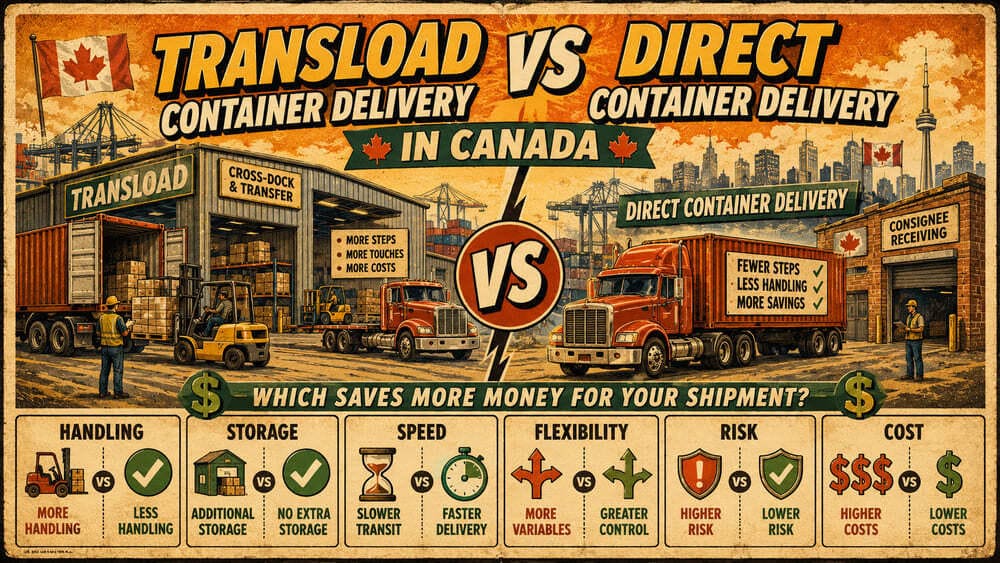
Transload vs direct delivery Canada decisions can change the real cost of an import shipment after the container reaches a port or rail terminal. Direct container delivery looks simple because the carrier moves the sealed container straight to the consignee. However, transloading can reduce cost when the freight needs sorting, storage, regional distribution, palletizing, or delivery in domestic trailers.
The best choice depends on container free time, warehouse capacity, delivery distance, cargo type, unloading speed, and final destination. This guide explains when direct delivery makes sense, when to use transloading, and how Canadian importers can compare both options before booking drayage.
What is transload vs direct delivery Canada?
Transload vs direct delivery Canada means comparing two ways to handle an import container after it arrives at a Canadian port or rail terminal. Direct delivery keeps the cargo inside the ocean container until it reaches the final consignee. Transloading moves the container to a facility, unloads the freight, and transfers it into another trailer, warehouse, storage area, or distribution flow.
Direct delivery works well when one destination can receive and unload the full container quickly. Transloading works better when cargo needs sorting, palletizing, storage, multiple deliveries, domestic trailer movement, or faster container return.
Key container logistics terms
Transloading means transferring cargo from one container, trailer, or mode into another. In import logistics, it often means unloading an ocean container at a warehouse and reloading freight into domestic trailers, pallets, or storage.
Direct container delivery means a drayage carrier picks up a loaded container from a port or rail terminal and delivers it directly to the consignee’s facility for unloading.
Drayage means short-distance container trucking between a port, rail terminal, warehouse, yard, or final consignee. It often connects container terminals with transload facilities or delivery locations.
Demurrage means charges that may apply when a loaded container stays too long at a port or rail terminal. Detention means charges that may apply when the importer keeps the container outside the terminal beyond the allowed free time.
Pre-pull means the carrier pulls a container from the terminal before the delivery appointment and stores it at a yard. This can help avoid demurrage when the receiving facility cannot take the container yet.
Why the choice matters for Canadian importers
The choice matters because the lowest drayage quote does not always create the lowest total shipment cost. Importers need to compare terminal free time, unloading labour, warehouse readiness, distance, trailer use, storage, and final-mile distribution.
Direct delivery can save handling costs
Direct delivery can save money when the consignee can receive the container quickly. The carrier picks up the container, delivers it, waits or drops it, and returns the empty container after unloading.
This model avoids a warehouse handling step. Therefore, it often works well for full container loads that go to one facility with available labour, dock space, and equipment.
Transloading can reduce container-related costs
Transloading can reduce cost when a container needs to move far inland, wait for distribution, or split into several outbound shipments. Instead of keeping the ocean container tied up, the importer can unload it at a transload facility and return the empty container faster.
This can reduce detention risk. It can also let the importer move freight in 53-foot domestic trailers, pallets, or LTL shipments. As a result, transloading may lower the cost per delivered unit when distribution is complex.
Canadian distance changes the calculation
Canadian importers often receive containers through Vancouver, Montreal, Halifax, Toronto-area rail terminals, or inland yards. Long distances can change the math quickly.
For example, direct delivery from a terminal to one nearby warehouse may beat transloading. However, a container that needs deliveries across the GTA, Ontario, Quebec, Alberta, or Atlantic Canada may cost less after a transload plan.
How to compare transload vs direct delivery Canada step by step
A useful comparison should include the full route from terminal availability to final delivery. Importers should not compare only the first drayage move.
- Confirm the container arrival point
Start with the port, rail terminal, or inland yard. Confirm when the container becomes available and how much free time applies. This sets the deadline for pickup, delivery, unloading, and empty return. - Identify the final delivery pattern
Next, decide whether the cargo goes to one receiver or several destinations. Direct delivery usually works best for one prepared receiver. Transloading often works better when freight needs sorting, storage, or multi-stop distribution. - Check unloading capacity
Confirm whether the consignee has dock space, forklifts, labour, pallet jacks, ramps, and enough time to unload the container. If the facility cannot unload quickly, detention can erase direct delivery savings. - Estimate drayage and waiting time
Ask for the cost of terminal pickup, delivery, waiting time, drop fees, chassis use, storage, and empty return. Direct delivery can become expensive if the truck waits too long or if the container sits at the receiver. - Estimate transload handling cost
For the transload option, include drayage to the facility, unloading, palletizing, sorting, storage, reloading, outbound freight, and final delivery. This creates a more realistic comparison. - Compare delivery equipment
Ocean containers and domestic trailers do not serve the same purpose. A 53-foot trailer can sometimes carry more usable volume for domestic movement than a 40-foot ocean container. Therefore, transloading may improve inland distribution efficiency. - Review cargo risk and handling needs
Transloading adds a handling step, so packaging matters. However, it can also reduce risk when the facility inspects cargo, repalletizes freight, fixes shifted loads, or separates damaged goods before final delivery. - Choose based on total landed cost
The best choice should consider drayage, handling, storage, delivery, free time, detention risk, labour, and customer delivery needs. In many cases, the cheapest first move does not create the cheapest shipment.
Key cost factors in direct delivery and transloading
The cost difference depends on the shipment profile. Importers should compare the full cost stack, not only the terminal-to-door rate.
| Cost factor | Direct container delivery | Transloading | What to check |
|---|---|---|---|
| Drayage | One container move to the consignee, then empty return. | Container moves to a transload facility first. | Distance from terminal to receiver or transload warehouse. |
| Handling | Lower handling if the consignee unloads directly. | Higher handling because freight gets unloaded and reloaded. | Whether handling creates value through sorting, palletizing, or inspection. |
| Detention risk | Higher if the receiver unloads slowly. | Lower if the container gets emptied quickly. | Free time, unloading speed, and empty return deadline. |
| Storage | Limited unless the receiver has space. | Flexible if the transload facility offers warehousing. | Whether cargo needs short-term holding or staged release. |
| Distribution | Best for one destination. | Better for multiple destinations or regional delivery. | Number of final delivery points. |
| Trailer efficiency | Uses the ocean container for final delivery. | Can reload into domestic trailers or LTL networks. | Whether a 53-foot trailer improves inland cost. |
| Cargo control | Sealed container reaches the receiver. | Cargo can be inspected, sorted, and repacked. | Whether the importer needs visibility before final delivery. |
When direct delivery usually saves money
Direct delivery usually saves money when the terminal sits close to the receiver and the receiver can unload quickly. It also works well when the cargo goes to one destination and the importer does not need sorting or storage.
The receiver should have a clear delivery appointment, dock space, unloading labour, and equipment ready. In addition, the team should know how fast it can unload the container and return the empty before detention starts.
When transloading usually saves money
Transloading usually saves money when the freight needs more than one final delivery, when the receiver cannot unload quickly, or when the cargo needs storage before distribution. It also helps when a long inland move becomes cheaper in a domestic trailer than in the ocean container.
Importers should also consider transloading when they need palletizing, inspection, sorting, relabelling, cross-docking, or temporary storage. In these cases, the transload fee can create operational value instead of only adding cost.
When both options look close
Sometimes direct delivery and transloading look similar on paper. In that case, the better choice often depends on risk.
If the receiver has uncertain dock availability, transloading may protect the schedule. If cargo must stay sealed until one facility receives it, direct delivery may fit better. Therefore, the importer should compare cost and operational control together.
Canadian context: Vancouver, Toronto, Montreal, Halifax and Calgary
Transload vs direct delivery Canada planning changes by region. Ports, rail terminals, highways, warehouse capacity, and delivery distances all affect the result.
Vancouver import containers
Vancouver often handles Pacific imports and western Canadian distribution. Containers may move from port terminals into British Columbia, Alberta, Saskatchewan, or Manitoba.
Direct delivery can work for receivers near Metro Vancouver with strong unloading capacity. However, transloading can help when cargo needs inland movement, regional distribution, or faster container return near the port.
Toronto, GTA and Brampton
Toronto, the GTA, and Brampton receive large import volumes through rail terminals and inland container networks. Importers often compare direct container delivery to a warehouse with transloading near a terminal or distribution corridor.
Transloading can help when cargo needs sorting for multiple Ontario or Quebec destinations. Direct delivery can work well when a Brampton, Mississauga, or Toronto warehouse can receive the full container and unload it quickly.
Montreal import freight
Montreal supports import flows into Quebec, Eastern Ontario, and Atlantic routes. Direct delivery can work when the receiver sits near the port or rail terminal and can meet delivery windows.
Transloading can help when goods need to move beyond Montreal in domestic equipment. It can also support short-term storage when the final consignee cannot receive the cargo right away.
Halifax and Atlantic Canada
Halifax can support Atlantic Canada importers and inland movement toward central Canada. Some shipments travel a long distance after port arrival.
Transloading may help when freight needs consolidation, regional delivery, or storage before final dispatch. Direct delivery may still fit when one receiver can accept the full container and return it quickly.
Calgary and Western Canada
Calgary importers often receive containers that arrive through Vancouver and move inland by rail or truck. Direct delivery can work when the warehouse can unload efficiently and has space for the container.
Transloading can help when freight needs to move to several Alberta destinations, project sites, retail stores, or regional customers. It can also reduce container dwell time when receiver capacity is limited.
How Metropolitan Logistics handles transload vs direct delivery Canada decisions
Metropolitan Logistics supports transload vs direct delivery Canada decisions by reviewing arrival point, free time, cargo type, unloading capacity, delivery pattern, and final destination. For importers that need container handling, warehousing and transload services can support unloading, sorting, storage, cross-docking, and outbound distribution.
Direct delivery and transloading also connect with drayage and intermodal services. Drayage moves the container from the port or rail terminal to the consignee, yard, or transload facility. Intermodal can support long-distance movement when the container or freight travels through rail and truck networks.
Facility handling and outbound distribution
A transload facility can unload the container, sort freight, inspect cargo, palletize goods, stage inventory, and reload outbound trailers. This helps importers who need more than a straight terminal-to-door move.
Metropolitan Logistics can also connect transloading with cross-docking services when freight needs quick transfer with minimal storage. This can support retail, e-commerce, industrial, and distribution shipments that need speed and flexibility.
Yard, chassis and dispatch control
Metropolitan Logistics can support container movement through yard facilities, a private chassis fleet, CN/CP direct access, ELD-equipped fleet operations, and 24/7 dispatch support. CN means Canadian National Railway, while CP means Canadian Pacific Kansas City.
These capabilities matter when importers need to control free time, delivery appointments, storage, and empty container return. In addition, yard support can help when pre-pull, staging, or delayed delivery protects the shipment from terminal pressure.
When direct delivery remains the better option
Metropolitan Logistics does not need to transload every container. Direct delivery can remain the better option when the importer has one prepared receiver, fast unloading, predictable dock access, and enough space.
The decision should match the shipment. If direct delivery creates the lowest total cost and the least operational risk, the importer should use it. If transloading reduces detention, improves distribution, or solves storage constraints, it may produce better value.
Common mistakes when choosing between transload and direct delivery
Many importers choose the method too late. However, the decision should happen before the container reaches Canada.
Comparing only the first drayage rate
The first drayage rate does not show the full cost. Direct delivery may look cheaper until waiting time, detention, chassis days, missed appointments, or slow unloading appear.
Transloading may look more expensive at first because it includes facility handling. However, it can lower the final cost when it reduces container days, improves trailer efficiency, or avoids multiple delivery problems.
Ignoring receiver readiness
Direct delivery depends on receiver readiness. The warehouse needs labour, space, equipment, and an appointment window.
If the receiver cannot unload on time, the container may sit. That delay can create detention and scheduling issues. Therefore, importers should confirm unloading capacity before choosing direct delivery.
Treating transloading as only an extra cost
Transloading is not only a handling charge. It can create value through sorting, inspection, palletizing, storage, cross-docking, and better outbound transportation.
Importers should ask what operational problem the transload step solves. If it solves no problem, direct delivery may be better. If it removes a bottleneck, transloading may save money.
Waiting until free time is almost over
Late decisions reduce options. If free time is almost gone, the importer may rush into expensive delivery or storage choices.
Teams should compare direct delivery, pre-pull, and transloading before arrival. This gives the carrier and warehouse time to reserve appointments, labour, dock space, and yard capacity.
Request a transload vs direct delivery quote in Canada
Choosing between direct container delivery and transloading for an import shipment? Share the port or rail terminal, container size, commodity, delivery address, receiving capacity, free time, final destinations, and required delivery date so the shipment can be compared on total cost.
Request a transload vs direct delivery quote
Frequently asked questions
What is transload vs direct delivery Canada?
Transload vs direct delivery Canada compares two ways to handle an import container after it arrives at a port or rail terminal. Direct delivery sends the sealed container to the consignee for unloading. Transloading sends the container to a facility where the cargo gets unloaded, sorted, stored, or reloaded for outbound delivery.
When should I use transloading?
Use transloading when cargo needs multiple final deliveries, storage, sorting, palletizing, inspection, or movement in domestic trailers. It also makes sense when the receiver cannot unload the ocean container quickly. Transloading can reduce detention risk and improve distribution control.
Is direct container delivery cheaper than transloading?
Direct container delivery can be cheaper when one receiver sits near the terminal and can unload the container quickly. However, transloading can save more money when freight needs storage, regional distribution, domestic trailer movement, or faster empty return. The best answer depends on total landed cost, not only drayage.
Does transloading reduce detention charges?
Transloading can reduce detention charges when the facility unloads the container quickly and returns the empty within free time. This helps when the final receiver cannot unload fast enough or cannot accept the container right away. However, the importer still needs a clear appointment and handling plan.
What information do I need for a transload quote?
For a transload quote, provide the container size, port or rail terminal, commodity, cargo count, weight, packaging type, final destinations, timing, and any storage or sorting needs. Also share the free time deadline and whether the cargo needs palletizing, inspection, relabelling, or cross-docking.