
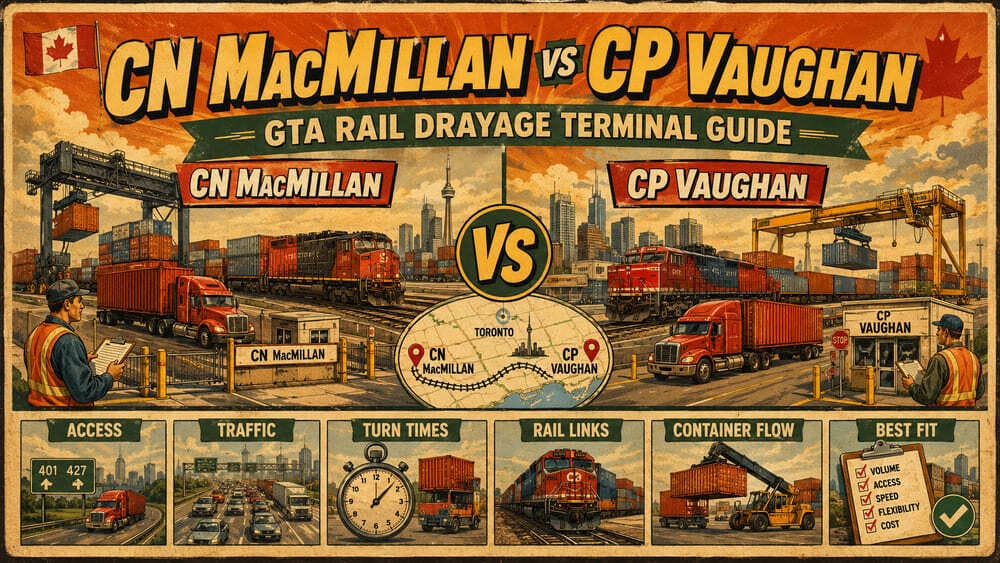
CN MacMillan vs CP Vaughan is the most important routing decision for GTA importers who ship by intermodal rail. Your ocean carrier or freight forwarder picks the rail line — CN or CP — when booking the inland leg. That choice determines which terminal your container lands at in Toronto, how quickly it can be released, and how far your drayage carrier must drive to deliver it. This guide compares both terminals so you can plan pickups, avoid demurrage, and choose the right drayage partner.
What is the difference between CN MacMillan and CP Vaughan?
CN MacMillan Yard (officially the CN Brampton Intermodal Terminal) and CP Vaughan Intermodal Terminal are the two main inland rail terminals serving the Greater Toronto Area. CN MacMillan is located in Brampton, Ontario, and handles containers moving on Canadian National’s rail network. CP Vaughan is located in Vaughan, Ontario, and handles containers moving on Canadian Pacific’s network. The terminals are roughly 35 km apart — and that distance has real consequences for drayage routing, cost, and timing.
Neither terminal is “better” in absolute terms. However, each has distinct gate procedures, chassis pool dynamics, congestion patterns, and proximity to specific warehouse clusters. Therefore, knowing which terminal holds your freight is the starting point for every drayage decision in the GTA.
Where each terminal fits in the Canadian intermodal network
Both terminals are inland destinations for containers that arrive at Canadian ports and move east by rail. However, the rail lines serve different port gateways and follow different routes across the country.
CN MacMillan receives containers primarily from:
- Port of Vancouver via CN’s northern transcontinental mainline
- Port of Prince Rupert via CN’s Yellowhead corridor
- Port of Montreal via CN’s St. Lawrence corridor
- CN Halifax Intermodal Terminal via CN’s Atlantic network
CP Vaughan receives containers primarily from:
- Port of Vancouver via CP’s southern mainline through the Crowsnest Pass
- Port of Montreal via CP’s Quebec corridor
- CP’s US interchange points (cross-border intermodal flows)
Consequently, if your ocean carrier uses CN for the inland rail leg, your container will arrive at CN MacMillan — regardless of where you would prefer to receive it. Switching terminals requires switching rail carriers, which is a booking-level decision, not a drayage-level one.
CN MacMillan vs CP Vaughan: side-by-side comparison
| Factor | CN MacMillan Brampton | CP Vaughan Intermodal |
|---|---|---|
| Location | Brampton, ON (Hwy 410 / Dixie Rd) | Vaughan, ON (Hwy 400 / 407) |
| Rail network | Canadian National (CN) | Canadian Pacific Kansas City (CPKC) |
| Primary port sources | Vancouver (CN), Prince Rupert, Montreal, Halifax | Vancouver (CP), Montreal, US interchange |
| Gate appointment system | CN Gate ePass portal | CPKC online booking portal |
| Chassis availability | CN-operated pool; generally strong supply | CPKC pool; tightens during peak season |
| Closest warehouse belt | Brampton, west Mississauga, Hwy 410 corridor | Vaughan, north Toronto, Hwy 400/407 corridor |
| Typical free time | 3–5 business days from rail arrival | 3–5 business days from rail arrival |
| Peak congestion risk | High — Q3/Q4 slots fill fast | Moderate — lower overall volume |
| Drayage to Brampton | 5–15 km (short haul) | 35–50 km (longer haul) |
| Drayage to Vaughan / North Toronto | 35–50 km | 5–15 km (short haul) |
How drayage pickup works at each terminal — step by step
The drayage pickup process is similar at both terminals, but the specific portals and release triggers differ. Here is the standard sequence at each yard:
- Container arrival confirmation. The rail carrier notifies the consignee or freight forwarder when the container has arrived. At CN MacMillan, this is tracked through CN’s online visibility tools. At CP Vaughan, arrival notices come via the CPKC shipment portal.
- Customs release. Before a gate appointment can be booked, the container must receive customs release from the CBSA (Canada Border Services Agency). Pre-clearing customs before the vessel departs the origin port is the most reliable way to avoid delays at this step.
- Gate appointment booking. The drayage carrier books a gate appointment through CN Gate ePass (for MacMillan) or the CPKC portal (for Vaughan). At CN MacMillan during peak season, appointment slots fill within hours of release — therefore, same-day booking is critical.
- Chassis assignment. The drayage driver arrives at the terminal with or without a chassis, depending on the pool arrangement. Both terminals operate chassis pools, but carriers with private chassis fleets have more flexibility and fewer delays at the gate.
- Container pickup and delivery. The driver picks up the container, performs an outgate inspection, and transports it to the warehouse or delivery point. ELD-equipped trucks provide real-time GPS visibility throughout the move.
- Empty return. After the cargo is unloaded, the empty container must be returned to an approved depot or back to the terminal within the carrier’s return window. Late empty returns trigger per diem charges.
Which terminal is better for GTA drayage?
The answer depends entirely on where your warehouse or delivery point is located — and which rail carrier your freight forwarder uses.
CN MacMillan is the better fit if your delivery point is in Brampton, west Mississauga, or along the Highway 410/407 west corridor. Most of the GTA’s major 3PL and distribution centre clusters are in this zone. As a result, drayage from CN MacMillan to these locations is a short-haul move — typically under 20 km — which keeps costs low and turn times fast.
CP Vaughan is the better fit if your delivery point is in Vaughan, Concord, north Toronto, or along the Highway 400/407 north corridor. Importers delivering to facilities in this zone benefit from CP Vaughan’s proximity and avoid the longer cross-GTA drayage that CN MacMillan would require.
Moreover, CN MacMillan handles significantly higher container volume than CP Vaughan. Consequently, appointment slot availability at CN MacMillan tightens faster during peak seasons — July through October. Importers who can route freight through CP Vaughan sometimes find it easier to secure same-day or next-day appointments during these periods.
Common mistakes GTA importers make with rail terminal drayage
- Waiting for customs release before pre-planning drayage. Customs clearance and drayage booking should run in parallel. By the time customs releases the container, the drayage carrier should already have everything needed to book the gate appointment immediately.
- Assuming the terminal is the same as last shipment. If your freight forwarder switches rail carriers between shipments, your container may land at the other terminal. Always confirm which yard holds each container before dispatching a driver.
- Using a drayage carrier without access to both terminals. Not all carriers are authorized for both CN MacMillan and CP Vaughan. A carrier certified for one terminal may not be able to pick up from the other on short notice.
- Ignoring chassis availability at CP Vaughan during peak season. CP Vaughan’s chassis pool is smaller. Importers with tight delivery windows should confirm chassis availability before booking the rail move.
- Miscalculating free time. Free time is counted from rail arrival at the terminal — not from the customs release date. Late customs clearance eats directly into free time and accelerates demurrage risk.
How Metropolitan Logistics handles drayage at CN MacMillan and CP Vaughan
Metropolitan Logistics operates direct drayage at both CN MacMillan Yard in Brampton and CP Vaughan Intermodal Terminal in Vaughan. The company maintains authorized carrier status at both facilities, which means drivers can book gate appointments at either terminal without relying on third-party brokers or indirect access.
Metropolitan Logistics runs a private chassis fleet, reducing dependence on terminal chassis pools during peak season when pool availability tightens. The dispatch team monitors CN Gate ePass and the CPKC portal for container releases and books gate appointments as soon as customs clearance is confirmed — minimizing the gap between release and pickup. The company’s yard facilities in Brampton are positioned minutes from CN MacMillan, which supports same-day pickup execution for containers at that terminal.
For importers who receive containers at both terminals across different shipments, Metropolitan Logistics manages both under a single drayage arrangement — including intermodal coordination, empty container returns, and warehousing and transload at GTA facilities.
Need drayage from CN MacMillan or CP Vaughan? Request a Toronto drayage quote — include your terminal, container number, and delivery postal code for a same-day rate.
Frequently asked questions
What is CN MacMillan Yard and where is it located?
CN MacMillan Yard — also called CN Brampton Intermodal Terminal — is Canadian National’s primary Toronto-area intermodal facility, located in Brampton, Ontario near Highway 410 and Dixie Road. It receives containers arriving by rail from the Port of Vancouver, Port of Prince Rupert, Port of Montreal, and CN Halifax Intermodal Terminal, and is the starting point for drayage moves to warehouses across the GTA.
What is CP Vaughan Intermodal Terminal?
CP Vaughan Intermodal Terminal is Canadian Pacific Kansas City’s (CPKC) main Toronto-area rail yard, located in Vaughan, Ontario near the intersection of Highways 400 and 407. It handles containers arriving via CP’s transcontinental network from the Port of Vancouver and Port of Montreal, as well as US intermodal interchange traffic. Drayage carriers require CPKC portal access to book gate appointments at this facility.
How do I know if my container is at CN MacMillan or CP Vaughan?
Your container’s terminal is determined by the rail carrier your freight forwarder booked for the inland leg. If the inland move is on CN, the container lands at CN MacMillan Brampton. If the move is on CP (CPKC), it lands at CP Vaughan. Your bill of lading or intermodal waybill specifies the rail carrier. Your drayage provider can confirm terminal assignment by checking the container number in the CN or CP tracking systems.
Can the same drayage carrier pick up from both CN MacMillan and CP Vaughan?
Yes, but only if the carrier holds authorized status at both terminals. Not all drayage providers are registered for both CN and CP facilities. When selecting a drayage partner in Toronto, confirm they have active access to both CN MacMillan and CP Vaughan — especially if you regularly receive freight on both rail networks.
How much free time do I get before demurrage starts?
Both CN MacMillan and CP Vaughan typically allow 3–5 business days of free time from the container’s rail arrival date before demurrage charges begin. The exact free time depends on your service contract with the rail carrier and the container type. Free time is measured from arrival at the terminal — not from customs release — so late clearance reduces your effective free window.