
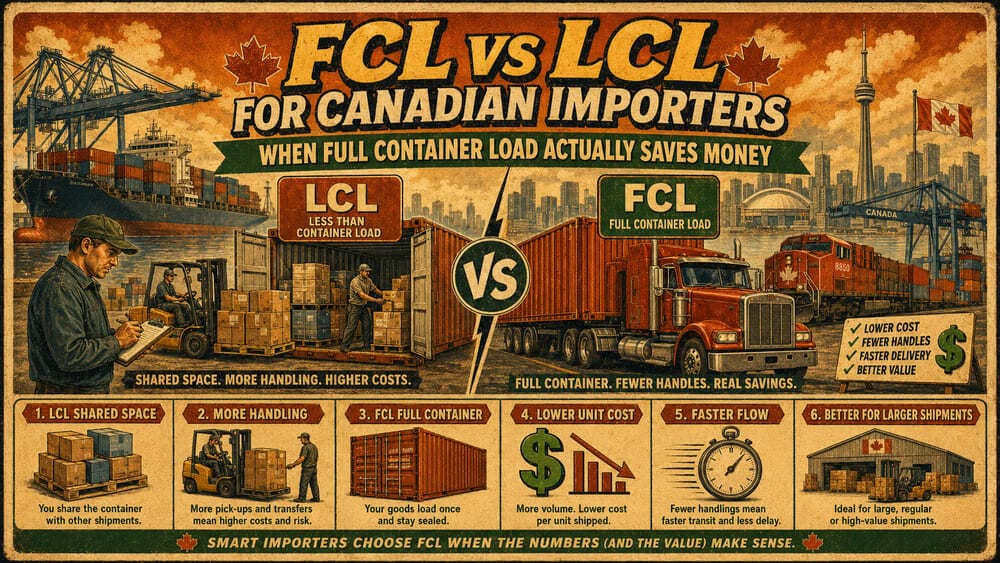
FCL vs LCL Canada decisions can change the real cost, speed, and risk profile of an import shipment. Many Canadian importers choose less than container load because the shipment looks too small for a full container. However, that choice can become expensive once destination charges, CFS handling, delays, and delivery complexity enter the calculation. This guide explains when full container load starts to save money, how to compare FCL and LCL properly, and which factors matter most for Canadian importers shipping through Vancouver, Toronto, Montreal, Halifax, and Calgary.
What is FCL vs LCL Canada?
FCL vs LCL Canada means comparing full container load and less than container load shipping for cargo moving into or across the Canadian logistics network. FCL gives one shipper exclusive use of a 20-foot or 40-foot container. LCL places one shipper’s freight inside a shared container with cargo from other importers.
FCL stands for Full Container Load. It does not always mean the shipper fills every cubic metre. Instead, it means the shipper controls the container space for one shipment.
LCL stands for Less than Container Load. It works well when the cargo volume stays small enough that paying only for cubic metres makes sense. However, LCL also adds consolidation, deconsolidation, CFS handling, and extra touchpoints.
Key container shipping terms
A CBM, or cubic metre, measures cargo volume. LCL pricing often uses CBM because shared-container cargo takes space instead of a full container.
A CFS, or container freight station, is a warehouse that consolidates LCL cargo before export or deconsolidates LCL cargo after arrival. Canadian importers often see CFS charges on LCL shipments.
A TEU, or twenty-foot equivalent unit, measures container capacity. A 20-foot container equals one TEU, while a 40-foot container equals two TEUs.
Drayage means short-distance container trucking between a port, rail terminal, warehouse, or final destination. Demurrage means charges that may apply when a container stays too long at a port or terminal. Detention means charges that may apply when the importer keeps a container outside the terminal beyond the free time.
Why the FCL vs LCL decision matters for Canadian importers
The FCL vs LCL decision matters because the cheapest ocean rate does not always create the lowest landed cost. Importers need to compare total cost, transit time, handling risk, customs timing, and final delivery before choosing the shipping method.
LCL can look cheaper at the quote stage
LCL usually looks attractive when a supplier ships only a few pallets, cartons, or crates. The importer pays by volume instead of paying for an entire container. Therefore, small shipments often start with LCL.
However, LCL quotes can hide the full Canadian cost picture. The shipment may face origin CFS charges, destination CFS charges, terminal fees, deconsolidation costs, documentation fees, delivery charges, and storage if the importer misses the pickup window.
FCL can reduce handling and time
FCL can reduce handling because the cargo stays inside one container. The shipment avoids shared-container deconsolidation and often moves more directly from port or rail terminal to warehouse.
This matters when the cargo has higher value, fragile packaging, seasonal demand, or a strict retail delivery window. In addition, FCL gives the importer more control over container routing, unloading, and delivery timing.
The right choice changes as volume grows
LCL makes sense at low volume. However, as cargo volume grows, the cost per CBM can rise until a 20-foot FCL becomes cheaper or safer. This point is the tipping point.
For Canadian importers, the tipping point often appears earlier than expected because destination CFS charges can increase the real cost of LCL. As a result, importers should calculate the break-even point before booking.
How to compare FCL vs LCL Canada step by step
A good FCL vs LCL Canada comparison should use the same origin, destination, cargo size, delivery deadline, and service level. Otherwise, the cheaper quote may not reflect the real project cost.
- Measure the cargo volume and weight
Start with accurate dimensions for every pallet, crate, carton, or machine. Then calculate CBM and confirm gross weight. LCL pricing often depends on volume, while FCL planning depends on container capacity, payload, loading method, and weight distribution. - Identify the shipping lane
Confirm the origin, port of loading, Canadian port or rail terminal, and final delivery point. A shipment to a Toronto-area warehouse through Vancouver has a different cost structure than a shipment through Montreal or Halifax. - Request both LCL and FCL options
Ask for an LCL quote and a 20-foot FCL quote when cargo volume approaches the break-even range. For larger shipments, also compare a 40-foot container. This helps the importer see when the full container starts to make sense. - Add destination charges
Do not compare ocean freight alone. Add CFS charges, terminal charges, documentation, customs brokerage, exams if applicable, drayage, delivery, storage risk, and other destination costs. - Compare transit time and reliability
LCL can take longer because cargo needs consolidation before sailing and deconsolidation after arrival. FCL often moves more directly. Therefore, importers should compare delivery date reliability, not only port-to-port transit time. - Assess cargo risk
Consider fragility, value, packaging strength, seasonality, and handling sensitivity. LCL adds more touchpoints, while FCL gives one importer more control over the container. As a result, FCL may save money by reducing damage, shortages, and delays. - Calculate the break-even point
Divide the full FCL landed cost by the LCL total cost per CBM. This gives a practical volume threshold. If the shipment sits near that threshold, the importer should also consider timing, risk, and delivery control. - Choose the method that supports the business goal
The best option depends on more than price. LCL may support small test shipments and flexible inventory. FCL may support launches, high-volume replenishment, seasonal goods, and time-sensitive commercial deliveries.
Key cost factors in full container load cost Canada comparisons
Full container load cost Canada comparisons should include ocean freight, terminal charges, inland movement, customs-related costs, and delivery conditions. Importers should also account for the cost of delay.
| Cost factor | FCL impact | LCL impact | What Canadian importers should check |
|---|---|---|---|
| Ocean freight | Fixed container rate for 20ft or 40ft space. | Charged by CBM or weight measure. | Compare total landed cost, not only ocean rate. |
| CFS charges | Usually lower because cargo does not need shared-container deconsolidation. | Often significant because cargo needs CFS handling. | Ask for destination CFS and deconsolidation charges. |
| Drayage | Container moves from port or rail terminal to warehouse. | Freight may move from CFS to final destination. | Compare delivery cost from terminal, CFS, or warehouse. |
| Transit time | Often more direct and predictable. | May take longer due to consolidation and deconsolidation. | Confirm availability date, not just sailing date. |
| Handling risk | Fewer cargo touchpoints. | More handling between CFS, container, and delivery. | Consider packaging, value, and shortage risk. |
| Storage risk | Container free time and appointment planning matter. | CFS pickup deadlines and storage rules matter. | Confirm free time and pickup cut-offs early. |
| Customs timing | One shipment under one container movement. | Multiple shipments share the container environment. | Prepare documents before arrival. |
The CBM tipping point
The CBM tipping point is the volume where LCL stops giving a meaningful cost advantage. In many Canadian import scenarios, importers start comparing FCL once cargo reaches roughly 10 to 12 CBM.
This number is not a universal rule. Heavy cargo, high CFS charges, slow deconsolidation, or strict delivery windows can make FCL attractive at a lower volume. However, light and low-value cargo with flexible timing may stay practical as LCL for longer.
20ft vs 40ft container economics
A 20-foot container often becomes the first FCL option for importers leaving LCL. It can work well for dense cargo, heavy pallets, and shipments that need exclusive container control.
A 40-foot container can lower the cost per unit when the importer has enough volume. However, it also requires more space at origin, more space at destination, and a delivery plan that can handle the full container.
Hidden costs that change the decision
Hidden costs often decide the final answer. LCL may include deconsolidation, CFS handling, warehouse transfers, waiting time, and storage. FCL may include chassis, drayage, container free time, detention risk, and unloading coordination.
Therefore, importers should compare both methods on a door-to-door or port-to-door basis. This creates a clearer view than a simple ocean freight comparison.
Canadian context: Vancouver, Toronto, Montreal, Halifax and Calgary
Canadian geography changes the FCL vs LCL decision. Importers should consider port choice, rail routing, warehouse location, and final-mile delivery before booking freight.
Vancouver import routing
Vancouver often supports Pacific imports from Asia and western Canadian distribution. FCL can work well when importers need rail-linked movement inland or direct container delivery to a warehouse.
LCL can still help with smaller shipments. However, importers should check destination CFS timing and charges before choosing it.
Toronto, GTA and Brampton importers
Toronto, the GTA, and Brampton receive large volumes of imported goods for retail, e-commerce, manufacturing, and distribution. Many shipments arrive through Vancouver, Montreal, or Halifax, then move inland by rail or truck.
FCL can help when a business has enough volume for direct container delivery to a warehouse. LCL can help smaller importers test suppliers, avoid excess stock, or bring in limited product lines.
Montreal import routing
Montreal can support importers serving Quebec, Eastern Ontario, and parts of Atlantic Canada. The FCL vs LCL decision often depends on warehouse location, delivery timing, and whether the cargo needs deconsolidation near the port.
Importers with regular replenishment may benefit from FCL once volumes become predictable. Smaller buyers may still use LCL for lower-volume orders.
Halifax and Atlantic Canada
Halifax can support importers moving freight into Atlantic Canada or inland toward central Canada. Since some destinations sit far from major distribution hubs, inland delivery costs can affect the FCL vs LCL comparison.
Importers should check the full route from arrival point to final warehouse. A low ocean rate may not stay low after inland delivery and handling.
Calgary and Western Canada
Calgary importers often receive freight that arrives through Vancouver and moves inland by rail or truck. FCL can support larger replenishment orders and project cargo that needs controlled delivery.
LCL can work for smaller commercial shipments. However, importers should compare the cost of CFS handling, inland movement, and final delivery to the Calgary area.
How Metropolitan Logistics handles FCL vs LCL Canada decisions
Metropolitan Logistics supports FCL vs LCL Canada decisions by reviewing cargo volume, route, timing, delivery location, and risk before recommending a shipping structure. For Canadian importers, the related ocean freight forwarding service can support FCL, LCL, documentation coordination, and container movement planning.
The comparison can also connect with drayage and intermodal services when containers move through Canadian ports, rail terminals, and inland yards. In addition, transloading and warehousing can help when importers need to unload containers, sort cargo, store inventory, or prepare final distribution.
Container delivery and inland control
Metropolitan Logistics can support container delivery through yard facilities, a private chassis fleet, CN/CP direct access, ELD-equipped fleet operations, and 24/7 dispatch support. CN means Canadian National Railway, while CP means Canadian Pacific Kansas City.
These capabilities matter when importers need to control timing after the container reaches Canada. For example, a business may need drayage from port to warehouse, rail-linked inland movement, or delivery appointments around warehouse receiving hours.
When LCL still makes sense
LCL still makes sense for small shipments, supplier testing, early-stage import programs, and cargo that does not justify a full container. Metropolitan Logistics can help importers understand how LCL connects with CFS handling, customs timing, and final delivery.
For a deeper LCL-specific explanation, importers can also review What Is LCL Freight and When Should Canadian Importers Use It?. This article focuses on the broader FCL vs LCL decision and the point where FCL starts to save money.
Common mistakes when comparing FCL and LCL
Most mistakes come from comparing incomplete quotes. Importers should avoid decisions based only on the lowest ocean freight number.
Comparing ocean freight without destination charges
An LCL quote can look cheaper until the importer adds CFS, deconsolidation, delivery, storage, and handling charges. Therefore, every comparison should include the full route to the final destination.
FCL quotes also need a complete view. Drayage, chassis, waiting time, unloading delays, and detention risk can affect the final cost.
Waiting too long to switch from LCL to FCL
Some importers keep using LCL after their volumes grow. This can create higher costs, slower delivery, and more handling risk.
Once shipments approach the 10 to 12 CBM range, importers should request an FCL comparison. If the cargo has high value or tight timing, they may need to compare even earlier.
Ignoring cargo risk
Fragile, branded, high-value, or time-sensitive cargo may need more control than LCL provides. A full container can reduce handling points and simplify delivery.
However, FCL does not automatically solve every issue. Importers still need proper packaging, blocking and bracing, loading plans, and delivery coordination.
Choosing FCL without a receiving plan
FCL requires destination readiness. The importer needs a delivery appointment, unloading labour, space for the container, and a plan for free time.
If the warehouse cannot unload quickly, detention costs can reduce the savings. Therefore, FCL works best when the importer controls both volume and receiving operations.
Request an FCL vs LCL import quote in Canada
Choosing between LCL and full container load for Canadian imports? Share the origin, destination, cargo dimensions, CBM, weight, commodity, ready date, and delivery deadline so the shipment can be compared on total landed cost, not just ocean freight.
Request an FCL vs LCL import quote
Frequently asked questions
What is the difference between FCL and LCL in Canada?
FCL gives one importer exclusive use of a 20-foot or 40-foot container. LCL places one importer’s freight inside a shared container with cargo from other shippers. In Canada, the best choice depends on CBM, destination charges, timing, cargo risk, and final delivery needs.
When is FCL cheaper than LCL for Canadian importers?
FCL often becomes cheaper than LCL when cargo reaches the practical CBM tipping point. Many Canadian importers start comparing FCL around 10 to 12 CBM because LCL destination charges can increase total cost. The exact point depends on route, cargo type, CFS charges, and delivery location.
What is full container load cost Canada based on?
Full container load cost Canada depends on container size, origin, destination, ocean rate, port or rail terminal, drayage, chassis needs, customs-related costs, and delivery timing. A 20-foot container and a 40-foot container can have different cost advantages depending on cargo weight and volume.
Is LCL freight Canada good for small importers?
Yes, LCL freight Canada can work well for small importers, supplier testing, low-volume orders, and flexible inventory programs. However, importers should check CFS charges, handling risk, transit time, and delivery fees. LCL works best when the shipment stays clearly below the FCL break-even point.
Should I choose FCL or LCL for a shipment to Toronto?
Choose LCL for a small Toronto shipment when the cargo volume stays low and timing remains flexible. Choose FCL when the shipment volume grows, the cargo needs fewer handling points, or the warehouse can unload a full container efficiently. The best decision should compare total landed cost to the final Toronto, GTA, or Brampton destination.