
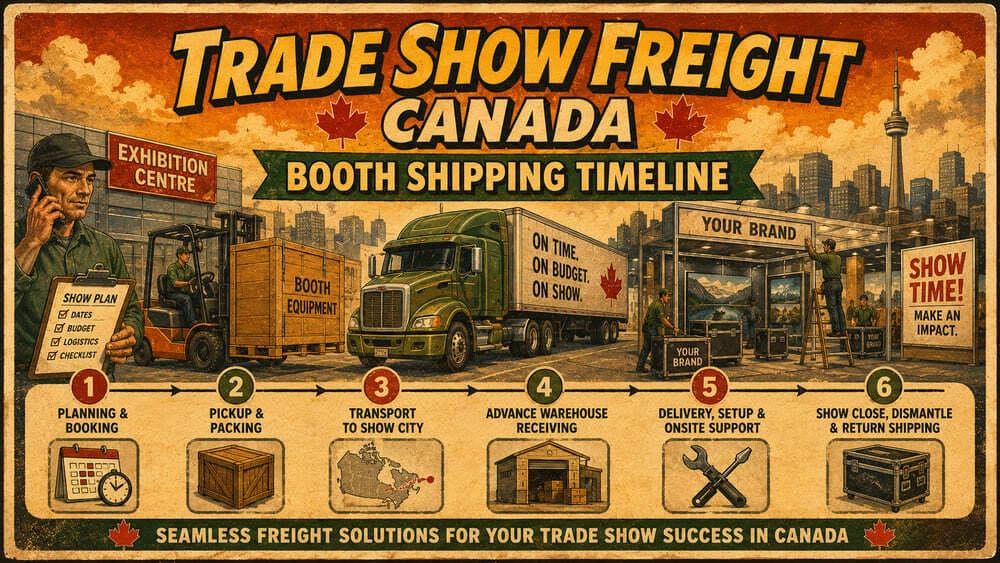
Trade show freight Canada projects need precise timing because event freight has a fixed deadline. A booth cannot arrive “a few days late” without affecting setup, staff travel, marketing campaigns, and the event budget. For event managers and marketing teams, the real challenge is not only shipping the booth to the venue. The freight also needs packing, labelling, advance warehouse coordination, delivery appointments, on-site handling, teardown planning, and return shipping after the show.
This guide explains how exhibition freight works in Canada, how to prepare a trade show booth for transport, and how to get everything back after the event without losing parts, missing deadlines, or paying avoidable handling charges.
What is trade show freight Canada?
Trade show freight Canada means the planned movement of exhibition booths, displays, signage, product samples, AV equipment, marketing materials, crates, and event infrastructure to and from Canadian venues. It can support a single conference booth, a national exhibition tour, a product launch, or a multi-city trade show schedule.
Unlike standard commercial freight, trade show freight follows strict venue timelines. The shipment often needs delivery to an advance warehouse, a marshalling yard, or a convention centre dock during a specific receiving window. Therefore, event freight requires more coordination than a regular pickup and delivery.
Key exhibition freight terms
An advance warehouse is a receiving location that accepts booth freight before the event move-in period. Event teams often use it when the venue does not accept early freight.
A marshalling yard is a staging area where trucks wait before the venue calls them to the dock. Large convention centres use marshalling yards to control traffic and dock congestion.
Material handling means the movement of freight inside the venue, usually from the dock to the booth space. Event organizers or venue contractors often manage this process.
Return freight means the shipment that leaves the venue after the show. It may go back to the office, another event, a storage facility, or a supplier.
Why exhibition shipping matters for event teams
Exhibition shipping matters because one logistics mistake can affect the entire event. A missing crate can leave the booth incomplete. A late delivery can reduce setup time. Poor packing can damage displays, counters, screens, or branded structures.
Trade shows have immovable deadlines
Event freight has a hard deadline. The show opens on a fixed date, and the booth must arrive before that date. As a result, event teams should work backward from the move-in schedule, not forward from the pickup date.
For example, a marketing team may need booth freight in Toronto on Monday morning for setup. However, the shipment may need to arrive at the advance warehouse several days earlier. Therefore, the pickup date should account for transit, staging, venue receiving, and possible traffic or weather delays.
Booth materials need careful sequencing
Trade show booths often include many parts. A shipment may contain modular walls, counters, flooring, lighting, monitors, banners, product samples, brochures, tools, and hardware. If teams pack these items without a system, setup can become slow and stressful.
For that reason, the booth should move as a controlled kit. Each crate, case, and carton should have a label, contents list, destination, booth number, and return instruction. In addition, critical setup items should stay easy to identify.
Return freight needs planning before the show
Many teams focus on getting freight to the event but forget the return plan. This creates problems during teardown. Staff may leave before freight gets picked up, labels may go missing, or the shipment may sit at the venue without clear instructions.
A good return plan starts before the outbound shipment leaves. The plan should define where freight goes after the show, who prepares the return labels, who closes the crates, and who confirms pickup.
How trade show freight Canada works step by step
A reliable exhibition freight plan follows a clear process. Each step should reduce uncertainty before the next handoff.
- Confirm the event schedule Start with the exhibitor manual. This document usually includes move-in dates, delivery windows, dock rules, marshalling yard instructions, advance warehouse details, material handling rules, and outbound freight procedures. In addition, confirm the booth number, venue address, show name, contractor name, and on-site contact. These details should appear on every shipment label.
- Build the booth freight list Create a full list of everything that needs to ship. Separate booth structure, graphics, AV equipment, samples, printed materials, flooring, furniture, tools, and spare parts. This list helps the team pack properly. It also helps the receiving team confirm what arrived before setup begins.
- Choose direct-to-show or advance warehouse delivery Some events allow direct delivery to the venue during the official move-in window. Others recommend or require delivery to an advance warehouse before the show. Advance warehouse delivery gives teams more buffer. However, it may add material handling steps. Direct-to-show delivery can reduce handling, but it needs tighter timing.
- Pack and label booth materials Pack booth materials in crates, cases, pallets, or cartons that match the freight type. Use stronger packaging for fragile displays, monitors, counters, and branded fixtures. Label every piece clearly. Each label should include the show name, exhibitor name, booth number, venue or warehouse address, piece count, and contact details.
- Book transportation with delivery windows in mind Book the shipment based on the required receiving date, not only the distance. For time-sensitive freight, confirm pickup windows, transit expectations, and delivery appointment requirements. If the freight moves between Canadian cities, build in buffer time. This matters especially when shipments travel between Vancouver, Toronto, Montreal, Halifax, or Calgary.
- Track delivery and confirm receipt Once the shipment moves, track it through each milestone. Confirm pickup, linehaul movement, arrival, and delivery. In addition, ask the receiving location to confirm the piece count. This step helps event teams catch problems early. If one crate goes missing, the team still has time to react before the show opens.
- Prepare for teardown before the event ends Before the show closes, confirm the return plan. Staff should know where return labels are, which carrier will pick up the freight, and where the shipment should go next. After teardown, teams should repack items in the same crates when possible. They should also check hardware, screens, samples, and graphics before sealing the shipment.
- Manage return freight and post-show storage Return freight may go back to a head office, storage site, next event, vendor, or warehouse. If the booth supports several shows, storage and inspection can help extend its useful life. After the shipment returns, check for damage, missing parts, and packaging issues. Then update the booth freight list before the next event.
Key factors that shape exhibition freight timelines
The right timeline depends on the event city, venue rules, booth size, packaging type, delivery method, and return destination. However, most delays come from missing paperwork, poor labelling, tight move-in windows, or unclear return instructions.
| Factor | Why it matters | Planning recommendation |
|---|---|---|
| Event move-in window | Venues accept freight only during specific dates and times. | Work backward from the move-in schedule and add buffer. |
| Advance warehouse deadline | Some shows require early delivery before the event week. | Confirm warehouse cut-off dates in the exhibitor manual. |
| Booth size | Larger booths need more crates, pallets, labour, and setup time. | Build a piece count and crate list before booking freight. |
| Packaging quality | Weak cartons or unlabeled cases can create damage and confusion. | Use crates, cases, or reinforced packaging for critical materials. |
| Venue access | Docks, marshalling yards, and downtown venues may restrict trucks. | Confirm appointment rules and truck instructions before dispatch. |
| Return destination | Freight may go to storage, another event, head office, or supplier. | Create return labels before the show starts. |
Small booths and portable displays
Small booths may ship in cases, cartons, or compact crates. However, teams should still treat them as event freight. Even a small missing part can affect the booth’s appearance.
Portable displays need clear labels and strong packaging. If staff carry some items while a carrier moves the rest, the team should document what travels by each method.
Large booths and custom exhibits
Large booths need a more detailed logistics plan. They may include modular structures, counters, lighting, flooring, screens, hanging signs, and product displays.
These projects often need crating, staging, scheduled delivery, and return storage. Therefore, event teams should plan the booth as a project, not a single shipment.
Canadian context: Toronto, Vancouver, Montreal, Halifax and Calgary
Trade show freight in Canada often moves between major event cities. Each city has different venue conditions, traffic patterns, and receiving rules. Therefore, event teams should adjust the timeline for each show.
Exhibition shipping Toronto
Exhibition shipping Toronto often involves convention centres, hotels, downtown venues, and high-volume trade show schedules. Because traffic and dock congestion can affect delivery, event teams should confirm venue receiving rules early.
Toronto events may also require advance warehouse delivery before move-in. This option can help marketing teams avoid last-minute delivery pressure.
Vancouver trade show freight
Vancouver events often need careful delivery planning around urban traffic, venue access, and regional freight movement. If booth materials move from another province, teams should build extra time into the schedule.
Advance planning also helps when freight includes fragile displays, AV equipment, or branded exhibit structures.
Montreal exhibition freight
Montreal trade show freight may involve bilingual labelling, downtown delivery rules, and scheduled receiving windows. For national campaigns, Montreal often sits within a broader route that may include Toronto or Halifax.
Clear documentation helps avoid confusion when multiple teams handle the booth. Labels should match the exhibitor manual and the internal booth freight list.
Halifax event freight
Halifax can support Atlantic Canada exhibitions, conferences, and regional events. Shipments coming from central or western Canada may need longer lead times.
For this reason, event teams should plan inbound freight early and confirm the return route before the show starts.
Calgary trade show shipping
Calgary trade show shipping often supports western Canadian events, franchise shows, energy-related exhibitions, retail events, and national roadshows. Because booth freight may travel long distances, staging can help control timing.
For multi-city event schedules, Calgary shipments should connect with the next show plan before the first event ends.
How Metropolitan Logistics handles trade show freight Canada projects
Metropolitan Logistics supports trade show freight Canada projects by coordinating booth shipping, timed delivery, venue freight movement, staging, and return freight. For event managers and marketing teams, the related event and exhibition logistics service can support exhibit transport, timed venue delivery, setup coordination, teardown planning, and freight returns.
For booths with fragile, branded, or high-value materials, crating and export packaging can help protect counters, displays, signage, AV equipment, and custom exhibit components. In addition, ground freight shipments can support domestic booth movement between Canadian cities and event venues.
Staging, dispatch and delivery control
Metropolitan Logistics can support staging through yard facilities when shipments need timing control before venue delivery. This helps when a venue does not accept early freight or when the booth needs to wait for a specific move-in window.
The operation can also include an ELD-equipped fleet and 24/7 dispatch support. ELD means electronic logging device, a system that tracks driver hours and supports transport compliance. Dispatch visibility helps teams coordinate pickup, transit updates, delivery appointments, and return freight.
Intermodal and container-related event freight
For larger exhibition projects, Metropolitan Logistics can connect event freight with container or intermodal movement when the route fits. Intermodal means freight moves through more than one transportation mode, often truck and rail. This can help when booths, displays, or event infrastructure move across long Canadian corridors.
The logistics network can also include a private chassis fleet, CN/CP direct access, and container drayage services when event freight moves in containers. CN means Canadian National Railway, while CP means Canadian Pacific Kansas City. These rail networks can support long-distance freight planning across Canada.
Common mistakes when shipping trade show booths
Trade show freight problems usually start before pickup. However, event teams can prevent most issues with better preparation.
Packing mistakes
Weak packaging creates avoidable damage. Booth counters, lighting, graphics, samples, and screens should not move loose inside cartons. Instead, teams should use fitted cases, crates, foam, dividers, or reinforced packaging when the material needs extra protection.
Unclear labels create another problem. Each freight piece should show the event name, exhibitor name, booth number, destination address, piece count, and contact details.
Timeline mistakes
Many teams book freight based only on transit time. However, exhibition freight also needs time for receiving, staging, material handling, and setup.
Teams should not assume the venue can accept freight at any time. The exhibitor manual should guide the delivery plan.
Return freight mistakes
Return freight often gets rushed because teardown happens quickly. Staff may leave the venue before freight leaves the dock, or they may forget to apply return labels.
To avoid this, teams should prepare return labels before the event. They should also assign one person to confirm that every piece leaves the venue correctly.
Request a trade show freight quote in Canada
Planning booth freight for a trade show, exhibition, conference, product launch, or multi-city event schedule? Share the event city, booth size, pickup location, venue or advance warehouse details, move-in date, and return destination.
Request a trade show freight quote
Frequently asked questions
How does trade show freight Canada work?
Trade show freight Canada works through planned pickup, packing, labelling, transport, venue delivery, material handling, teardown, and return freight. Event teams usually follow the exhibitor manual because it includes delivery windows, advance warehouse details, and outbound freight rules. A good plan also confirms return shipping before the show starts.
What is exhibition shipping Toronto?
Exhibition shipping Toronto means moving trade show booths, displays, signage, samples, and event materials to Toronto venues or advance warehouses. It often requires timed delivery, clear labelling, and coordination with venue rules. Because Toronto venues can have strict dock schedules, teams should confirm receiving instructions early.
Should trade show booths ship to the venue or advance warehouse?
Trade show booths can ship either to the venue or to an advance warehouse, depending on the event rules. Advance warehouse delivery adds buffer and reduces last-minute risk. Direct-to-show delivery can reduce handling, but it requires precise timing during the official move-in window.
How should I pack a trade show booth for freight?
Pack a trade show booth in labelled crates, cases, cartons, or pallets based on the material type. Use protective packaging for graphics, counters, AV equipment, lighting, and fragile display parts. In addition, include a contents list and mark every piece with the show name, booth number, and exhibitor name.
How do you get trade show freight back after the event?
To get trade show freight back after the event, prepare return labels, pickup instructions, and a destination plan before the show begins. During teardown, repack items in the correct crates and confirm the full piece count. Then the freight can return to storage, head office, a supplier, or the next event.