
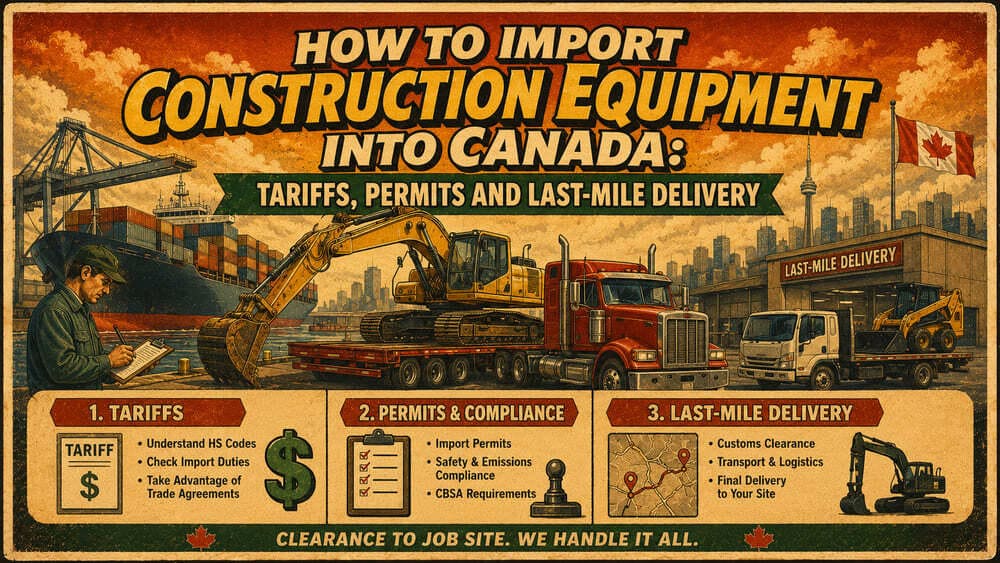
Import construction equipment Canada projects require more than ocean freight, trucking, or a customs entry. Construction and infrastructure companies must plan tariff classification, permits, documentation, port handling, inland transportation, and last-mile delivery before the equipment reaches the job site. One delay can affect crews, cranes, subcontractors, project milestones, and rental schedules.
Therefore, importers need a clear logistics plan before the equipment leaves the seller, manufacturer, auction yard, or overseas port. This guide explains how construction equipment imports work in Canada, what customs and permit issues to check, and how to move heavy machinery from port or rail terminal to the final project site.
What is import construction equipment Canada?
Import construction equipment Canada means bringing heavy machinery, construction vehicles, attachments, tools, or job-site equipment into Canada for commercial use. The shipment may include excavators, loaders, graders, lifts, cranes, compactors, generators, drilling equipment, skid steers, paving equipment, or specialized infrastructure machinery.
This process combines customs compliance and physical logistics. The importer must identify the equipment, classify it under the correct tariff code, prepare documents, confirm permit requirements, arrange customs clearance, and plan delivery to the final location.
Key import terms for construction equipment
A tariff classification is the Harmonized System, or HS, code that describes the imported product. Customs authorities use the HS code to determine duty treatment and reporting requirements.
Value for duty means the customs value that helps calculate duties and taxes. Importers should support this value with invoices, purchase records, and related documents.
Country of origin means the country where the equipment qualifies as made, produced, or substantially transformed. This may differ from the country where the seller ships it from.
Last-mile delivery means the final movement from a port, rail terminal, warehouse, yard, or border point to the construction site. For heavy equipment, this step can involve permits, escorts, route checks, cranes, ramps, or specialized trailers.
Why heavy equipment imports matter for Canadian projects
Heavy equipment imports matter because construction schedules depend on asset availability. If an excavator, crane component, drilling rig, or lift arrives late, the project team may lose production days. As a result, labour, subcontractors, rented tools, and site access windows can sit idle.
Customs delays can disrupt job-site schedules
Customs clearance starts before the shipment reaches Canada. Importers need accurate invoices, serial numbers, model details, origin information, and tariff classification. If the paperwork contains gaps, customs brokers may need corrections before release.
For construction teams, this creates a practical problem. The equipment may physically arrive in Canada, but the site cannot use it until the importer clears customs and arranges delivery. Therefore, project managers should treat customs planning as part of the construction schedule.
Oversize delivery creates extra planning work
Many construction machines exceed standard transport dimensions or weight limits. As a result, last-mile delivery may need route planning, oversize permits, pilot cars, bridge checks, or special receiving equipment.
The delivery site also matters. A downtown Toronto infrastructure site creates different access challenges than a wind project near Calgary or a port-side construction project in Halifax. Therefore, the logistics plan should account for both the machine and the destination.
Imported equipment needs a full landed-cost view
The purchase price does not show the full cost of importing equipment. Importers should plan for ocean freight or cross-border trucking, terminal charges, customs brokerage, duties, GST, storage, exams, inland transportation, permits, escorts, cranes, and site delivery.
This full landed-cost view helps procurement teams compare options. In addition, it helps finance teams avoid surprises after the equipment arrives.
How to import construction equipment Canada step by step
A construction equipment import should follow a structured sequence. Each step should reduce the risk of customs holds, storage costs, delivery delays, and site disruption.
- Confirm the equipment details
Start with the make, model, year, serial number, dimensions, weight, engine type, attachments, and condition. Also confirm whether the equipment can drive, roll, lift, or load under its own power. These details shape both customs classification and transport planning. - Identify the correct HS code
Classify the equipment under the correct HS code before booking shipment. The HS code affects duty treatment and customs reporting. If the equipment includes attachments or parts, check whether they require separate classification. - Check country of origin and trade treatment
Confirm where the equipment qualifies as originating. The country of origin can affect duty treatment under Canada’s tariff system or trade agreements. Importers should collect origin documents early, especially for high-value equipment. - Review permit and control requirements
Most standard construction equipment does not require a special import permit, but importers should never assume. Some goods can fall under import controls, safety rules, environmental requirements, or other agency rules. Therefore, check the equipment type, technology, engine, attachments, and intended use before shipment. - Prepare commercial import documents
Gather the commercial invoice, bill of sale, packing list, bill of lading or waybill, origin documentation, equipment specifications, serial numbers, and broker instructions. Clear documentation helps the customs broker submit a cleaner entry. - Book international or cross-border freight
Choose the transport mode based on origin, equipment size, urgency, and cost. Equipment may move by roll-on/roll-off vessel, flat rack, container, breakbulk, truck, or rail-linked service. However, the transport method must match the equipment’s dimensions, weight, and loading needs. - Arrange customs clearance before arrival
Send documents to the customs broker before the equipment reaches the Canadian port, border, or rail terminal. Early review gives the broker time to catch missing information. As a result, the importer can reduce storage, demurrage, and release delays. - Plan port, terminal, or yard recovery
Once the equipment arrives and clears customs, the logistics team must recover it from the port, terminal, bonded facility, or yard. This step may need appointment scheduling, terminal release, chassis or trailer planning, and heavy-lift coordination. - Execute last-mile delivery to the site
The final move should match the site access plan. Confirm truck route, gate access, unloading method, ground conditions, safety requirements, and receiving contact. If the move needs permits or escorts, secure them before dispatch. - Inspect and document arrival
After delivery, inspect the equipment, record condition, verify serial numbers, and confirm attachments. Then update internal records for finance, maintenance, insurance, and project management.
Tariffs, duties, GST and permits: what importers should check
Importers should check tariffs, duties, GST, permits, and other agency requirements before the shipment moves. These items shape both landed cost and release timing.
| Item | Why it matters | What to check before shipping |
|---|---|---|
| HS code | Customs uses classification to determine duty treatment. | Confirm the correct tariff item for the machine, attachment, or part. |
| Country of origin | Origin can affect duty treatment and documentation. | Collect origin documents from the seller or manufacturer. |
| Value for duty | Duties and taxes use declared value as a core input. | Support the value with invoice, bill of sale, and payment records. |
| GST | Commercial imports generally face 5% GST unless a specific rule applies. | Budget GST and confirm recovery treatment with accounting advisors. |
| Import permits | Some controlled goods need permits or special review. | Check whether the equipment appears on an import control list or needs another agency approval. |
| Environmental and safety rules | Engines, emissions, used machinery, or special equipment may trigger extra checks. | Review equipment specs, engine details, and intended use before import. |
| Last-mile permits | Oversize or overweight moves may need provincial or municipal permits. | Confirm dimensions, axle weights, route limits, and delivery site access. |
Tariff classification
Tariff classification should happen early because it drives duty treatment and customs reporting. A small classification error can create delays, corrections, or unexpected costs.
Construction equipment can fall under different tariff headings depending on function, design, attachments, and condition. Therefore, importers should not classify all machinery under one general category. A customs broker can help review the technical description before the shipment moves.
Duties and GST
Duties depend on the HS code, country of origin, and customs value. Some equipment may qualify for low or free duty treatment, while other goods may face duty depending on classification and origin.
Commercial imports into Canada generally face 5% GST. Importers should include GST in the landed-cost estimate and confirm accounting treatment with their finance team. However, they should avoid relying on rough duty assumptions for high-value equipment.
Permits and controlled goods
Permit requirements depend on the equipment type, origin, technology, and applicable Canadian rules. Standard construction machinery may not need a special import permit, but some controlled products require review under Canada’s import controls.
In addition, used equipment may raise cleaning, soil, pest, safety, or environmental concerns. Importers should confirm that machinery arrives clean and properly documented. This matters when equipment previously worked on farms, mines, forestry sites, or construction sites abroad.
Canadian import context: Vancouver, Toronto, Montreal, Halifax and Calgary
Canadian equipment imports often move through major ports, rail terminals, inland yards, and construction corridors. Each region creates different logistics conditions.
Vancouver equipment imports
Vancouver supports many Pacific trade lanes and western Canadian construction projects. Equipment arriving through the West Coast may move inland toward British Columbia, Alberta, Saskatchewan, or Manitoba.
Importers should plan terminal recovery, rail or truck options, and final delivery timing before arrival. In addition, large machinery may need staging near the port or an inland yard before last-mile delivery.
Toronto, GTA and Brampton delivery
Toronto, the GTA, and Brampton often support equipment imports for infrastructure, commercial construction, industrial projects, and contractor fleets. The area has strong access to highways, warehouses, rail terminals, and construction markets.
However, congestion and restricted delivery windows can affect last-mile planning. Therefore, teams should confirm route access, unloading needs, and site receiving hours before dispatch.
Montreal equipment imports
Montreal can support construction equipment moving into Quebec, Eastern Ontario, and Atlantic routes. Importers should plan documentation, terminal access, and regional delivery needs early.
For project sites in dense urban areas, route planning becomes critical. Oversize machinery may need careful timing, municipal coordination, or staged delivery outside peak traffic periods.
Halifax and Atlantic Canada
Halifax can support equipment imports for Atlantic Canada projects, infrastructure work, port-related construction, and regional distribution. Since some project sites sit far from major inland hubs, importers should plan final delivery as a separate phase.
A buffer between arrival and site delivery can reduce risk. It also gives the project team time to prepare unloading equipment and access plans.
Calgary and Western Canada projects
Calgary often supports construction, energy, infrastructure, and industrial projects across Alberta and Western Canada. Imported equipment may arrive through Vancouver, move by rail or truck, and continue to a Calgary-area yard or job site.
For remote or industrial sites, the delivery plan should include road restrictions, seasonal conditions, and oversize movement rules. As a result, last-mile planning can matter as much as the international move.
How Metropolitan Logistics handles import construction equipment Canada projects
Metropolitan Logistics supports import construction equipment Canada projects by connecting customs-ready planning, port or terminal recovery, staging, inland transport, and final-site delivery. For construction and infrastructure customers, the related construction and infrastructure logistics service can support heavy equipment, materials, and component deliveries for Canadian project sites.
Metropolitan Logistics can also support containerized or intermodal equipment movement through drayage and intermodal services. This can help when imported machinery or attachments move through Canadian ports, rail terminals, yards, and inland destinations.
Staging, yards and controlled delivery
Yard facilities can help when equipment clears customs before the site can receive it. This is useful when a project site lacks space, cranes, ramps, or a ready access road.
A staged approach also helps teams inspect equipment, separate attachments, and schedule delivery around site conditions. In addition, 24/7 dispatch support can help coordinate appointments, drivers, site contacts, and time-sensitive updates.
Chassis, intermodal and fleet support
Some imported construction equipment moves in containers or on specialized platforms. Metropolitan Logistics can support these moves with a private chassis fleet, CN/CP direct access, ELD-equipped fleet operations, and container transport planning.
CN means Canadian National Railway, and CP means Canadian Pacific Kansas City. These rail networks can support long-distance equipment movement across Canadian corridors when intermodal service fits the cargo and route.
Last-mile delivery to construction sites
Last-mile delivery often creates the highest operational risk. The equipment may need a specific trailer, a permit, a clear route, a prepared unloading zone, and a receiver who understands the site plan.
Metropolitan Logistics can help coordinate the delivery sequence from terminal or yard to project site. This can reduce idle time and help construction teams receive equipment when crews, ramps, forklifts, cranes, or operators stand ready.
Common mistakes when importing construction equipment
Most import problems start before the equipment arrives in Canada. However, importers can reduce risk when they check documentation, compliance, and delivery requirements early.
Customs and documentation mistakes
A vague invoice can slow down customs review. The invoice should show the seller, buyer, equipment description, serial number, value, currency, origin details, and shipment terms.
Importers also create risk when they guess the HS code. Instead, they should review the equipment function, attachments, and technical specifications before classification. This matters even more for high-value machines.
Permit and compliance mistakes
Some importers assume all construction equipment can enter Canada without extra review. That assumption can create delays. Equipment with special technology, unusual attachments, engines, or controlled components may need additional checks.
Used machinery can also create problems if it arrives dirty. Soil, plant matter, or debris may trigger cleaning, inspection, or delay. Therefore, sellers should clean equipment before shipment and document the condition.
Last-mile delivery mistakes
The final site delivery can fail even after customs clearance. Oversize equipment may need permits, escorts, route review, or special unloading equipment.
Importers should not wait until release to plan this step. Instead, they should confirm dimensions, weight, access roads, receiving hours, ground conditions, and unloading method before the shipment arrives.
Request an import construction equipment quote in Canada
Planning to import excavators, loaders, lifts, generators, attachments, or specialized construction machinery into Canada? Share the equipment details, origin, port or border point, documents, dimensions, weight, and final project site so the import move can be planned from customs clearance to last-mile delivery.
Request an import construction equipment quote
Frequently asked questions
How do I import construction equipment into Canada?
To import construction equipment into Canada, confirm the equipment details, classify it under the correct HS code, prepare commercial documents, review permit requirements, arrange customs clearance, and plan final delivery. The process should start before the machine leaves the seller or overseas port. Early planning reduces customs delays, storage costs, and site delivery problems.
What documents do I need for heavy equipment shipping Canada customs?
Heavy equipment shipping Canada customs usually needs a commercial invoice, bill of sale, bill of lading or waybill, packing list, equipment specifications, serial numbers, origin details, and broker instructions. Depending on the equipment, importers may also need permits, technical documents, or compliance records. A customs broker can review the file before arrival.
Do I pay duties when importing construction equipment to Canada?
Duties depend on the HS code, country of origin, and value for duty. Some machinery may qualify for low or free duty treatment, while other equipment may face duty. Commercial imports generally also face 5% GST unless a specific rule applies.
Does used construction equipment need special cleaning before import?
Used construction equipment should arrive clean and free of soil, plant matter, debris, and contamination. Dirty machinery can create inspection, cleaning, or delay risks. Importers should ask the seller to clean the equipment before shipment and provide clear photos or condition notes.
How does last-mile delivery work for imported heavy equipment?
Last-mile delivery moves the equipment from a port, rail terminal, yard, warehouse, or border point to the construction site. The move may need specialized trailers, route planning, permits, escorts, cranes, ramps, or prepared unloading areas. Importers should plan this step before the shipment arrives in Canada.