
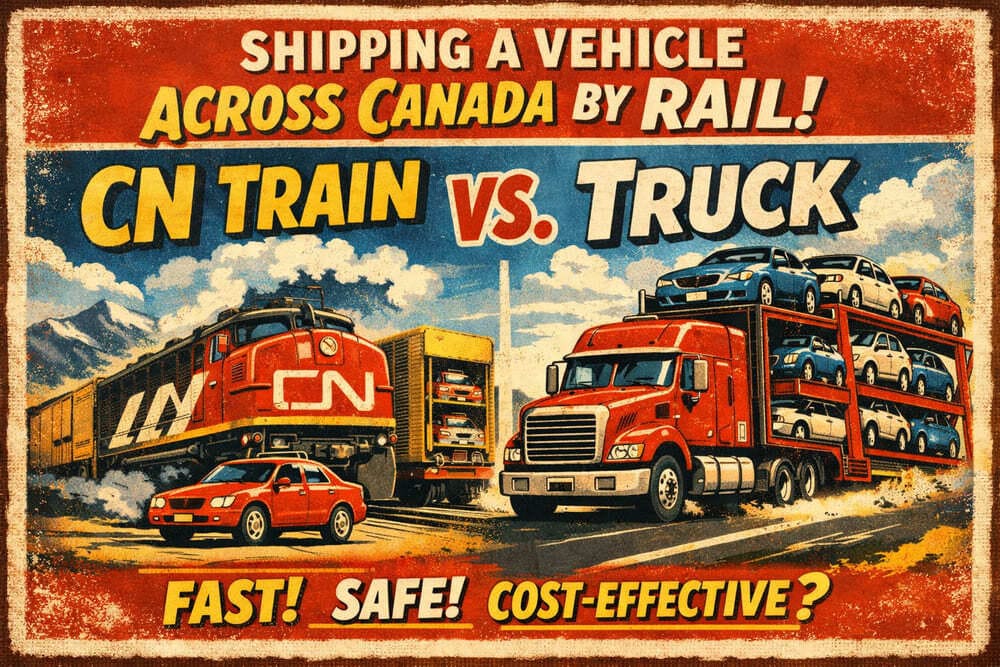
Vehicle shipping by rail in Canada is one of those options many people discover only after they start comparing car transport quotes. Rail-based vehicle transport can move a car across long Canadian routes using major freight rail networks, often with truck service at one or both ends of the move.
However, rail is not always cheaper, faster, or easier than truck. It can work well for long-distance moves between major terminals, flexible timelines, and running vehicles. It can also become less practical when the customer needs door-to-door service, tight scheduling, or pickup outside a major rail corridor.
This guide explains how vehicle shipping by rail works in Canada, what it costs, how it compares with truck transport, and when it makes sense to consider rail-assisted auto shipping.
For vehicle shipping requests, Metropolitan Logistics works with Rail Auto Canada as a trusted partner for car transport in Canada. Customers can request a quote through Rail Auto Canada when they need help comparing rail-assisted, open carrier, enclosed, or truck-based options.
What is vehicle shipping by rail in Canada?
Vehicle shipping by rail in Canada means moving a car through a freight rail network for the long-distance part of the journey. The vehicle may travel in a specialized rail car between major cities, then use truck transport for terminal access, pickup, or final delivery.
This is different from putting a car on a passenger train. Customers do not drive to a VIA Rail station and load their car onto a passenger service. Instead, rail vehicle shipping uses freight infrastructure and carrier terminals.
Key rail vehicle shipping terms
Rail-assisted transport means a vehicle moves by rail for part of the route and by truck for pickup, delivery, or terminal access.
Terminal-to-terminal shipping means the customer drops off the vehicle at an origin terminal and picks it up at a destination terminal.
Door-to-door shipping means the carrier picks up and delivers as close as safely and legally possible to the requested addresses. With rail-assisted moves, this often includes truck transport before or after the rail segment.
CN means Canadian National Railway. It operates a major freight rail network across Canada.
CPKC means Canadian Pacific Kansas City. It also operates key Canadian rail corridors and serves many freight markets.
Open carrier means the vehicle moves on an open auto transport trailer.
Enclosed carrier means the vehicle moves inside a covered trailer or protected transport unit.
How vehicle shipping by rail works in Canada
Vehicle shipping by rail usually works as a rail-and-truck combination. The rail segment handles the long-haul movement, while truck service connects the vehicle to and from terminals.
Terminal-to-terminal rail shipping
Terminal-to-terminal service usually costs less than door-to-door rail-assisted shipping. The customer drops off the vehicle at the origin terminal and picks it up at the destination terminal.
This option works best when both terminals are convenient. It can become less practical if the terminal sits far from the customer’s actual pickup or delivery address.
Door-to-door rail-assisted shipping
Door-to-door rail-assisted shipping adds truck transport at one or both ends. A carrier may pick up the car from the customer, move it to a terminal, rail it across the country, then deliver it by truck near the destination.
This option gives more convenience, but it can reduce rail’s cost advantage. Truck legs, terminal handling, and scheduling can make the total price similar to regular truck transport.
Why rail still needs truck support
Most vehicle moves do not begin and end directly at rail terminals. Customers usually live, work, or relocate to residential areas, dealerships, military bases, campuses, or suburban addresses.
As a result, truck transport often connects the vehicle to the rail network. This is why customers should compare the full door-to-door cost, not only the rail linehaul cost.
CN vs CPKC for vehicle shipping routes
Canada’s two major freight rail networks serve many of the country’s key east-west corridors. The right network depends on origin, destination, terminal access, timing, and carrier availability.
CN rail corridors
CN connects several major Canadian freight hubs, including Vancouver, Edmonton, Saskatoon, Winnipeg, Toronto, Montreal, and Halifax. This makes CN relevant for many long-distance vehicle routes.
For vehicle shipping, CN may support major east-west lanes where terminal access and scheduling align with the customer’s move.
CPKC rail corridors
CPKC also operates an important east-west Canadian freight corridor. Its network includes major points such as Vancouver, Calgary, Regina, Winnipeg, and Toronto.
CPKC can be relevant for Alberta, Prairie, Ontario, and Western Canada vehicle moves when carrier partnerships and schedules make sense.
Which network is better?
There is no single best rail network for every customer. The better option depends on the route, terminal location, available departures, service provider, and final delivery needs.
In practice, customers usually do not choose the rail network directly. The auto transport provider reviews the route and recommends the available option that fits timing, cost, and service requirements.
Vehicle shipping by rail Canada cost
Vehicle shipping by rail in Canada can offer cost advantages on some long routes, especially when the customer can use terminal-to-terminal service. However, rail is not automatically cheaper than truck.
Once terminal fees, truck legs, and pickup or delivery needs enter the quote, rail-assisted transport can become comparable to truck transport.
| Route | Rail estimate | Truck estimate | Planning note |
|---|---|---|---|
| Toronto to Vancouver | $1,800–$2,100 CAD | $1,400–$1,900 CAD | Rail can help when terminal service fits, but truck may compete strongly. |
| Toronto to Calgary | $1,500–$1,800 CAD | $1,200–$1,600 CAD | Door-to-door rail-assisted service may narrow the savings. |
| Vancouver to Calgary | $600–$800 CAD | $700–$950 CAD | Shorter route with a smaller price gap. |
| Toronto to Edmonton | $1,550–$1,850 CAD | $1,250–$1,650 CAD | Terminal access and timing affect the final choice. |
| Halifax to Toronto | $950–$1,200 CAD | $900–$1,200 CAD | Truck may be similar once total service is included. |
These are planning ranges for standard running vehicles. Final pricing depends on the vehicle, route, season, terminal access, carrier capacity, service type, pickup location, and delivery location.
Why rail can look cheaper at first
Rail can have a lower long-haul cost because trains move freight efficiently over long distances. This can make the rail portion look attractive on a per-kilometre basis.
However, the customer still needs to account for terminal handling and the truck service before or after rail. Those extra pieces can reduce the savings.
When rail costs less
Rail is more likely to cost less when the route is long, both terminals are convenient, the vehicle runs, and the customer can use terminal-to-terminal service.
The savings become harder to achieve when the customer needs door-to-door delivery or lives far from a rail terminal.
When truck may cost the same or less
Truck may cost the same or less when the route is shorter, the customer needs door-to-door service, the terminal is inconvenient, or the rail schedule creates extra delay.
Truck service can also provide more direct routing. For many personal vehicle moves, that convenience can outweigh a small rail price difference.
Rail vs truck vehicle shipping timelines
Rail and truck follow different scheduling models. Truck transport usually offers more direct timing, while rail transport depends on terminal cut-offs, train schedules, and terminal processing.
Rail transit timelines
Rail transit time includes more than the train ride. The vehicle may wait at the origin terminal before departure and at the destination terminal before release.
| Route | Typical rail timing |
|---|---|
| Toronto to Vancouver | 9–16 days total with terminal time |
| Toronto to Calgary | 8–12 days total with terminal time |
| Vancouver to Calgary | 5–7 days total with terminal time |
These timelines can change with terminal congestion, rail schedules, season, weather, and vehicle release procedures.
Truck transit timelines
Truck transport can often move faster because it does not depend on rail departures or terminal processing in the same way.
| Route | Typical truck timing |
|---|---|
| Toronto to Vancouver | 7–10 days door to door |
| Toronto to Calgary | 5–7 days door to door |
| Vancouver to Calgary | 3–5 days door to door |
Truck timing still depends on carrier routing, weather, pickup access, delivery access, and capacity. However, it usually offers more scheduling flexibility.
Which is faster?
Truck is usually faster and more predictable for customers with a firm deadline. Rail may work well when the customer has a flexible schedule and can tolerate terminal windows.
Customers relocating for work, school, military posting, or a fixed delivery date should compare both timing and cost before choosing rail.
Advantages of vehicle shipping by rail
Rail vehicle shipping can make sense in specific situations. It is not the best fit for every shipment, but it does offer real advantages when conditions line up.
Lower environmental impact
Rail can move freight with lower emissions per tonne-kilometre than truck on long routes. For customers who care about reducing transport emissions, rail-assisted shipping may be attractive.
This benefit matters most on long-distance routes where rail handles the main linehaul segment.
Reduced highway exposure
Rail can reduce direct highway exposure during the long-haul part of the move. When the vehicle travels in a protected rail car, it may face less road debris than it would on an open highway carrier.
This can matter for long routes, winter conditions, fresh paint, or sensitive finishes. However, customers should still confirm the exact transport method because service types can vary.
Potential savings on long routes
Rail may save money on very long routes when terminal-to-terminal service works. The best savings usually appear when the customer can avoid extra truck legs.
If both the origin and destination terminals sit close to the customer, rail can become more competitive.
Limitations of rail vehicle shipping in Canada
Rail has practical limits. Customers should understand these before choosing rail over truck.
Terminal access can be inconvenient
Rail terminals usually sit in industrial areas, not residential neighbourhoods. Customers may need to drive to the terminal, arrange a ride back, and do the same at destination.
If the terminal sits far from either address, the time and cost can reduce the benefit of rail.
Non-running vehicles may not qualify
Rail vehicle shipping usually requires a running vehicle. The car needs to start, steer, brake, and roll safely so crews can load and unload it.
Non-running vehicles often need truck transport with winch loading or specialized equipment. Customers should disclose any mechanical issue before requesting a quote.
Rail has less schedule flexibility
Rail departures follow freight schedules. If the customer’s timing changes, adjusting the shipment can be harder than changing a truck pickup.
Rail also has terminal cut-offs and release procedures. This can make it less convenient for customers with tight deadlines.
Door-to-door rail can reduce the savings
Many customers want door-to-door convenience. Once a provider adds truck service at both ends, the total cost may approach or exceed truck-only transport.
For that reason, rail-assisted shipping should be compared as a complete service, not just as a rail rate.
When rail makes sense vs when truck wins
The best choice depends on distance, terminal access, timeline, vehicle condition, and budget.
| Choose rail when | Choose truck when |
|---|---|
| The route is long and terminal access is convenient. | You need door-to-door delivery. |
| The vehicle runs and drives safely. | The vehicle is non-running or needs special loading. |
| Your timeline is flexible. | Your delivery deadline is firm. |
| You want to reduce long-haul road exposure. | You want faster and more predictable timing. |
| Terminal-to-terminal service fits your move. | Your origin or destination is far from a rail terminal. |
| Environmental impact matters to your decision. | Convenience matters more than a small price difference. |
Rail works best for long-distance hub moves
Rail is strongest when the move runs between major Canadian hubs with convenient terminal access. Toronto to Vancouver, Toronto to Calgary, and similar long-distance lanes can be worth comparing.
However, the customer still needs to consider pickup, drop-off, terminal procedures, and final delivery.
Truck works best for flexibility
Truck transport works better when customers need residential pickup, direct delivery, flexible dates, or faster movement.
It also works better for shorter routes, remote locations, rural addresses, non-running vehicles, and customers who cannot manage terminal logistics.
Rail Auto Canada: Metropolitan Logistics’ partner for car shipping in Canada
Metropolitan Logistics works with Rail Auto Canada as a partner for vehicle shipping requests in Canada. This helps customers connect with a company focused on domestic auto transport, while Metropolitan Logistics continues to support broader logistics, freight, warehousing, and commercial transportation needs.
Rail Auto Canada can help customers compare rail-assisted and truck-based vehicle shipping options. The best recommendation depends on the route, timing, vehicle type, pickup access, delivery access, and budget.
Customers can learn more through Rail Auto Canada’s car shipping Canada service or request pricing through its quote form.
How Rail Auto Canada helps compare rail and truck
Rail Auto Canada can review the customer’s origin, destination, vehicle details, schedule, and service preference. Then it can help determine whether rail-assisted transport, open carrier, enclosed transport, terminal service, or truck-based delivery makes the most sense.
This matters because rail is not automatically better. On some routes, truck may be faster and similar in price. On other routes, rail-assisted service may fit well if terminal access and timing align.
What information to provide
For an accurate quote, customers should provide:
- vehicle year, make, model, and trim;
- pickup city and delivery city;
- preferred pickup and delivery dates;
- running condition;
- terminal or door-to-door preference;
- open or enclosed preference;
- any low clearance, modifications, oversized tires, roof racks, or mechanical issues.
Customers can submit these details through the Rail Auto Canada quote form.
Common mistakes when choosing rail vehicle shipping
Many rail shipping problems start when customers assume rail is always cheaper or easier. A better decision comes from comparing the full move.
Comparing only the rail linehaul cost
The rail segment may look less expensive, but terminal handling and truck legs can change the final price.
Customers should compare total cost from pickup to delivery. This includes terminal access, drayage, carrier fees, and any extra delivery requirements.
Underestimating terminal logistics
Terminals may sit far from the customer’s home, office, base, dealership, or buyer. Drop-off and pickup can take time.
Customers should confirm terminal location before booking. If the terminal is inconvenient, truck transport may be a better fit.
Expecting truck-like scheduling
Rail follows fixed schedules and terminal procedures. It does not offer the same flexibility as a truck pickup.
Customers with firm deadlines should ask about timing carefully before choosing rail.
Trying to ship a non-running vehicle by rail
Rail transport usually requires the vehicle to run, steer, brake, and roll. Non-running vehicles may need truck-based transport.
Customers should disclose the vehicle condition during the quote request. This prevents failed loading or last-minute service changes.
Request a rail or truck vehicle shipping quote
Choosing between rail and truck vehicle shipping in Canada? Metropolitan Logistics recommends requesting a quote through its auto shipping partner, Rail Auto Canada.
Rail Auto Canada can review the route, vehicle details, timing, terminal access, and service preference before recommending a transport option.
Request a vehicle shipping quote
You can also contact Rail Auto Canada directly:
Phone: +1 (289) 536-6499
Email: hello@railautocanada.ca
Frequently asked questions
Can you ship a vehicle across Canada by train?
Yes, rail-assisted vehicle shipping is available on some Canadian routes. The vehicle may move by rail for the long-haul segment and by truck for pickup, delivery, or terminal access. Rail Auto Canada can help customers compare rail-assisted and truck-based options for their route.
Is rail vehicle shipping cheaper than truck in Canada?
Rail can be cheaper on long routes when terminal-to-terminal service works well. However, terminal fees and truck service at either end can reduce or eliminate the savings. Customers should compare the full door-to-door or terminal-to-terminal quote before choosing.
How long does it take to ship a car by rail across Canada?
Rail vehicle shipping can take longer than truck because it depends on terminal processing and train schedules. Toronto to Vancouver may take around 9–16 days with terminal time. Truck transport on the same route may be faster and more direct.
Which is better for shipping a car, CN Rail or CPKC?
CN and CPKC both serve important Canadian freight corridors. The better option depends on the route, terminal access, schedule, and available service provider. Customers usually do not need to choose the network directly because the transport provider reviews the best available option.
Can a non-running vehicle be shipped by rail in Canada?
Rail vehicle shipping usually requires a running vehicle that can start, steer, brake, and roll safely. Non-running vehicles often need truck transport with winch loading or specialized equipment. Customers should disclose vehicle condition before requesting a quote.
What are the disadvantages of shipping a car by rail?
The main disadvantages include limited terminal locations, slower timing, less schedule flexibility, and running-vehicle requirements. Door-to-door rail-assisted service can also cost close to truck transport once terminal handling and truck legs are included.
Who should I contact for rail vehicle shipping in Canada?
Metropolitan Logistics recommends contacting its partner Rail Auto Canada for vehicle shipping requests. Customers can request a quote through the Rail Auto Canada quote form, call +1 (289) 536-6499, or email hello@railautocanada.ca.
The bottom line
Vehicle shipping by rail in Canada can offer real advantages when the route is long, terminal access is convenient, the vehicle runs, and the timeline is flexible. It can reduce long-haul road exposure and may provide cost advantages in the right situation.
However, truck transport is often faster, more flexible, and easier for door-to-door moves. For many customers shipping one vehicle on a specific schedule, truck-based transport may provide the better overall experience.
The best choice comes from comparing both options based on the actual route, vehicle, timeline, and service needs. For vehicle shipping requests, Metropolitan Logistics recommends Rail Auto Canada as its partner for car transport in Canada.
Request a car shipping quote from Rail Auto Canada
Phone: +1 (289) 536-6499
Email: hello@railautocanada.ca
Related reading:
- How Much Does Vehicle Shipping Cost in Canada? 2026 Price Guide
- How Car Shipping Works in Canada
- How to Transport Vehicles Across Country in Canada
- Car Shipping Services Canada
Get a Car Shipping Quote
Across Canada
Submit your vehicle details through our trusted partner Rail Auto Canada. They’ll review your route, vehicle type, timing, and transport options.